

4 October 2026 is the 90th anniversary of the iconic Battle of Cable Street, when the united working class of London’s East End decisively saw off the attempt of Oswald Moseley’s fascist blackshirts to march through their area. This was the time of the Spanish Civil War, and the predominantly Jewish and Irish working class of the area was highly politicised and alive to the rising threat of fascism across Europe.
Today, everyone from the Zionist Board of Deputies of British Jews (BoD) to the Morning Star and Unite the Union depicts Cable Street as a heroic uprising against fascism variously led by Jews, the Communist Party or a ‘coalition of the organised working class’, depending on their prevailing interest. This easy retelling of history masks how the BoD counselled Jewish workers to stay at home in fear, while the Communist Party leadership initially instructed members not to march through the East End but instead head to Trafalgar Square for a rally in support of Republican Spain.
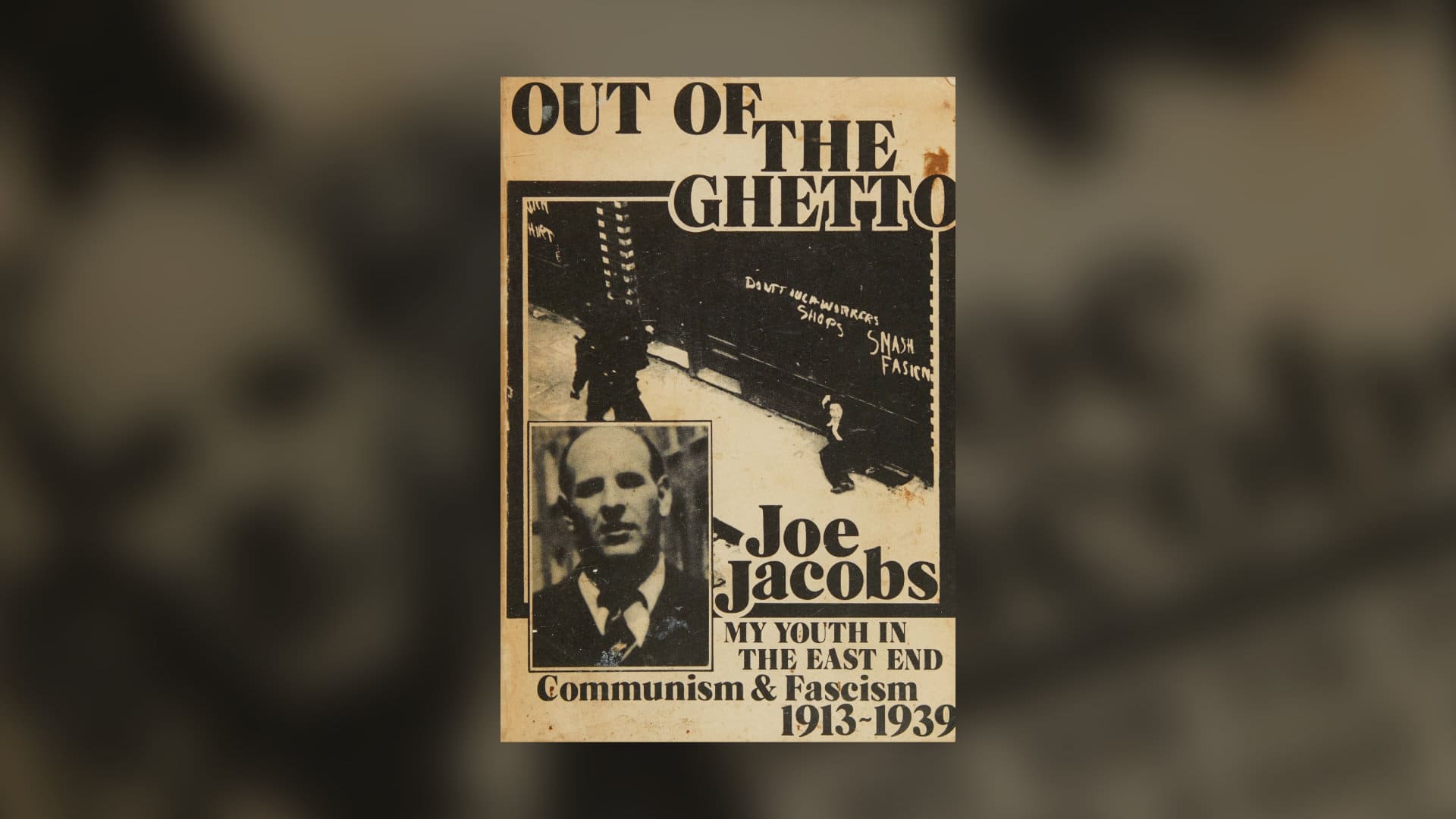
On the 90th anniversary of the Battle of Cable Street, we reproduce an edited version of the 1992 FRFI review by CAROL BRICKLEY of Out of the Ghetto by Joe Jacobs. The book was first published by his daughter Janet Simon in 1978, shortly after Jacobs’ death in 1977. An interview with Janet Simon can be found on our website.
Jacobs was born in 1913 in the East End of London, the son of Polish and Russian Jewish immigrants. His book is a historical document [from] which there gradually emerges a picture of life in the East End between the Wars: grim lives of relentless poverty and exploitation in the clothing industry; rackrenting landlords and greedy sweatshop owners. Alongside this a life on the streets and in cafes reflecting the Jewish culture of the area. It was also a political street life as the youth, at most one generation from Soviet Russia, hotly debated world affairs. Street meetings were commonplace – Christians, Labour Party, trade unions, communists, socialists, anarchists, unemployed workers and many others (including an ex-police inspector who claimed to be the Heir to the Throne of England).
What also emerges is a picture of the young communist, Joe Jacobs, an activist, not a theoretician or intellectual, who by the age of 23 was Stepney Communist Party branch secretary and a leading figure in the fight against fascism. Not that you would know this from official Communist Party (CP) histories. Joe Jacobs and his friends were written out of history.
Jacobs’ first doubts about the direction of the CPGB came with the closing down of International Labour Defence (ILD) in 1935 on the grounds that the CP should concentrate on Party building and united action with the Labour Party and trade unions. Jacobs saw the ILD and other mass organisations as recruiting and mobilising grounds for the CP – a means of involving people in activity which would lead them to communism. He was shaken by the decision but nonetheless accepted it after a long argument. The emergency of Mosley’s British Union of Fascism (BUF) in the East End was to focus his attention.
Arguments emerged in Stepney CP from a section of its leading members (with a direct link to District and National leadership) that members should give up ‘street work’ in favour of ‘Trade Union work’. Jacobs rejected the view that greater influence in the Labour Party and trade unions would be more effective in fighting fascism than anti-fascist work on the streets. The unions, he argued, were in the hands of right-wing leaders and ‘the Social Democrats’ role in society was to betray the workers’ – and what about the masses of unemployed and unorganised workers?
The watershed of the dispute came when Mosley announced that his blackshirts would march through the East End on 4 October 1936. It was a deliberate anti-Jewish provocation. Jacobs and his friends knew that the fascists could be sure of massive police protection. This was not the first battle with the blackshirts: many had waged an unremitting fight to prevent fascist meetings and marches. Arrests and injuries were commonplace; it was the stuff of Jacobs’ everyday life. As soon as Mosley’s march was announced in the East End anti-fascists began to organise to stop them, adopting the slogan ‘They shall not pass’ from the Spanish anti-fascist movement.
Jacobs and his circle were shocked when the CP called for support for a Young Communist League rally in Trafalgar Square in support of Spanish workers at the same time as the fascist march. They already knew that the district leadership were opposed to confronting the fascists and this was confirmation that this was the party line. Jacobs was instructed by the local full-time organiser: ‘If Mosley decides to march, let him’. This was also the Labour Party position – ‘free speech’.
Jacobs and his friends decided to fight the decision and a meeting with the district leadership was arranged, only days before the march. While they were being treated to a diatribe on the comparative importance of the YCL rally, a message arrived from central headquarters that the decision had changed. The leadership had become ‘aware of the real situation only that day’. The ‘real situation’ was that with or without the CP, the East End would march against the fascists.
At first Jacobs thought this a great victory – Cable Street went down in history as the day the fascists were beaten. But after the march, the district leadership renewed its attack on ‘street work’, publishing a document proposing emphasis on work in the trade unions, the Labour Party and the Co-op Guilds, and omitting confrontation with the fascists.
What was at issue was not the distinction between ‘street work’ and ‘trade union work’ but the accommodation to social democracy that underlay the turn. Jacobs knew this and was blunt in his opposition. For his pains, and still considering himself a loyal communist, Jacobs was first suspended and then expelled from the CP with little chance to argue his standpoint.
It is hard in a short space to do justice to Jacobs’ book which contains a wealth of facts and description of political struggle: the planned escape of a Yugoslav communist by the ILD network; his friends who fought in the Spanish Civil War. It is timely, now that fascism is on the upsurge again, that Jacobs’ account is once again available to political activists and communists. In this way his political struggle as a communist continues. Which is more than can be said for the CPGB who have ended, as Jacobs predicted, in the ranks of social democracy, ready to betray the workers’ struggle. n
Out of the Ghetto: my youth in the East End: Communism and Fascism 1913-1939 Joe Jacobs, Phoenix Press, 2nd edition, 1991, 320pp.