

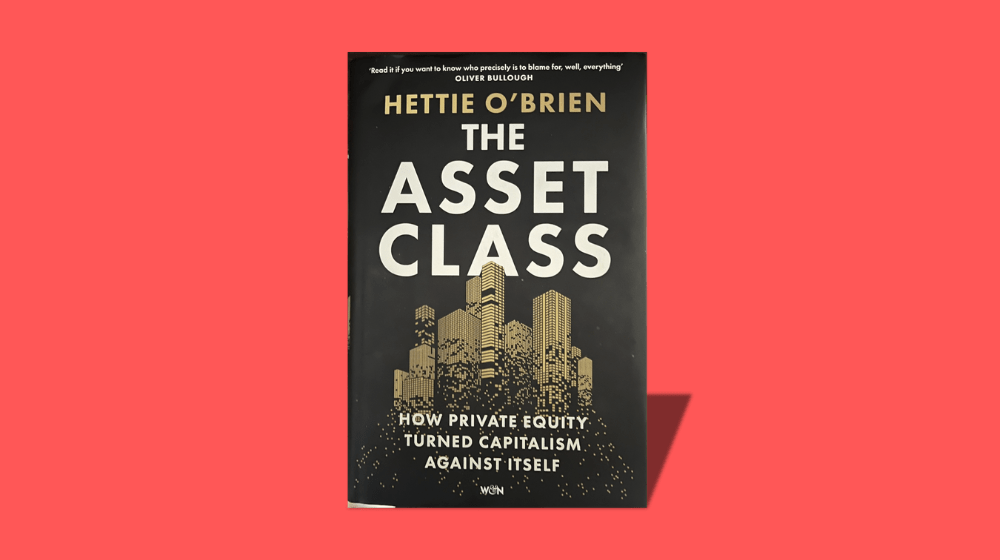
The Asset Class: how private equity turned capitalism against itself, Hettie O’Brien. Weidenfeld and Nicolson 2026, 310pp £25 hdbk.
This work states that one particular type of capital ownership, ‘private equity’ (shares in private companies), is undermining capitalism. This will puzzle any materialist. After all isn’t capitalism, whatever its legal form, a system which is undermining itself because of its own systemic contradictions? What will the author endeavour to show? Will the account explain the role of ‘private equity’ as a new stage in the civil war between capitalists, for the concentration of ownership of capital, of monopoly? Will she tie this to capitalism’s control of the state machinery, and relate this to the ever-intensified exploitation both of the masses and planetary life generally? Or will she present some sort of descriptive lament about one form of private ownership, regretting parliament’s failure to protect the pre-existing and presumably acceptable form of accountable public shareholdings?
The author, a writer for The Guardian, is one of that species of commentators who, despite their education, has chosen to avoid openly siding politically with the working class, while describing, albeit concernedly, their plight. Politically, to side effectively with the working class requires an understanding of imperialism today, one which the author clearly has not yet chosen to acquire. Rather, the book expresses the anxieties of the middle classes, as the system that affords them some privileges, threatens to cut them out. The author presents her ‘Asset Class’ story as a personal research journey. She proceeds in conversational style, combining easily read descriptions of the locations of her interviews, and selected personalities, by which she aims to turn ‘the spinach of business reporting into something more palatable’ (p9). Within the text and in the chapter notes, references to books of a similar popular nature by similarly anxious authors are provided. An appendix of well laid out chapter notes, rather than footnotes or end notes, is used.
The account starts with the evolution of private equity, a legal category of property ownership, from 1976 onwards. These are shareholdings that are not for offer on a public market, and so such companies are not required to provide details of their financial arrangements. O’Brien’s account covers the scooping of profits by the new owners, who then maintain the businesses by replacing distributed profits with new borrowings (debt), pledged against their purchased assets. This leaves companies staggering under interest burdens, and with collapsing infrastructure, while they brazenly abuse customers. It then describes the many ills that the owners have imposed on those consumers. The examples switch to and fro between the US and Britain because of the extraordinary size of the US funds involved. These private companies plunder their newly purchased companies, and in particular – the author’s major concern – public services. The lame conclusion of the book however is a most naïve expression of surprise that this has been ‘allowed’ to happen. The author expresses ‘a sense of amazement’ that private equity ‘had been allowed to present itself as a solution (for previous failings) for so long, even as its actions kept telling another story.’ (p248) She provides no data to help the reader, for example for global public stockholdings, currently valued globally at over $124trn, in large but falling numbers, compared to the $10trn of numerically expanding but smaller sized private shareholdings.
Clearly the author approves of the market mechanism of capitalism, because we are told that while ‘the basic idea that reward should correspond to risk was a good one’ (p246), private equity ‘had grown so destructive that, judged solely by its effects, it might well have been designed … to turn our own energies against us’. (p248) She then asks rather strangely, ‘Wasn’t that reason enough to fight it?’ She clearly thinks the growth of this asset class is a step backwards from the more extensive current form of publicly marketed equity, rather than as a symptom of the decay of capitalism itself.
Here the driving force behind private equity is explained in terms of human ambition. Capitalism as a system is not the problem, nor is a scientific understanding of capitalism necessary to fight it. To try to write on this subject, yet to then conclude that she is simply puzzled by the subject investigated, is of no use at all to those actually willing to fight imperialism. More complete accounts of the rise and impact of private equity from an explicit establishment standpoint can easily be found at the Bank for International Settlements website, or private agents such as Marquee-Equity.
Despite therefore the many illustrations of greed, of profiteering by private equity operations, the damage to the interests of patients, the elderly, the environment, renters and ‘residents’, (the words ‘workers’ or ‘working class’ do not appear in the index) is not explained theoretically. The zenith of such organisations is identified as the ‘private office’ arrangement, where very secretive, very private services for ultra-high-net-worth individuals are conducted. We are left at this point to sort out why all this has happened. So, while another journalist and ‘critical’ author, Nicholas Shaxson,* remarked that the ‘mind is repelled’ by O’Brien’s account, and the previous Director of Liberty, Baroness Shami Chakrabarti’s review ridiculously imagines that now the ‘apex predators…should rest a little less easy’ with its publication, the reader is denied a real explanation of the imperatives of capital accumulation. We are abandoned, in effect simply to vote against private sin and choose public saintliness. The absolute theoretical poverty of the work means that it is of no use to socialists, who are already painfully aware of the crisis conditions of imperialism. It provides no solutions and sits as an exercise in hand wringing that may at best produce forlorn indignation in other liberals.
Paul Bullock
* His book Treasure Islands: Tax Havens and the Men Who Stole the World, is reviewed in FRFI