

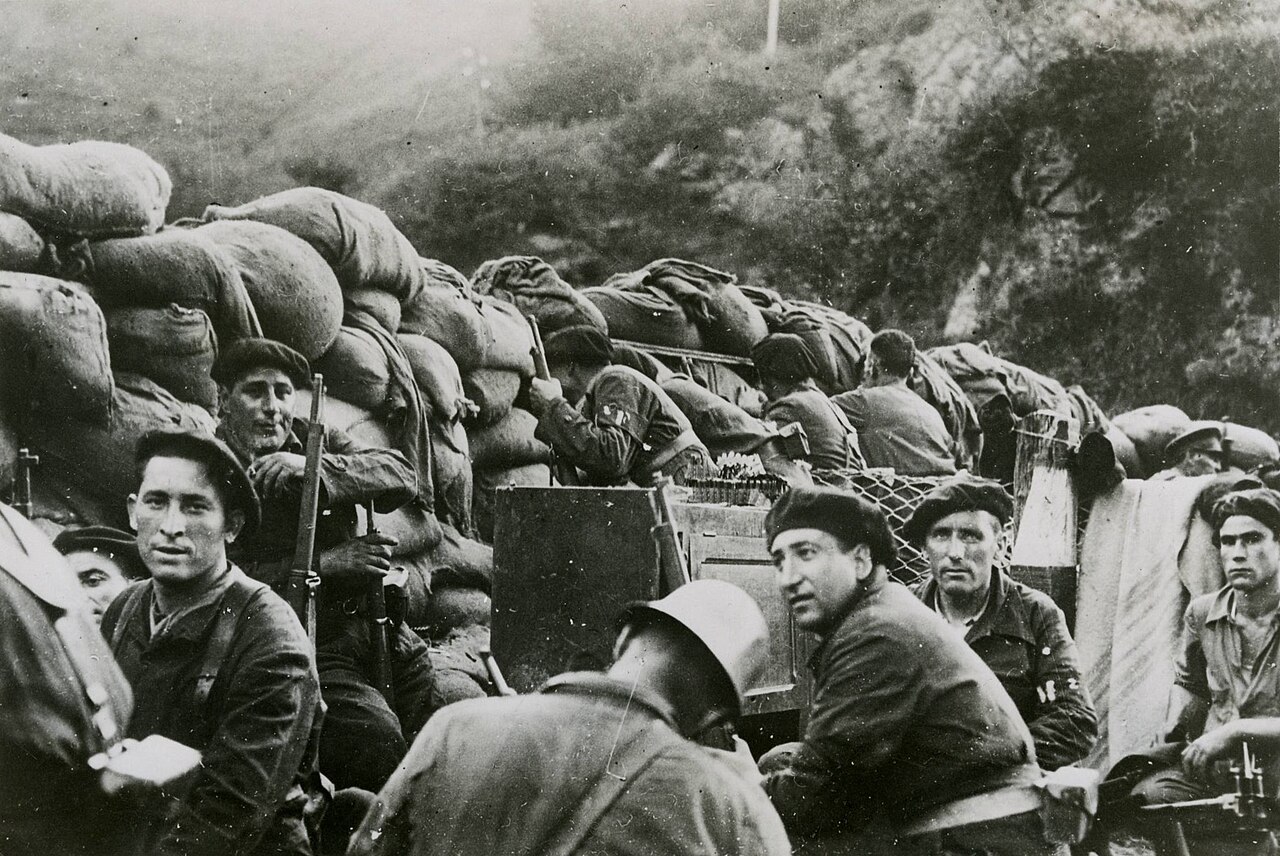
In October 1936, the first organised brigades of young fighters from around the world arrived in Spain, responding to a call from the Communist International to defend the democratically-elected Second Republic against a fascist military revolt. Over the next two years more than 40,000 international volunteers from 50 countries would fight alongside the Spanish working class on the streets of Barcelona, Madrid and other cities to defend the Republic against the Nationalist rebel forces of Francisco Franco. The Spanish Civil War, which began with a coup attempt on July 1936 and lasted until 1 April 1939, saw up to 500,000 people killed in a life-and-death struggle between revolutionary working-class forces abandoned by the governments of imperialist Europe, and Spanish fascists armed and funded by the fascist regimes of Germany and Italy. It culminated in the victory of the fascist junta that would impose a reign of terror over Spain until the restoration of a limited bourgeois democracy after Franco’s death in 1975. Ninety years later CASSANDRA HOWARTH looks at how the failures of social democracy paved the way for the victory of fascism from the earliest days of the Civil War.
A rising tide of revolutionary fervour
In the early 1930s, Spain was still in many ways a feudal country, dominated by wealthy landowners including the Catholic Church, which retained huge political and economic power, and a powerful military apparatus. The Church also exerted influence over the emerging industrial and banking sectors of the country. The middle classes, the bourgeoisie, were comparatively weak, and limited in their ability to force through a more ‘modern’ form of democratic government that would allow them to develop the forces of production. At the same time they faced the constant threat of a vast mass of landless peasants and the impoverished urban working class demanding social and economic change, increasingly being forced to look for revolutionary solutions with a strong tradition of communist and anarchist political organisation. These class tensions created a turbulent political climate in Spain, which led to the fall of the monarchy and to the establishment of a bourgeois-democratic regime in 1931.
A coalition government formed of both socialist and bourgeois forces offered a limited democratic programme of land reform, development of industry, the separation of the Church from State affairs and the promises of decent education and healthcare. However, three years on, it was clear that the fledging Republic had failed to solve the acute problems faced by the working class. In October 1934, around 30,000 armed miners, workers and peasants took over the region of Asturias. They formed an alliance of socialists, communists and anarchists which openly declared a proletarian revolution. The response of the so-called ‘democratic’ Republic government was immediate: it sent in the army, including factions led by a young general, Francisco Franco, to brutally suppress the workers. However, the revolutionary fervour bubbling away across Spain continued, resulting in the elections of 1936 bringing to power a Popular Front coalition government, formed of both left-wing organisations and ‘progressive’ bourgeois Republican parties.
Popular Front vacillates
Impatient at the timid reforms of the Popular Front government, mass strikes continued and the working class confronted the rising right wing in bloody conflicts in the streets daily; meanwhile, in the countryside, peasants expropriated up to one million hectares of land. The government, caught in a vice between its need to control the aspirations of the working class and its loyalty to the bourgeoisie, refused to meet the demands of the working class as their anger erupted across the country. It continued to rely on the state apparatus to control the working class, giving support even to the most viciously reactionary elements within it, fearing more the rise of a revolutionary movement than the quite overt mobilisation of fascist forces during this period to regain control of the state. Ultimately, it was prepared to throw in its lot with a ruling class more than willing to use fascism to defeat the possibility of revolution and crush the working class to ensure the stability of capitalism.
The coup began in July 1936, with a military uprising in Spanish colonial garrisons in Ceuta and Melilla in north Africa, followed by a declaration of rebellion by Franco in the Canary Islands. The fascist revolt quickly spread to parts of northern, southern and western Spain but in the major industrial cities including Madrid, Barcelona and Valencia, socialists and communists stood firm, demanding that arms be distributed to the people to resist the fascist coup.
Just as in Chile in 1973, the social-democratic government faltered, more terrified of an emboldened, revolutionary working class being armed than of the fascist junta making its way towards Madrid. Even liberal historians agree that had the government taken rapid steps to arm the workers at this point, the coup could probably have been crushed very quickly. But instead it vacillated, and even when it became clear that it had no option but to form a workers’ militia it equivocated. On 18 July, the day after the coup, then prime minister Casares Quiroga refused an offer of help from the CNT (National Workers Confederation) and UGT (General Union of Workers) and insisted that legal methods could defeat the uprising. Ultimately it was the workers themselves who forced the issue, calling a general strike. They opened weapons caches, some buried since the 1934 risings, and formed militias. At every turn, the government attempted to restrict their ability to fight.
‘Non-intervention’ – the isolation of the anti-fascist struggle
Just as the Popular Front government of Spain paved the way for the eventual victory of Franco’s fascist forces in 1939, so the support of social democratic forces in Britain for its imperialist policies left those mobilising to fight fascism isolated. The principle of ‘non-intervention’ embraced by all the major imperialist powers in effect allowed the fascist regimes of Mussolini in Italy and Hitler in Germany to arm and fund the Spanish rebels to the hilt. At the outbreak of the Spanish Civil War, the British government immediately suspended arms sales to the Republican government and refused its vessels permission to refuel in Gibraltar. The then-backbench Conservative MP Winston Churchill articulated the ruling class’s fear clearly: ‘Should the communists become masters of Spain we must expect the infection to spread very fast both through Italy and France.’ As always, the overtly imperialist position of the British government was given the necessary support by the forces of social democracy – with both the TUC and the Labour Party in September 1936 supporting the policy of ‘non-intervention’. The TUC explicitly ruled out any collaboration with the Communist Party over the call to send arms to Spain and made it clear that industrial action in support of the Republican government would be unacceptable. Meanwhile the USSR stood in defence of the Republic, offering diplomatic support, volunteers, weapons and vehicles.
The Spanish Civil War was a crucible for politics in Europe in many ways. It showed how the failure of social democracy in Spain paved the way for the triumph of fascism against a militant and revolutionary working class, as it had done in both Germany and Italy. But it also provided a rallying cry – led by communists – for international solidarity and resistance.