

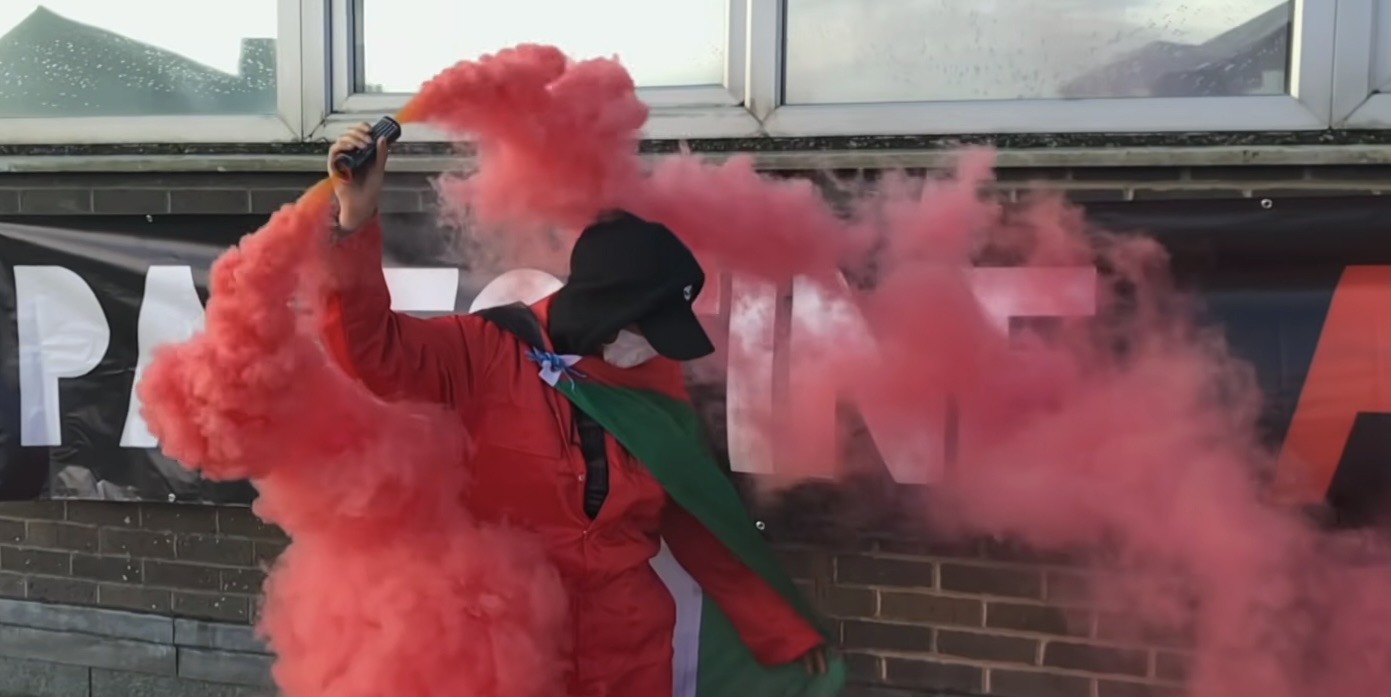
Palestine Action: The Truth Behind the Ban – Dispatches, Channel 4, aired 9 February 2026.
As the first six members of the Filton 24 come to the end of their retrial on criminal damage charges in relation to an action against Zionist arms manufacture Elbit Systems UK in August 2024, SHIREEN HABASH reviews Palestine Action: The Truth Behind the Ban, a documentary which purports to be an impartial investigation into the ideology and aims of Palestine Action, querying the government’s agenda and justification for proscribing the organisation under the Terrorism Act 2000.
The documentary aired immediately after the release of six of the Filton 24 prisoners – who had been tried for an action against Elbit systems in August 2024, with the jury failing to convict them on any count – and just days before the High Court ruled that the proscription of Palestine Action was unlawful on 13 February 2026. This decision has now been appealed by the government and there will be a Court of Appeal hearing on 28-29 April.
Palestine Action was founded in 2020 with the goal of shutting down the operations of Elbit Systems UK. In five years, the group carried out actions targeting key sites of Britain’s military and defence infrastructure – including Elbit Systems, Thales Group and RAF Brize Norton. These companies are central to the supply chains that sustain British imperialism and arm the Zionist state. In July 2025 Palestine Action was formally proscribed as a terrorist organisation by Labour’s then-Home Secretary Yvette Cooper, who told Parliament that ‘The group has a footprint in all 45 policing regions in the UK and has pledged to escalate its campaign.’ The documentary notes that out of 385 actions carried out by Palestine Action prior to proscription, there were just three instances of serious property damage.
Journalist Matt Shea examines the proscription of Palestine Action, primarily via a series of interviews with activists and critics alike. The latter are given a far easier ride as they attempt to frame the organisation as radical, potentially extremist, and ideologically suspect.
The programme opens with the 7 October 2023 Al Aqsa Flood operation by Hamas, framing Israel’s subsequent assault on Gaza as a ‘response’, thus erasing historical context and presenting colonial violence as something reactive rather than structural. The Al Aqsa Flood followed decades of occupation, settler-colonial expansion, blockades, sieges, repeated military assaults and over 600 Palestinians in Gaza and the West Bank killed by Zionists in the year 2023 up until 7 October alone.
Shea positions himself as a friend of one of the interviewees, Ellie Kamio, a member of the Filton 24, whom he interviews moments after she is granted bail with her co-defendants, following the end of the first trial. He also interviews pro-Palestinian US activist Fergie Chambers and one of Palestine Action UK founders: Huda Ammori. Through all these interviews, he repeatedly asks about the legitimacy of the Palestinian armed resistance and Palestine Action’s ties to foreign organisations, which he insinuates may have fuelled the terrorist accusations.
On the other side of the equation, Shea speaks to Zionist hacks, including Gideon Falter of the so-called Campaign against Antisemitism and John Woodcock, a former Labour MP, now Lord Walney, author of a 2024 government review on ‘political extremism’. These interviewees persistently and intentionally conflate anti-Zionism with anti-Semitism. Shea does not call them out on this obfuscation, which serves the political function of smearing anti-imperialist resistance as racism and deflating criticism of the Israeli state. Instead, he allows them to put across what is effectively the case for the prosecution in the ongoing trials of pro-Palestine activists.
The documentary repeatedly refers to speculative links between Palestine Action and Iran, with no evidence provided at all. The airing of the programme at a time when the US and Israel were gearing up to attack Iran, with tacit British government support, makes the spurious link between ‘domestic terrorists’ and a suspect foreign power all the more important from an imperialist propaganda point of view.
The documentary does not interrogate the motives of the British state, only questioning the proportionality of its response to Palestine Action’s activities. However, by showing scenes of continuing protest and solidarity, it inadvertently reveals that the ban on Palestine Action comes not from the strength of the state, but from its scramble to keep a grip on the political movement against the genocidal occupation of Gaza and the West Bank and stifle growing internationalism amongst British workers.
Palestine Action performed damage and sabotage interfering with Britain’s export of arms to Israel. Since proscription other groups have continued to carry out such actions and the Keysight Three now join those remanded in custody awaiting trial at some distant date. The state is on the offensive not just against direct action, but against all forms of solidarity with Palestine. Protesters asserting the lawful right of juries to act according to their conscience have been arrested outside Woolwich Crown Court where the Filton retrial has been taking place. It is more urgent than ever to build a strong movement in solidarity with those who a stand on the side of the Palestinian people’s struggle against occupation, that can defend activists at court and on the streets. Documentaries like this are designed to hinder the building of this solidarity and we must actively work to counter their narrative.
Solidarity with all those who stand on the side of Palestinian liberation!
Shireen Habash