

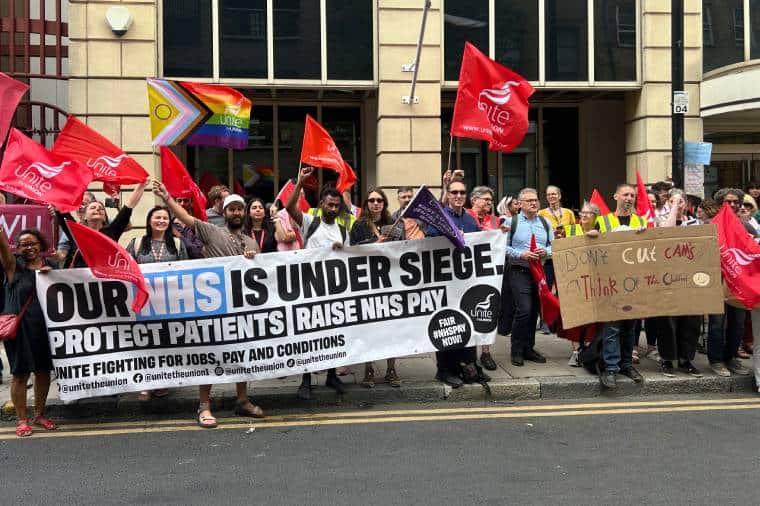
Over the past 25 years, a series of chilling official maternity care reviews have revealed that up to 418 babies may have died unnecessarily. There have been 90 or so recommendations, and five official promises of ‘never again’. Yet the deaths of women and children continue, as do the investigations.
The inquiries focus on ‘failing’ trusts, Morecambe Bay, East Kent, Shrewsbury and Telford and Nottingham University Hospitals, but there is clearly a national crisis.
Nottingham University NHS Trust is the latest hospital under the spotlight for shocking maternity unit outcomes. The inquiry led by senior midwife Donna Ockenden and published in July 2026 involved interviews with 2,500 families and 800 members of staff and started in 2022, relating to incidents between 2012 and 2025. Over those 13 years, experts concluded that there were potentially avoidable outcomes for mothers and babies in 444 maternity cases and 76 neonatal cases. Reasons included mismanaged labour, hospital-acquired infection and poor postnatal care by midwives and doctors. Different care may have altered the outcome for 260 babies who died or were harmed. Of that number, 155 died while 105 suffered serious injury due to substandard care, with some left with permanent brain damage. Different care may have also prevented the deaths of six mothers. Additionally, 94 babies were stillborn, and the team investigated the deaths of 27 mothers between 2006 and 2024.
A week after the Ockenden Report, a government-commissioned inves-tigation into maternity services was published. The National Maternity and Neonatal Investigation was ordered in 2025 after then Health and Social Care Secretary of State Wes Streeting met with bereaved families. The report includes chilling evidence of unsafe clinical environments, women and families being ignored and racism and discrimination embedded within the system.
The Save Liverpool Women’s Hospital campaign has summarised the many reports in the last few years on the crisis in maternity in the NHS and the alarming figures represent a health service in crisis.
Unsustainable work conditions
Many midwives are exhausted, overstretched and working in unsustain-able conditions.
A 2023 survey by the Royal College of Midwives found that of the respondents 88% worked additional unpaid hours, 74% regularly faced unrealistic time pressures and workloads, and found that midwives and support staff are working 100,000 unpaid hours a week to support maternity services. Thirty-one maternity units have closed since 2014 reducing the total number from about 190 to 130 and at the last count, England had a shortage of around 2,500 full‑time midwives.
Among the richer nations, Britain ranks among those with the highest neonatal and infant mortality rates. In 2022-24, 252 women died from direct or indirect causes during or soon after pregnancy among 1,969,321 maternities, meaning that the rate of maternal death for this period was 12.80 per 100,000 maternities. As a comparison, in 2018, New Zealand had 1.7 maternal deaths for every 100,000 live births.
Race and class
The figures for maternal and child health reveal inequalities due to poverty and racism. Asian and black women are reported as roughly twice and three-times more likely to die in pregnancy and childbirth than white women. Maternal deaths can be direct (pregnancy-related complications) or indirect (pre-existing conditions worsened by pregnancy).
After slight decreases in the previous six years, the mortality rate for women in England from black and ethnic backgrounds increased again in 2022-24. Black women are twice as likely to have a stillborn baby as are their white counterparts.
The 2024 Confidential Enquiry into Maternal Deaths (MBRRACE-UK) concluded that women from the most socioeconomically deprived areas of England were twice as likely to die in pregnancy and up to six weeks after delivery compared to women living in the least deprived areas. The maternal mortality rate in this group has been increasing overall over the past decade, and recent data shows the gap in mortality rates based on socioeconomic status is widening.
Research on socioeconomic deprivation and maternal factors is more limited, but a study from 2014 found nearly 70% of postpartum haemorrhage cases occurred in the two most deprived quintiles and in 2016 research identified deprivation as a risk factor for severe maternal sepsis.
Socioeconomic deprivation and ethnicity have also been linked to the maternity complications of pre-eclampsia, with the highest risk in women from deprived areas and black women across all quintiles of deprivation.
Many migrant women face unaffordable NHS fees leading to disengagement with services. They are routinely charged 150% of NHS costs, and as much as £14,000 for complex births. Asylum-seeking pregnant women are regularly moved by the Home Office disrupting their care. Women with No Recourse to Public Funds have higher risks of adverse maternal outcomes. Maternity Action unsuccessfully took the government to the High Court to try and remove maternity charges for migrant women after three deaths that were found to be related to a lack of maternity care due to charges.
Capitalism is bad for your health
The recent maternity reports are an indictment of the NHS and health care provision under capitalism. They reveal how abnormal events become normalised in a period of capitalist crisis and how the health, welfare and survival of women and babies is devastated as a result. Universal healthcare, set up under the post-war welfare state, is under sustained attack, as capitalism fails to provide the scale of investment in hospitals, training and staff salaries required to provide a decent health service for all. Only a socialist system, planned for need not profit, can solve this crisis.