

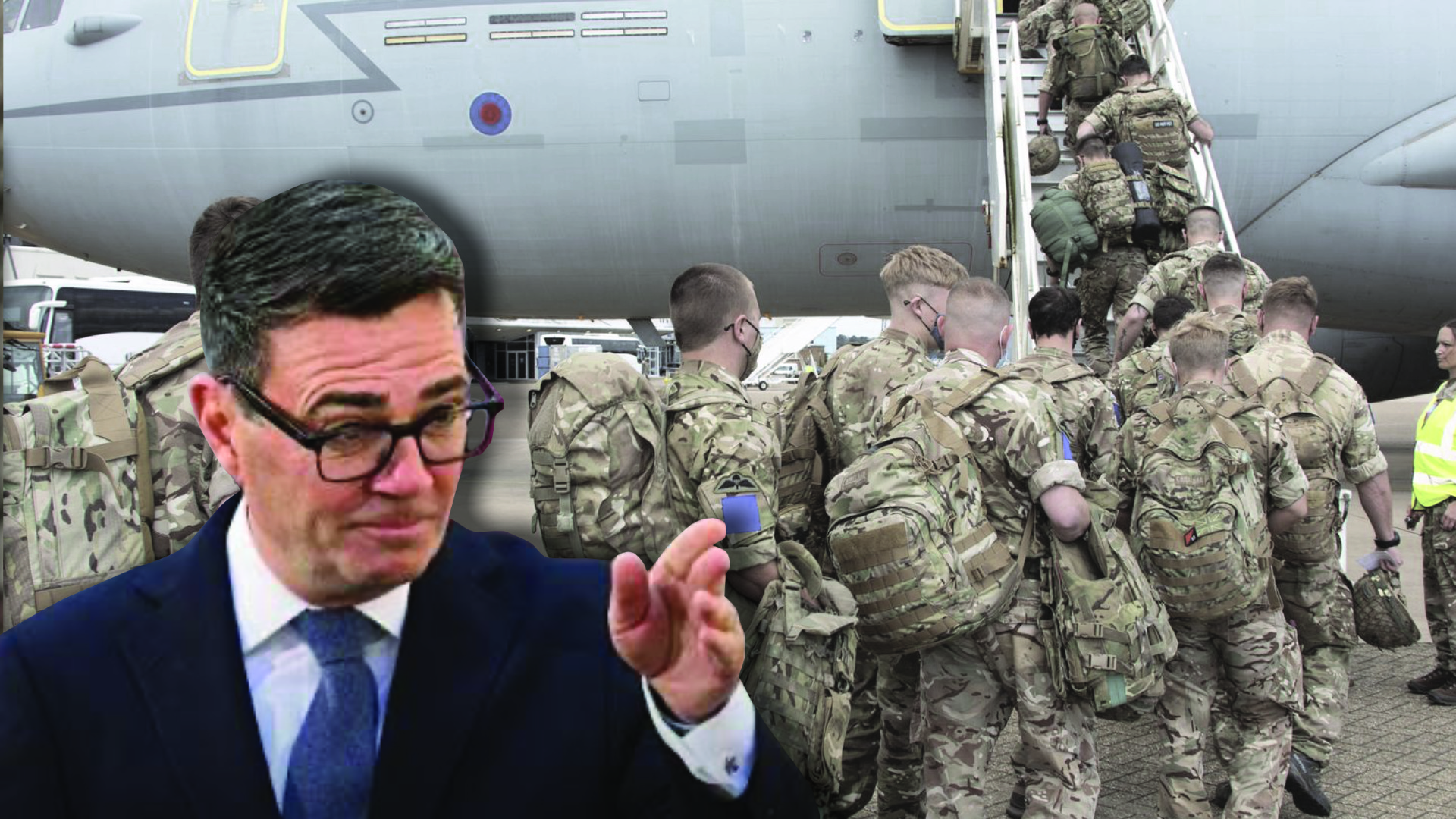
Andy Burnham’s appointment as Prime Minister on 20 July has one over-riding purpose: to accelerate his predecessors’ drive towards militarism and war, and to drive through the devastating attacks on the working class necessary to pay for the massive cost of rearmament. Alongside this is a relentless propaganda effort aimed at persuading the British public, which has no appetite for increased military spending, that it faces ‘unprecedented threats’ from China or Russia or Iran. ROBERT CLOUGH and JAMES MARTIN report.
Outgoing Prime Minister Keir Starmer’s ‘welcome gift’ to Burnham was a requirement to cut spending on the sick and poor to pay the military. Burnham thinks he can create more room for the Labour Party to reingratiate itself with the clearly disillusioned Labour voter. His appointment was arranged by Labour MPs to save their skins in the face of the collapse of the working class’s support for Labour. However, if the military spending doesn’t happen, Britain’s prominent role in asserting control over the Ukrainian government, and the long term economic benefits already planned, will be frustrated.
Schemes to raise the cash for the military face immediate obstructions. Burnham’s electoral ploy was to promise not to raise the main taxes, reject wealth taxes and stick to former Labour Chancellor Rachel Reeves’ borrowing rules. This places him in a very difficult place. The OECD has urged the government to abandon the ‘triple lock’ guarantee for state pensions, but this will certainly be put off until after the next election. Spending for Special Educational Needs and Disabilities (SEND) will be a targeted area. Other cuts will again aim at the Personal Independence Payments scheme, and sickness benefits.
Starmer sets up Burnham to fund the military
In July 2024 Starmer commissioned a strategic defence review to be led by former NATO General Secretary and Labour minister Lord Robertson and in October Reeves enthusiastically stated that spending on the military was a significant part of the government’s reinvestment programme, part of ‘restoring stability to our country again’. Reeves said that she would put national security at the heart of her plan to ‘kickstart economic growth’. Now this growth is tied to Britain’s material interests in Eastern Europe.
Ukraine is a vast storehouse of agricultural and mineral assets. It is also the front line in European imperialism’s drive against Russia. Labour’s Conservative predecessors had already provided the plans to join in the extraction of Ukraine’s wealth and forestall Russia’s competing ambitions. Starmer’s and now Burnham’s military spending continues this push, one which the working class will pay for. The spending also aims to reset British relations with the EU while adapting to US imperialism’s duplicitous attempts to stifle the EU’s expansion into Ukraine and retain opportunities to break into the vast unexploited regions of the Russian Federation.
On 2 March 2025, two days after Ukrainian President Volodymyr Zelensky’s humiliation in the White House by Donald Trump, Starmer seized the initiative for Europe to announce a four-point plan to work with Ukraine and weaken Russia. At a London summit, Britain, France and other countries (now totalling 34) agreed to step up their control over Ukraine in a ‘Coalition of the Willing’. European Commission President Ursula von der Leyen said that there was now an urgent need to ‘re-arm Europe’.
The ‘coalition’ is not treaty-based, and stands outside NATO to avoid a direct clash with the US. Starmer then announced an additional £1.6bn of UK export finance to sell more than 5,000 air defence missiles to Ukraine. This came on top of a £2.2bn loan to provide more military aid using profits from frozen Russian assets as collateral. For this, in July 2026 French President Emmanuel Macron enthusiastically rewarded Starmer with France’s highest honour, the Legion d’Honneur, while Zelensky awarded him Ukraine’s Order of Freedom’ in a round of ruling class self-congratulation.
Robertson review
On 2 June 2025 Robertson duly provided his Strategic Defence Review. In 1991 Britain spent 4.2% of its GDP on its armed forces. It is currently 2.3%, but in real terms the sums remains roughly the same. The past restraint on any absolute increase in military spending was dubbed the ‘peace dividend’ from the collapse of the Soviet Union. While Britain today has only the fifth largest body of active military personnel in Europe, its military spending to GDP ratio remains higher than other European countries (apart from Poland) to defend its huge global investments. Before he resigned, Starmer had agreed to spend 3.5% of GDP on core defence by 2035 plus another 1.5% on security infra-structure to meet the NATO agreement, encouraged by Trump’s repeated threats to abandon the organisation.
European rearmament
Europe’s biggest military powers, including Britain and France, are not yet on course to reach their 3.5% target. Germany aims to hit 3.7% by 2030. Eleven European countries are financing at least half of their increase in defence spending by raising taxes or cutting spending, and Burnham will have to follow suit. Spain exempted itself, saying it would cap spending at 2.1% of GDP. Others such as Portugal solemnly swore to reach the target but have made little effort to do so. Italy creatively claimed a 39% increase to hit 2% of GDP last year, although 93% of this was accounting trickery. The economic and social demands of each country’s working class are clearly obstacles to these proposed increases.
Despite Labour’s continuous modernisation of the military, Robertson berated the government in April for showing ‘corrosive complacency’ regarding national security; stating that ‘We cannot defend Britain with an ever-expanding welfare budget.’ Then-Defence Secretary John Healey and now Burnham’s Chancellor wanted £18bn more than the additional £13.5bn the Treasury offered to add to the military budget. This would have had to come from the NHS and education. Further wrangling produced a small increase of 0.1% of GDP by 2030, for a total of 2.7%, but Healey resigned on 11 June saying the plan fell ‘well short of what is required for defence and the country at this dangerous time’. Armed Forces Minister Al Carns resigned the same day, stating that the funding plan was ‘not built for the threat we face’. The resignations at the defence ministry finished off Starmer, who threw in the towel on 22 June.
The task for Burnham is to find the £4.7bn savings before meeting the immediate promise to spend 2.7% of the GDP on defence from 2027-2028. Hypothetical MOD ‘efficiency’ savings of £10.7bn by 2029/30 will require using AI to remove around £1bn currently spent on ‘external assistance’ ie consultancy, and allow the sacking of 20% of ‘human resource’ staff, while cutting the armed forces housing budget, and reducing spending on cadets, all requiring spending delays to drag out the process over a longer period.
Most of this will be extracted from social service spending. Even before Burnham was anointed prime minister, renewed calls for getting the ill back to work were again in train: the Timms and Milburn reviews will be at hand in the autumn proposing the required cuts. This will of course not only reduce state welfare budget but force ill-prepared workers into the areas needing unskilled labour at the lowest pay rates. The issues for communists remain the same: imperialist military spending is aimed at maintaining a barbaric class system globally and we must get rid of it and replace with socialism.