

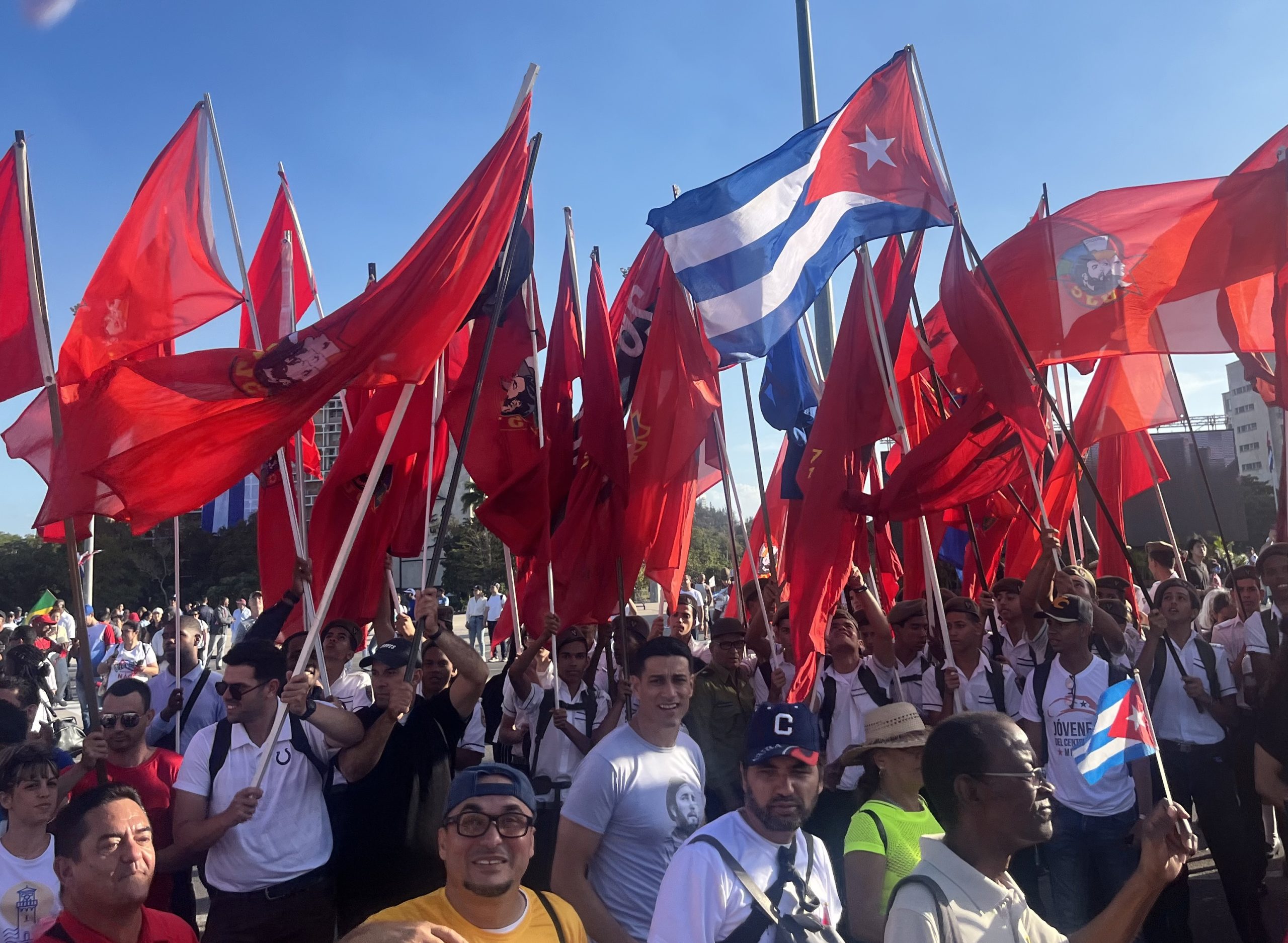
The US blockade on Cuba is a deliberate act of imperialist aggression, designed to impose collective punishment on the entire Cuban population. Since January 2025, the intensification of the blockade under the US’s second Trump administration has multiplied the staggering economic harm inflicted on Cuba.
Eight minutes of the blockade costs Cuba the equivalent of a year’s education provision for children with hearing difficulties ($129,500); 16 minutes equals the annual cost of the drug Nusinersen for paediatric spinal muscular atrophy ($250,000).
Now the assault is being dramatically escalated. Under US President Donald Trump and Secretary of State Marco Rubio’s ‘maximum pressure’ policy, new sanctions have been announced almost every other Thursday for two months since 23 July, targeting Cuban companies, institutions and individuals. The energy sector has been singled out, with sanctions hitting the state oil company, its research arm and energy importers. More than six nationwide blackouts have hit Cuba this year; in some provinces, there have been blackouts lasting up to 30 hours.
By deliberately denying Cubans the fuel and energy needed for daily life, the blockade imposes conditions intended to threaten the survival of the Cuban people. As Cuba’s government has pointed out, this meets the UN Genocide Convention’s definition of genocide: an act intended to destroy, in whole or in part, a national, ethnic, racial or religious group, including by deliberately inflicting conditions of life calculated to bring about physical destruction.
A threat of a good example
The US blockades Cuba because it shows that another world is possible, an alternative to capitalist exploitation and imperialist domination. Following the 1959 revolution, the working class seized the means of production and has built a society based on socialism, justice and international solidarity.
The blockade is a weapon of imperialist warfare designed to make socialism unviable, punish the Cuban people for defending their sovereignty and create the conditions for political overthrow. This was made explicit in 1960 by former US Assistant Secretary of State Lester Mallory, who called for measures to bring about ‘hunger, desperation and overthrow of government’. Sixty-six years later, US imperialism is pursuing the same objective.
Energy siege
Since late January 2026, the US has imposed a near-total oil blockade on Cuba, cutting off fuel needed for transport, agriculture, hospitals, schools and industry. Since then, only one Russian tanker has reached Cuba, carrying 100,000 tonnes of crude oil in humanitarian aid – welcome solidarity, but only a fraction of what the island needs. By the end of May, Cuba was already 2,667,800 tonnes short of its planned fuel supply.
The US attack on Venezuela in January has compounded the siege, cutting off another vital source of Cuban oil. The result is an energy crisis that reaches into every part of daily life. Havana’s passenger transport system is operating with just over 100 buses, against around 3,000 needed for adequate service. Higher education was moved online during the first semester of 2026, while blackouts have forced school lessons into corridors and courtyards.
In hospitals, the consequences are potentially fatal. When the electricity fails, ageing generators must activate within seconds, while ventilators without functioning batteries can require manual operation.
The blockade also attacks Cuba’s ability to generate income. The US is targeting its internationalist medical missions, imposing visa restrictions on countries working with Cuban doctors and recycling the discredited claim that these missions constitute forced labour. Cuban medical cooperation provides healthcare where local systems are understaffed and under-resourced, while the missions generate vital foreign revenue for Cuba.
A blockade without borders
US imperialism uses its control of global finance to threaten banks, shipping companies and governments that trade with Cuba with exclusion from US markets and the dollar.
More than 7,000 containers carrying food, fuel, water equipment and medicines bound for Cuba were stranded in Caribbean ports because companies fear US sanctions. As Foreign Trade Minister Oscar Pérez-Oliva Fraga has said, ‘those who remain impassive, allowing this genocide to be committed, and those who are bowing to the interests of the US’ must be held accountable for the loss of innocent Cuban lives.
Imperialism also seeks to isolate Cuba politically. As Latin America shifts to the right, governments whose interests align with US imperialism are increasingly joining the attack. In August, the Dominican Republic expelled nine Cuban diplomats, while Colombia’s new President Abelardo de la Espriella announced his administration will cut diplomatic relations with the revolutionary government. Earlier this year, at least eight Latin American and Caribbean countries ended their medical agreements with Cuba, including Jamaica and Honduras, following US threats and visa restrictions.
International solidarity
Yet solidarity persists. In September, senior officials from the Cuban Institute of Friendship with the Peoples (ICAP) were sanctioned, revealing the US’s fear of the relationships Cuba has built with workers, students, and anti-imperialists worldwide. The Nuestra América Convoy carried solidarity directly to Cuba in March, alongside brigades that travelled to the island in August for activities marking the centenary of Fidel Castro’s birth. Their presence demonstrates that Cuba is not isolated: across borders, generations and movements, people continue to defend the Revolution and draw inspiration from its example.
British governments may formally oppose the blockade, but British banks and companies illegally comply with US extraterritorial sanctions. Solidarity comes once a year at the UN, as the vast majority of the General Assembly has voted to demand an end to the blockade for 33 consecutive years, but governments tolerate the siege in practice. The task for communists, sbocialists and anti-imperialists is clear: defend Cuba against imperialist aggression. The fight to defend Cuban socialism is the fight to defend socialism itself – and it is a fight we must take up here.
End the blockade! No to sanctions! Viva Cuba socialista!