

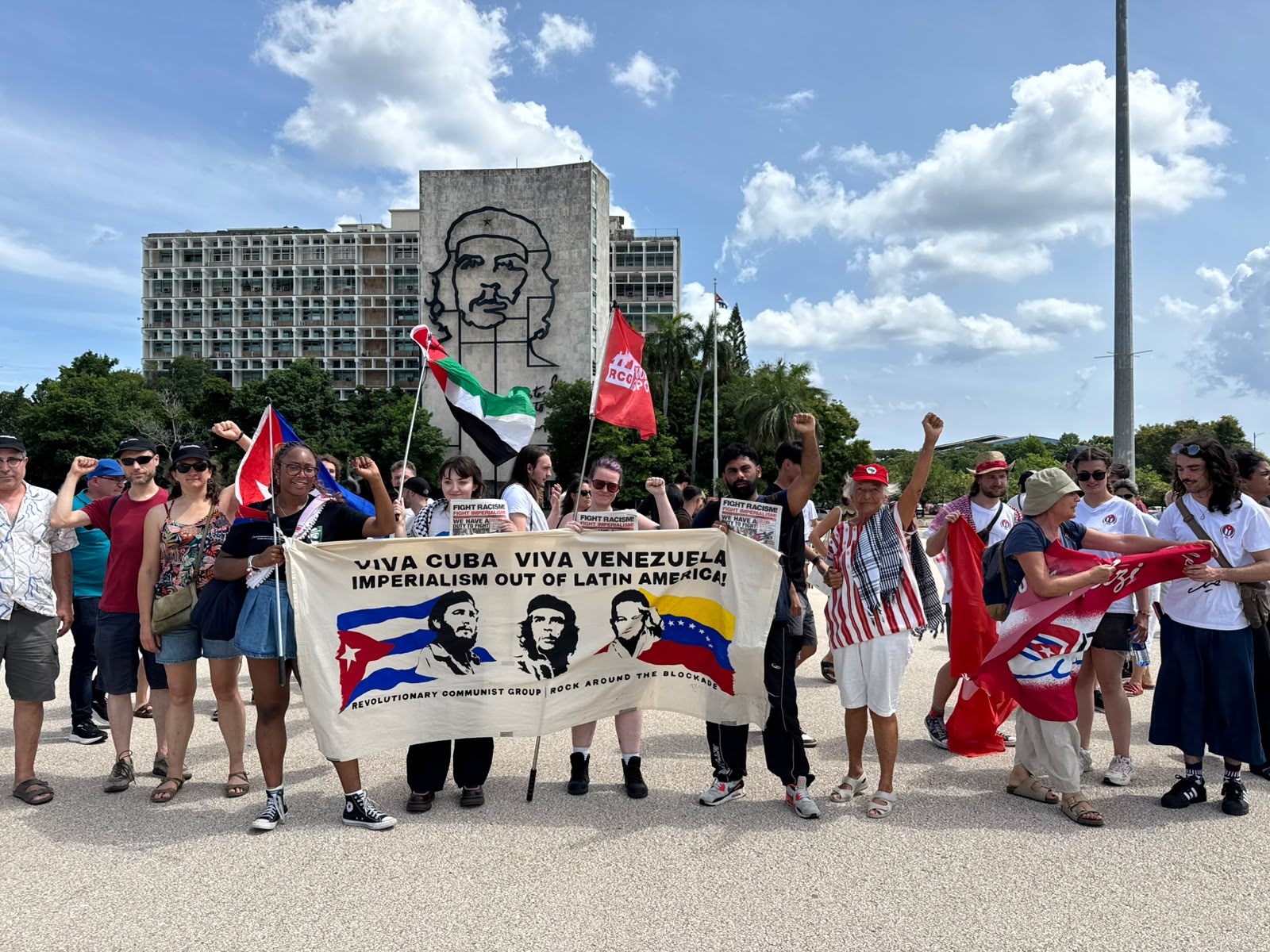
In August 2026 comrades from the Revolutionary Communist Group and Rock around the Blockade joined the 53rd José Martí European Solidarity with Cuba Brigade, organised by the Cuban Institute of Friendship with the Peoples (ICAP). The US blockade is causing a silent genocide in Cuba through its merciless economic warfare which has produced severe shortages and hardship, deliberately designed to suffocate the island and break the Cuban people’s resistance.
Yet Cuba has not surrendered. Under the weight of imperialist aggression, the Cuban people continue to defend their revolution, organise collective survival and build socialism. We arrived in Cuba at a critical moment of intensified imperialist siege. For two weeks, travelling across the island, we met farmers, cleaners, doctors, students and revolutionary organisations confronting the consequences of the blockade and fighting to preserve Cuba’s sovereignty and social gains. Their determination exposed the political reality behind the shortages: Cuba’s crisis is not a failure of socialism, but the result of a deliberate imperialist war aimed at forcing the Cuban people into submission. Taking place in the centenary year of the late Cuban leader Fidel Castro’s birth, the brigade offered a first-hand understanding of both the immense challenges confronting Cuba and
the resilience, internationalism and revolutionary determination with which its people continue to resist.
The RCG affirms its commitment to stand with Cuba, in the spirit of the words spoken by Cuba’s President Miguel Diaz Canel on 8 August: ‘The moment demands more than declarations of principles. It demands a qualitative leap in our international articulation and coordination.’
Fidel’s legacy, a weapon for the future
The political centrepiece of the brigade was the First International Colloquium ‘Fidel: Legacy and Future’, held in Havana to mark 100 years since Fidel Castro’s birth and reaffirm his enduring legacy. Bringing together more than 1,500 delegates from 63 countries, the conference was not simply an occasion to commemorate a historic revolutionary leader, but to confront a central question: what does Fidel’s legacy mean for the struggles of the present?
The answer was clear throughout the four days of discussion. Fidel’s thought cannot be confined to history. His analysis of imperialism, national liberation, internationalism and socialism remains profoundly relevant in a world marked by parasitic and decaying capitalism.
President Miguel Díaz Canel’s keynote speech placed Fidel’s legacy firmly within Cuba’s present conditions. He recalled both the immense social transformation made possible by the revolution and the principled internationalism that saw Cuba support liberation struggles across Africa, Latin America and Palestine.
But he also addressed the reality facing Cuba today: tightening US sanctions, economic hardship, blackouts, shortages and an escalating media war. These difficulties are the direct result of the barbaric US blockade and its genocide against the Cuban people. He stressed that now, more than ever, we must fight not only in solidarity with Cuba, but for humanity and the liberation of the working class of the world.
Alongside the main sessions, several smaller discussions examined Fidel’s Marxist-Leninist theory and its practical application. Speakers included Cuban specialists from a range of sectors, as well as activists and left-wing academics from across the world. We were able to exchange experiences with international solidarity activists and develop actions for the future, which formed the basis of the conference’s final declaration.
As socialist Cuba confronts one of the most difficult periods in its history, the question posed by the colloquium was not simply what Fidel achieved, but what future can be built from his legacy. The answer is clear: resistance, internationalism and the conviction that a better world must be fought for. The RCG is taking up this call.