

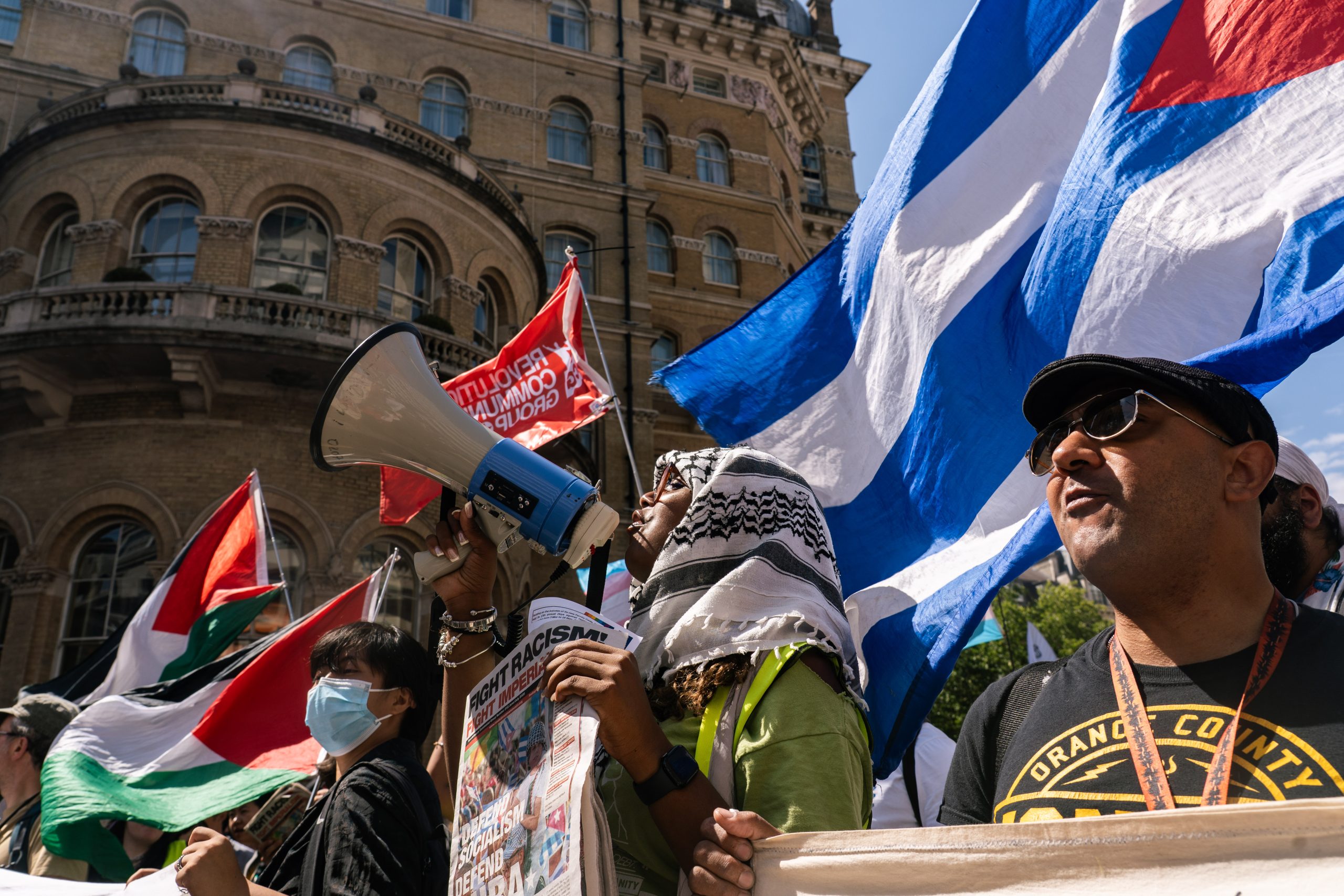
Cuba’s achievements would be extraordinary in any country. That they have been won by an underdeveloped former slave colony, under a decades-long blockade imposed by the most powerful imperialist country in the world, proves beyond doubt that socialist planning is superior to capitalism. All who defend the most elementary socialist principles – solidarity, welfare, equality – must champion the cause of the Cuban revolution, now more than ever.
Healthcare for All
The victories of Cuban healthcare under socialism are immense. Before the 1959 revolution, 90% of children in rural Cuba had intestinal parasites, and the infant mortality rate was 60 per 1,000 live births. The Cuban revolution transformed lives with a healthcare system which is entirely state-funded and owned, free from private interests and organised to meet public health needs, rivalling even imperialist nations in a variety of health measures. By the 2010s, Cuba’s infant mortality rate had fallen to 4.5 per 1,000 live births, lower than in the US or Britain.
Cuba’s biotechnology sector is world-class. Cuba created the world’s first meningitis B vaccine in 1989. It was the first country in the world to eliminate mother-to-child HIV transmission in 2015. During the Covid-19 pandemic, socialist Cuba was the only country in Latin America and the Caribbean to develop a vaccine – in fact creating five.
Even in an energy crisis, Cuba continues to provide free healthcare for all. In Pinar del Río, for example, prenatal consultations have been relocated to ensure electricity-dependent diagnoses can continue, while ultrasound equipment and maternity homes have been fitted with photovoltaic systems that guarantee essential functioning, lighting and other basic needs.
For the nearly 3,000 patients requiring haemodialysis, the state guarantees transport to and from hospitals three times a week via an organised taxi service, directing scarce fuel where it is needed most.
Cuba prevails despite US imperialism’s increasingly brutal onslaught. Its healthcare system shows what is possible when resources serve humanity rather than profit.
Chi Hong
Ecological Sustainability
While capitalism burns the planet for profit, socialist Cuba has pioneered ecologically sustainable development and spent decades preparing for a climate crisis it did not create. Following the collapse of the socialist bloc in the 1990s, Cuba was forced to find creative ways to adapt to scarcity, developing urban farming and organic methods of agriculture to reduce dependence on fuel and imported fertilisers.
In 2006, 2015 and again in 2019 Cuba was identified in international studies as the only country in the world to provide a high level of human development at an environmental cost which the planet can sustain. Mobilising thousands of volunteers in 2006 to replace nine million lightbulbs free of charge, Cuba became the first country in the world to eliminate inefficient tungsten filament lighting. Tarea Vida (Life Task) is the revolutionary government’s 100-year plan to defend the island and its population from the effects of climate catastrophe.
The US has done its utmost to sabotage these efforts. Under Donald Trump’s first administration alone, Cuba was hit with 243 hostile economic measures, 56 of them aimed directly at strangling Cuba’s energy sector. Cuba has responded with creative and collective resistance, new photovoltaic parks and tens of thousands of solar panels. The Union of Young Communists is mobilising to build a renewable future by 2030. Every panel raised is a blow against imperialism and a step toward energy sovereignty.
Cuba shows the world what is possible when socialist planning replaces production for profit. In the face of extinction, socialist Cuba chooses survival.
Charley Ward
Gender and sexual equality
The triumph of the revolution signalled a new era of struggle against all forms of inequality. Vilma Espin, a leader in Cuba’s revolutionary struggle, founded and was President of the Federation of Cuban Women (FMC) in 1960. Abortion was decriminalised in 1965 and since 1979 has been free, legal and available on demand for the first ten weeks of pregnancy.
Today over four million Cuban women and girls over 14 years old (90% of the female population) are members of the FMC. By 2021 women accounted for 71% of medical professionals, 84% of laboratory personnel and 53% of science and technology workers. Over 55% of members of Cuba’s national parliament are women.
The National Centre for Sex Education (CENESEX) was founded in 1989 and pioneered the transformation of Cuban society in relation to LGBTQ+ rights, spearheaded by Mariela Castro. Cuba provides free gender-affirming surgery under its socialist healthcare system while CENESEX provides education and support to trans people and their families. A key milestone for gender and sexual equality is Cuba’s 2022 Family Code. Its creation and approval by referendum was a mass democratic exercise involving debates throughout the country.
The 2022 udpated Code provides legal protections against domestic abuse and gender-based violence and enshrines a shared responsibility of care within the household. It bolsters rights for children, emphasising the needs of the child and parental responsibility rather than custody, recognising the presence of non-traditional families, whether they be inter-generational households or same-sex couples.
With strong legal protections against discrimination and the legalisation of same-sex marriage, adoption and gestational surrogacy, the Family Code puts Cuba at the front of the global fight for the liberation of LGBTQ+ people.
Nancy Mays
Internationalist Solidarity
‘Share what you have, not what you have left’ is a Cuban motto, and the island’s ongoing support for the struggles of the international working class, even at this time of extreme US aggression, shows the socialist state will never abandon its principles.
Cuba backed liberation struggles in Algeria, Colombia, South Yemen, Ethiopia, Nicaragua and Grenada. Cuba’s support for Palestine has included training both resistance fighters and doctors, sending aid, rejecting relations with Israel and supporting the International Court of Justice genocide case. Cuba’s interventions in the 1970s and 1980s to fight alongside SWAPO and MPLA troops to liberate Namibia and Angola was fundamental to the defeat of apartheid in southern Africa.
In 2004 Cuba and Venezuela co-founded the Bolivarian Alliance for the Peoples of Our America whose achievements include providing free eye care to 6.5 million people. Cuba has been recognised on multiple occasions by the World Health Organisation for providing relief following disasters in Kashmir, Indonesia, Bolivia, Mexico, Haiti, and Chile. Cuba sent the largest medical contingent of any country to west Africa to combat the 2014 Ebola epidemic, and to over 40 countries during the Covid-19 pandemic.
Cuba has trained thousands of doctors from around the world for free. Despite its own blockade-induced shortages, Cuba dispatched rescue workers to assist Venezuela after the earthquakes in June 2026; Cuban medical workers were among the first to respond following the disaster.
Wherever people struggle for their liberation, Cuba has stood with them. You must now stand with Cuba as it struggles against the US blockade.
Felix Lancashire