

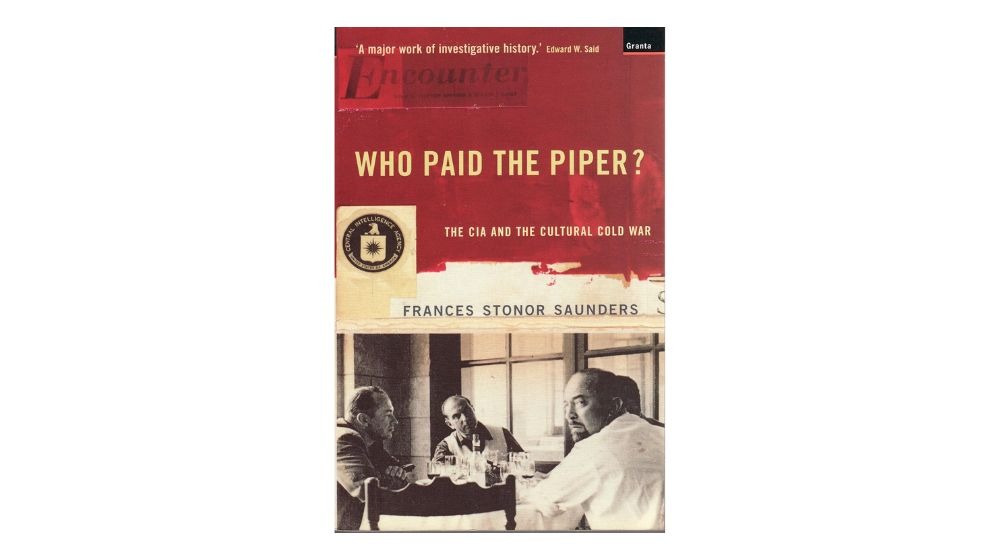
Who paid the piper? The CIA and the Cultural Cold War, Frances Stonor Saunders, Granta Books 1999, £20
During the 1950s and 1960s, the United States Information Services [USIS], based within US embassies throughout Europe, sponsored the study of United States culture, particularly literature, to counteract the burgeoning influence of Soviet Studies. The funding for this came from the Central Intelligence Agency [CIA] and was funneled through other cultural organisations such as the Ford Foundation, the Rockefeller Foundation and above all, the Congress for Cultural Freedom [CCF]. In the early 1960s I was an undergraduate. The study of American literature appeared to me then to be stimulating new area of study. I continued in this field as a postgraduate and eventually became a lecturer in American literature, which I have remained for the rest of my professional life. The study of American literature, history, politics, sociology, film and so on, took off massively in the 1960s and 1970s and is now common in almost every university in this country. What Saunders shows in this book is that this apparently spontaneous growth of a new discipline was nothing of the sort. Not very far below the surface one finds clear evidence of a determined plan by the CIA to corral cultural and intellectual life after World War II to the service of US imperialism and the Cold War. The CIA became in effect the major artistic patron on a scale that have made the Medici blink. This book plots the development of this enterprise that was only finally wrecked by the Vietnam war and the rise of the New Left. I write this as someone startled to discover that my apparently autonomous intellectual development came about as a result of a secret plot by the intelligence services of a foreign country.
‘During the height of the Cold War, the US government committed vast resources to a secret programme of cultural propaganda in western Europe. A central feature of this programme was to advance the claim that it did not exist. It was managed, in great secrecy by the USA’s espionage arm, the Central Intelligence Agency. The centrepiece of this covert campaign was the Congress for Cultural Freedom, run by the CIA agent Michael Josselson from 1950 till 1967. Its achievements – not least its duration – were considerable. At its peak, the Congress for Cultural Freedom had offices in 35 countries, employed dozens of personnel, published over 20 prestige magazines, held art exhibitions, owned news and features service, organized high-profile international conferences, and rewarded musicians and artists with prizes and public performances. Its mission was to nudge the intelligentsia of western Europe away from its lingering fascination with Marxism and communism and towards a view more accommodating of the American way.’
For those who set up the CCF the Cold War was. essentially, a cultural war. The Marshall Plan to bring economic aid to a starving and economically devastated Europe was thought to be useless as an instrument for the establishment of US hegemony unless it was accompanied by an ideological aid programme. George Kennan, architect of the Marshall Plan, in a speech to the National War College in December 1947, introduced the concept of the ‘necessary lie’ as the vital element of US post-war diplomacy. Mirroring the Soviet Union’s skilful use of propaganda, Kennan advocated a policy that was to be based on paradox and contradiction: the truth would be defended by lies; freedom by manipulation: democracy propagated by ruthless control; open government sustained by secret and covert activities. The main sustainers of this dreadful inversion would not be the right-wing ideologues or the erstwhile fascist sympathisers so hastily rehabilitated after the war, but those designated as the Non-Communist Left [NCL]. The main strategist for this roping together of the NCL into the US sphere was Arthur Koestler. Long admired in the West for his denunciation of Stalinism, Koestler was early recruited by the CCF to persuade left-leaning intellectuals that they should overcome their confused thinking and sceptical detachment from politics. Essentially, Koestler, having bounced himself out of the power structures of Eastern Europe, willingly embraced the feet of the new power elites of the West. Following the old adage of the need to fight fire with fire, Koestler persuaded the CIA to fight communism with ex-communists, defined ‘those who were disillusioned with communism but still faithful to the ideal of socialism’. Thus did the CIA get into bed with the socialists.
Three key texts stand as testimonies to this strategy: Arthur Schlesinger’s The Vital Centre, Koestler’s The God that failed and George Orwell’s Nineteen Eighty-Four. Apart from these three, the philosopher Isaiah Berlin, politician Averell Harriman, composer Nicholas Nabokov and critic and writer Melvyn Lasky, in addition to Josselson, were the prime movers and hired hands of the project. Most of these men had left-wing credentials that gave the necessary aura of authenticity to their positions. Although there was an attempt to set up a US version of the CCF, it was wrecked by the quarrelsomeness of homegrown US intellectuals and the integrity of few individuals like the playwright Arthur Miller and writer Mary McCarthy. (The social philosopher Hannah Arendt, however, was.one of the staunchest supporters.) No such problems were encountered in Britain where intellectuals, politicians and artists flocked to the freebies and sold themselves cheap into dishonourable slavery for the price of a few days in a posh hotel or an overseas trip. Encounter, edited by the poet Stephen Spender, was the main intellectual organ of Cold War propaganda. Spender later claimed not to have known where the money came from for the loss-making journal, but his career was effectively ruined by revelations of CIA patronage. Orwell, on the other hand, was a knowing paid agent and handed over lists of his erstwhile Communist Party comrades to the British secret services while waging ferocious war against the left in his trite and grossly over esteemed works of fiction.
Almost every ‘radical’ or ‘left-wing’ journal of the Cold War was funded by the CIA. These included Partisan Review in the United States and Transition in Uganda. The whole list of academic and cultural journals emanating from US universities in this period, and detailed by Saunders, was funded by the CIA through front learned foundations. In essence there was no natural sustainable market at all for the growth of a liberal, intellectual ‘centre’; the illusion of one was created by creative accounting. The most startling artistic achievement of the CIA was the sponsorship of Abstract Expressionism – defined by Nelson Rockefeller as ‘free enterprise art’. The fact that the free market could never have sustained such developments did not cause any hesitation in the CIA’s embrace of the unsellable. The fact that most of these painters ended their lives in early violent deaths did not cast a shadow over the scheme to show the West as the natural home of free artistic experiment. And as Saunders points out, there was never any danger of the CIA running out of money.
The methods of bribery and manipulation were totalitarian but there were moments of high farce as when the CIA commissioned a translation of TS Eliot’s obscure modernist poem The Four Quartets and had copies air-dropped over the Soviet Union. As tragedy, there was the absolute nadir of McCarthyism and the communist purges of the 1950s. Falling between farce and tragedy is the collapse of the official Left in Britain. Labour leaders Hugh Gaitskell, Denis Healey and Anthony Crosland were all knowing and willing supporters of the CCF. After the Labour election victory of 1964 Josselson wrote to US cultural historian Daniel Bell, ‘We are all pleased to have so many of our friends in the new government.’
The success of the CIA strategy depended on the dominant class definition whereby to be non-political was to be anti-communist. Intellectual freedom was the freedom to take up a pro-capitalist position. This position was succinctly denounced and exposed by Conor Cruise O’Brien in 1966 as ‘The inculcation of uniformly favourable attitudes towards American politics and praсtices’. The Vietnam war and the supine failure of the Old Left to raise any voice against it created the impetus for the revolutionary left in for the revolutionary left in Europe and the States. It was the turning point as US soldiers were killing and dying in Vietnam while killing and dying in Vietnam while the bought and sold intellectuals of the left remained silent for fear of offending their masters. The rise of the New Left, uncontaminated by Cold War politics, marked the demise of the CCF and its tawdry band.
That there was a vibrant and alternative left against which the CIA felt the need to conspire is shown in Tim Robbins’ The cradle will rock. This film, released to cinemas in Britain at the end of April, shows how the Theatre Arts Project, part of Roosevelt’s New Deal, developed a revolutionary people’s theatre in the heart of the failed capitalism of the depression. The film captures the exuberance and optimism that a new society could emerge from the debris society could emerge from the debris of mass unemployment and poverty and of how this hope was undermined by the scare tactics of the red menace industry fueled by terrified megalomaniacs like William Randolph Hearst and Nelson Rockefeller. But not before one glorious, rumbustious and illegal performance of Mark Blitzstein’s Brechtian musical which gives its title to the film. In the 1930s, to be an artist was to be on the side of the people, to be committed and to believe that art itself must dirty its hands with politics and the real lives of people. Even fascists like the poet Ezra Pound and futurist Marinetti believed in the political function of art. It was the task of the ideologues of the Cold War to create the myth of the neutral or unpolitical artist and to make that the position that paid off.
There is an overlap between the film and the book. At the end of the film, Rockefeller, who has just ordered the destruction of Diego Rivera’s mural commissioned for the Rockefeller building because it featured the head of Lenin, discusses with Hearst how they can encourage a more apolitical form of art. They hit upon the idea of patronage for those artists like Matisse who are content to focus on fruit and flowers. The encouraging of such art by grants and gifts will drive out the disturbing art which addresses social issues. What the film illustrates is the creative and unruly energies unleashed by the process of artistic creativity. It is these energies, anarchic and uncontrollable. which create such terror in the ruling classes and which they want to manipulate into the empty forms of the decorous and harmonious.
Saunders’ book and Robbins’ film both illustrate an uncomfortable truth about the distance between the rhetoric of the open society and the reality of control; of an intellectual environment in which our thoughts are not our own.
Jacqueline Kaye