

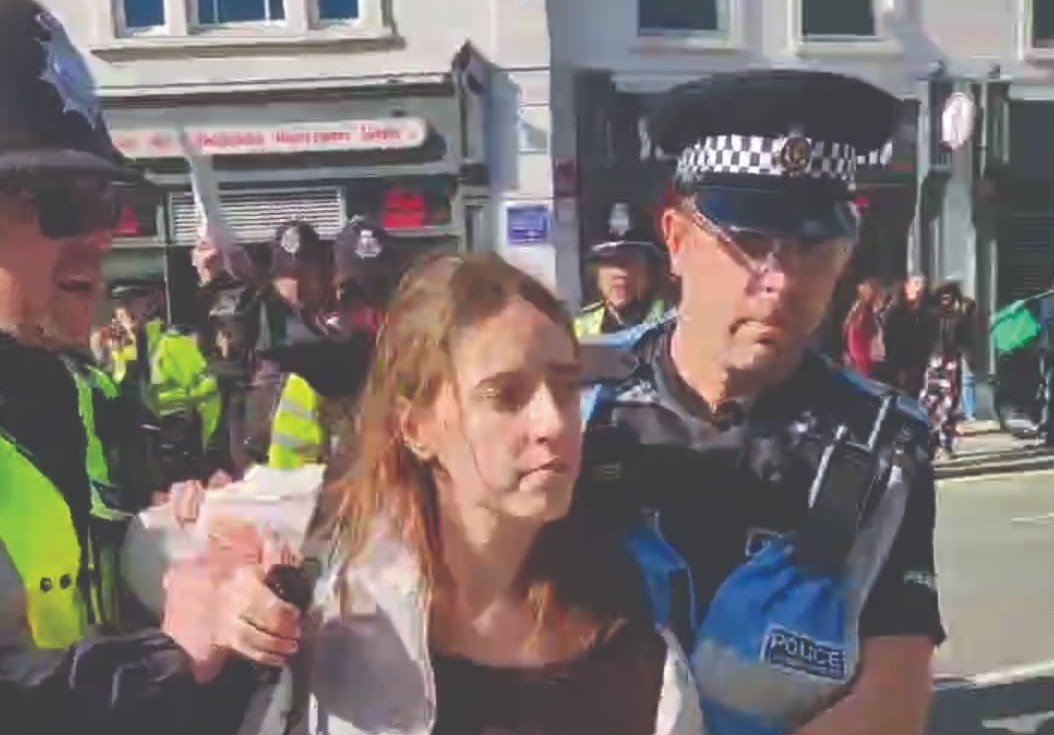
On 14 March, an FRFI supporter was arrested in Brighton, on suspicion of a ‘racially-aggravated public order offence’, after leading protesters in chants using the word ‘Intifada’. Three people in London currently face a Crown Court trial for using the same word. This political policing of the vocabulary of the Palestinian struggle must be fought at every turn.
This is not the first time the British government has instructed the police to arrest people for using the words ‘Victory to the Intifada’ or ‘Globalise the Intifada’ in slogans or on placards. The previous attempt was in January 2024, at the behest of the then Conservative government; three FRFI supporters were among those arrested. This ended in No Further Action from the police. Now it is the Labour government’s turn.
Azza Azaki, Abdallah Alanzi and Haya Adam (who was expelled from SOAS University of London for her activism for Palestine) were arrested outside the Ministry of Justice on a protest in solidarity with hunger striking pro-Palestine prisoners in December 2025. Their alleged offence was to have chanted ‘Globalise the Intifada’. They have been charged with contravening Section 18 of the Public Order Act or, in the words of the Crown Prosecution Service, ‘stirring up racial hatred’. The RCG and Defend SOAS 2 Campaign supported the three on 25 February at Westminster Magistrates’ Court as they entered a not guilty plea, and again at Southwark Crown Court on 25 March. A further hearing will take place on 21 July; if the case is not dismissed, the trial go ahead in 2028.
Our Brighton comrade was arrested following a doxxing campaign by local Zionists. Two weeks earlier, on 28 February, the RCG, alongside other local groups, had organised a pro-Palestine counter-demo in response to a Zionist march through the town. During the counter-demo our comrade led chants and delivered a speech, asserting the internationally recognised right of an occupied people to resist, including through armed struggle. Prominent local Zionist Heidi Bachram filmed our counter-demo and posted video of our comrade on X demanding the police identify and arrest her.
Brighton RCG responded by mobilising for an emergency protest to politically challenge this threat of arrest. As soon as our march arrived in the town centre, the police swooped in to drag our comrade into a police van. She was then taken to Brighton Custody Centre, where we held a protest until she was released. The following day our comrade spoke alongside Sarah of the SOAS 2 to a crowd of thousands at the annual Al Quds Day rally for Palestine in London, demanding an end to police repression of the Palestine movement.
Intifada is an Arabic word meaning ‘to shake off’, most associated with the mass uprisings of the Palestinian people in 1987 (First Intifada) and 2000 (Al Aqsa Intifada). The RCG has used it consistently on banners and in chants since those uprisings, as an integral component of our solidarity with the risen people of Palestine’s righteous struggle against Zionist occupation. The attempt to silence and criminalise those who use ‘Intifada’ here in the imperialist heartland not only attacks our right to free speech but directly attacks the legitimacy of the Palestinian resistance itself.
Defend free speech on Palestine!
Bail conditions: the process is the punishment
Until 2006 only a court could impose bail restrictions. The only condition that the police could impose was to return to the police station on a given date. Police today now have carte blanche to impose any manner of conditions on arrestees as they release them pending some future decision on whether they will eventually be charged.
This power is widely exploited to punish protesters, many of whom are never actually charged with any offence. Exclusions from the Borough of Westminster in London or the centres of other cities are commonplace. The 86 people arrested at Wormwood Scrubs in January this year are banned from a 500m radius of three prisons. More draconian conditions have included not to attend any protest at all and not to distribute political literature. This is deliberately designed to make it harder for activists to operate. Representations against bail conditions can and should be made either to the police themselves or by asking for a hearing in the magistrates’ court.