

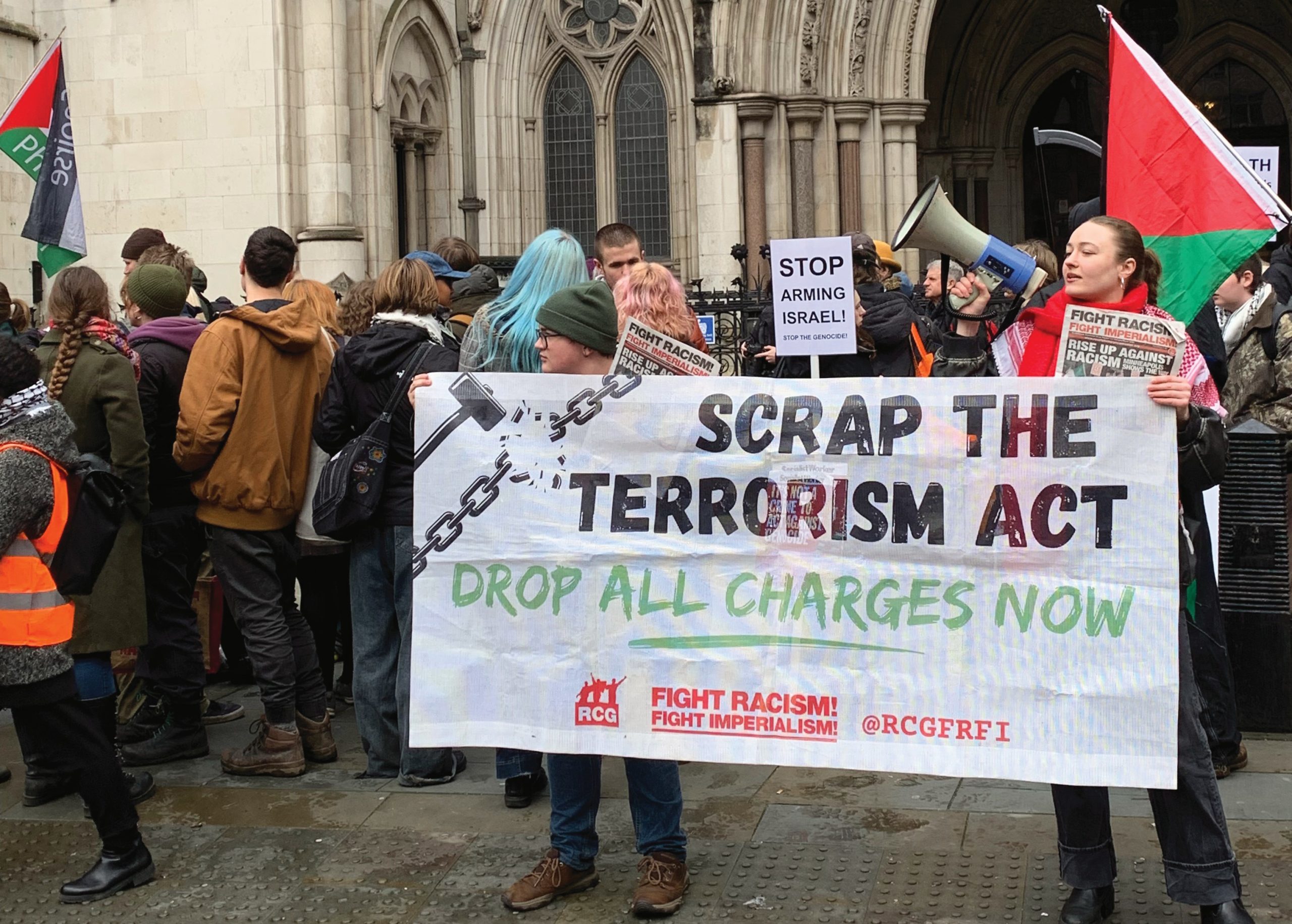
On 4 February 2026, the first six members of the Filton 24 to go on trial walked free from court. This was the start of a series of victories for pro-Palestine activists. NICKI JAMESON assesses the gains and lessons.
Having been arrested in 2024, for taking direct action to dismantle weaponry destined for use in the Zionist genocide in Gaza, the Filton 6 were held under terrorism powers, remanded in custody for 18 months and tried for aggravated burglary, violent disorder and criminal damage. The jury acquitted them all on the first and most serious count, which is potentially punishable by life imprisonment, and returned a mixture of acquittals and no verdicts on the other charges.
The release on bail of these six rapidly led to the freeing of all but one of the imprisoned Filton 24, and the dropping of the aggravated burglary charges against the remaining defendants. This was a massive kick in the teeth for the state’s attempts to criminalise pro-Palestine activism.
The days and weeks that followed saw other positive outcomes from the courts:
- The High Court ruled that the proscription of direct-action group Palestine Action under the Terrorism Act (TA) 2000 was unlawful.
- This threw into disarray the prosecution of hundreds of people under s13 of the TA 2000 for holding placards saying ‘I support Palestine Action’.
- The ‘Moog 4’, remanded for allegedly damaging equipment at a weapons factory in Wolverhampton, were released on bail pending their trial in June.
- A jury at Kingston Crown Court failed to reach a verdict in the case of Hanin Barghouti, charged under s12 of the TA 2000 for making a speech that allegedly encouraged support for a proscribed organisation, Hamas.
- At Bristol Crown Court, the jury went further and unanimously acquitted Kwabena Devonish on a similar charge. In her speech on 8 October 2023, she had said that she ‘would never condemn the resistance of Palestinians because their resistance is due to the occupation’ and that Hamas ‘are fighting for freedom… fighting for the people’.
- The Crown Prosecution Service lost a High Court challenge to a ruling that it could not prosecute Mo Chara of Irish rap group Kneecap under s13 of the TA for allegedly encouraging support for proscribed organisation Hezbollah, as it had failed to charge him within the legal time limits.
These victories result from a combination of consistent solidarity work on the streets and outside prisons and courts, the preparedness of prisoners to risk their own lives by engaging in prolonged hunger strikes, good lawyers working at the service of the political movement and – in the case of jury trials – the involvement of ordinary people within the legal process, a right now under attack by the Labour government.
The struggle is far from over. The Filton 24, Moog 4 and Hanin Barghouti still face trials and retrials. The government’s appeal against the ruling on the proscription of Palestine Action will be heard on 27-28 April. Although the trials of the ‘placard holders’ have been put off to an unspecified date after this, they have not been dropped, and the police have already reneged on their statement that they would not make further such arrests until the appeal was concluded.
Smash the Terrorism Act!
The government decision to proscribe Palestine Action now hangs in the balance. The acquittal of the Filton defendants on the most serious charges and the clogging up of the magistrates’ court with hundreds of people, many elderly or disabled, charged for holding placards, have not helped the government convince the public of Palestine Action’s inherent dangerousness and the need to treat it as a terrorist organisation.
The Terrorism Act itself has not, however, suffered much damage from this process. The decision to proscribe Palestine Action has repeatedly been described as ‘over-reach’ or a ‘misuse’ of the Act and the government is said to be considering whether to implement some new category of designation for direct action and civil disobedience groups, which cause disruption and damage, but do not necessarily merit proscription as ‘terrorist’. Meanwhile, the very existence of terrorism legislation as a means of outlawing support for revolutionary movements, and the continued proscription of Hamas, Hezbollah, the Kurdish PKK etc goes largely unquestioned.
Just as the TA’s predecessor, the 1974 Prevention of Terrorism Act, was used to criminalise the Irish community and prevent effective solidarity with armed resistance to British occupation of the Six Counties, today’s legislation is used to prevent solidarity with those fighting Zionism in Palestine and Lebanon. The creation of a division between the ‘misuse’ and ‘appropriate use’ of TA 2000 proscription feeds straight into the well-worn ‘Kitson strategy’ – pioneered by Brigadier Frank Kitson, who headed British army colonial forces in Malaysia, Kenya and Ireland – in which militant resistance is criminalised and more respectable and reformist forms of opposition allowed to continue within parameters acceptable within a ‘democratic society’. These parameters themselves are also being constantly narrowed, most recently on 15 March when the annual London Al Quds Day march was banned by the Metropolitan Police, and generally by increasing restrictions on the most docile of protests.
The campaigning work of Prisoners for Palestine, Defend our Juries, CAGE and others has ensured that the court processes around Palestine Action have reached a wide audience which opposes the ban’s interference with democratic rights of protest and dissent. However, on 26 February, when the Supreme Court handed down a crucial judgment on the interplay between the Terrorism Act and Human Rights Act (HRA), the RCG and Defend SOAS 2 campaign were alone in protesting at the court.
The Supreme Court ruled that s12(1A) of the TA – which relates to ‘recklessly’ (as opposed to deliberately) encouraging support for a proscribed organisation – did not disproportionately interfere with free-dom of expression as protected by Article 10 of the European Convention on Human Rights. This would otherwise have been an important argument in the cases of Hanin Barghouti and Kwabena Devonish, as well as in that of our comrade Sarah of the SOAS 2, who is also charged under s12 and whose trial begins on 22 June. We are mobilising to support Sarah at court and asking all our readers to help us in this struggle. While maximising the gains made by the Filton prisoners and their supporters, we need to push back against the suggestion that the treatment of Palestine Action is an anomaly, defend all those criminalised under the Terrorism Act for their solidarity with Palestine, and call for the Act to be repealed in its entirety.
Schedule 7: punishment at the borders
On 17 February 2026 FRFI supporter Louis was detained at Manchester airport under schedule 7 of the Terrorism Act – the third time that he has been detained when returning to Britain since 2024.
Schedule 7 allows nameless officers to ‘detain’ individuals at Britain’s borders for up to six hours, not requiring ‘prior authority or any suspicion’. Detainees routinely have their luggage minutely searched, have no right to silence or ‘no comment’ during questioning, and have devices confiscated for an extendable seven days for further investigation. Pro-Palestinian journalists have been subjected to harassment using this provision, as has lawyer Fahad Ansari, the solicitor representing Hamas in its bid to be deproscribed by the British state. In March 2026 Ansari lost a High Court legal challenge in which he contended that he should have been provided with a gist of the reason for his targeting.