

After examining the immediate consequences of the Second World War in Europe in part one of this series, Kotsai Sigauke now looks at how US imperialism asserted its military and economic superiority over its chief international rivals, British and French imperialism, to fix its place as the world’s leading imperialist power.
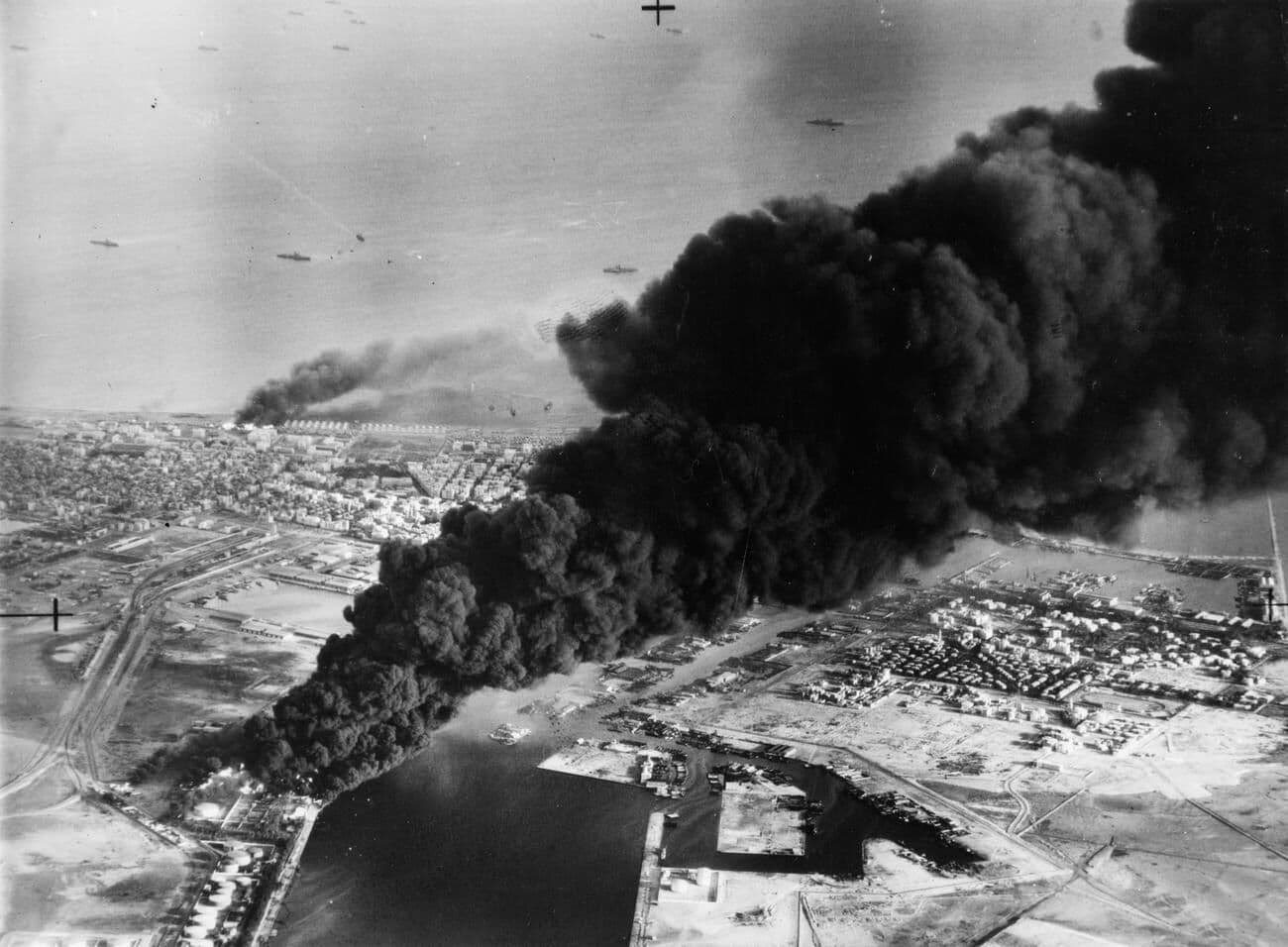
The displacement of British imperialism by US imperialism was confirmed by the 1956 Suez Crisis. The Suez Canal is a vital world trading link running through Egypt. Opened in 1869, it was owned and operated by the Franco‑Egyptian Suez Canal Company, which became a joint British‑French concessionary enterprise in 1875. In 1956, objecting to the foreign control of the canal by Britain and France, nationalist Egyptian president Gamal Abdul Nasser – the country’s first Egyptian president – seized control of the canal unannounced, declaring it nationalised. Nasser had already angered France and Britain respectively by assisting Algerian rebels against French colonialism and Palestinian resistance to Zionism. France then approached Israel to plan an armed response. Britain joined them, signing the Protocol of Sèvres by which on 29 October 1956 Israel would attack Egypt in Sinai. Britain and France would issue an ultimatum to halt the fighting and then invade to topple Nasser’s government and de‑nationalise the Suez Canal. The attack was carried out and it provoked fury across the Middle East.
The US seized its opportunity to extend its influence and threatened Britain by denying it access to dollars from the International Monetary Fund (IMF). Britain suffered a run on the pound and lost a sixth of its gold and dollar reserves in a single day, forcing Prime Minister Anthony Eden to back down and withdraw British forces; Eden was forced to resign following the disaster. Britain’s dominant political role was now clearly subordinated to US imperialism.
Consolidating European capitalism
US imperialism was determined to assert its role as the dominant global imperialist power. Since 1948 it had promoted a united European bourgeoisie to ‘contain’ the spread of socialism. As the French and British empires dissolved, the member states of the new European Economic Community (EEC), established in 1957 – West Germany, Belgium, France, Italy, Luxembourg and the Netherlands – aimed at a process of economic and political integration with the support of the US. Three institutions became the foundations of what would eventually make up the united European Communities (EC). These were the European Coal and Steel Community (ECSC), initially established in 1952 to constrain West German steel and coal production, the EEC and Euratom (established in 1957 to coordinate atomic research).
In 1962, the six EEC countries, after threats from France, had agreed to establish the Common Agricultural Policy, in effect by 1967. Its essential purpose was to modernise: to increase agricultural productivity while subsidising the living standards of farmers, to maximise European agricultural self‑sufficiency. There was a common import tariff, agricultural export subsidies and production quotas. This was most important for France. By 1968 tariffs and restrictions on manufacturing trade between EEC countries were removed thanks to the Common Market.
French President Charles de Gaulle and West German Chancellor Konrad Adenauer reconciled their political views, after years of post war French suspicion of German intentions, by signing the Élysée Treaty on 22 January 1963, the new cornerstone of European integration.
The Merger Treaty of 1965 put the ECSC, the EEC, and Euratom under a single Commission and established the Council of the European Communities; it came into effect in 1967. This is what is known as the EC. Despite this, there would be no further significant centralisation of political power due to the hostility of De Gaulle, who envisioned France leading a ‘Europe of the states’ with no supranational bodies having any authority.
In the conditions of the post‑war boom, with rapid capital accumulation, stable prices and low unemployment, the EEC member states performed well. Between 1960 and 1969, average real annual GDP growth was: 4.8% for Belgium, 5.5% for France, 4.5% for West Germany, 5.7% for Italy, 3.6% for Luxembourg and 4.4% for the Netherlands. Britain, which had refused to join the EEC in 1957, was lagging behind and had to reassess its strategy. A pro‑Europe versus pro‑US political split was emerging within the British ruling class. Britain had its first two applications rejected in 1961 and 1967 by de Gaulle who saw Britain as a Trojan Horse for US influence and wanted to assert French imperialism’s interests in the European bloc.
Challenges to British imperialism
Britain’s relationship with the rest of Europe was sharply contradictory. It acted as the key bridge between Europe and the US – especially in NATO where it had been the driving force. Immediately after the war, then British Prime Minister Winston Churchill – in his 1946 Zurich speech – pushed for French‑German reconciliation and unity in Europe, but still hoped that Britain could remain a separate and independent imperialist power with its empire intact.
This was proven to be a fantasy by the beginning of the 1960s. The rapid economic recovery and development of Japan, France, Italy and West Germany, encouraged by US imperialism as bulwarks against socialism, meant that British goods were being outcompeted by the use of the latest technologies and higher labour productivity in these countries. By the beginning of the 1950s, Britain’s share of the world market was in decline. In contrast with EEC countries, Britain’s real GDP growth between 1960 and 1969 was 2.9%. It was forced to devalue the pound sterling in 1967, asking for relief loans from the IMF. It was also becoming increasingly clear that the colonies would have to be granted independence. British imperialism would soon find itself without a colonial empire it could rely on for guaranteed trade and would now face EEC tariff walls. However, within the ruling class, the acceptance of a subordination to higher European institutions was weighed more heavily against the risks of closer relations with US imperialism.
To counter this, Britain formed the European Free Trade Association (EFTA) in 1960 with Austria, Denmark, Norway, Portugal, Sweden and Switzerland, all countries not in the EEC. EFTA was a free trade association for industrial (non‑agricultural) products. Finland joined in 1961 and Iceland in 1970. Britain hoped that EFTA and the EEC would eventually combine into a wider free trade area; this would have allowed Britain to avoid compromising its political independence in the EC, and widen its tariff free trade. The EC member states duly rejected this idea. Britain, forced to accept reality, again applied to join the EC. Once de Gaulle was removed, Britain would finally be allowed to join it in 1973. The British ruling class remained divided and a referendum had to be held in 1975 to settle the question of EC membership, but the divisions over the question of Europe and the US have continued to split the British ruling class to this day.
Managed decolonisation
The Suez Crisis and the unmistakable strength of US imperialism had made the issue of decolonisation more important. The US continued hypocritically to use the slogans of ‘self‑determination’ and ‘decolonisation’ in reference to the colonies of European imperialist powers so they would be opened to US finance capital. Pressure from the US, combined with the rise of national liberation and anti‑imperialist movements forced the ruling classes in Europe to yield independence to the colonies. Between 1957 and 1965, the British empire was rapidly dis‑established – 18 colonies gained their independence. The key issue for British imperialism was to ensure that the newly independent countries would not turn to socialism and therefore remain open for profit‑making.
This was openly expressed by Tory prime minister Harold Macmillan in his ‘Winds of Change’ speech of 1960. After acknowledging that the growth of national consciousness was a ‘political reality’ he then asked:
‘As I see it the great issue in this second half of the twentieth century is whether the uncommitted peoples of Asia and Africa will swing to the East or to the West. Will they be drawn into the Communist camp? Or will the great experiments in self‑government that are now being made in Asia and Africa, especially within the Commonwealth, prove so successful, and by their example so compelling, that the balance will come down in favour of freedom and order and justice?’
It was US imperialism that would ensure that they would swing to the West. US imperialism helped the European imperialist states remove governments of former colonies who were either socialist or simply not anti‑communist enough. Neocolonial settlements were imposed on the former colonies and pro‑imperialist regimes were propped up, increasingly isolating the Soviet Union. This allowed US finance capital to enter the former colonies and compete with the previous colonisers for influence. Reflecting US imperialism’s strength compared to the imperialist European states, US foreign direct investment, particularly in former African colonies, increased at the fastest rate.
US imperialism and Europe
From 1958 the EEC/EC continued its crawl towards a united imperialist bloc. British capitalism struggled to accumulate its wealth within Britain industrially, and so its international money dealing activities and overseas investments rose in importance as a result. It was losing colonies and its influence in the Middle East had been greatly diminished by the Suez Crisis. In contrast, US imperialism had never been so assertive. The Common Market created opportunities for US finance capital. The biggest corporations in Europe were US companies such as IBM, GM, Ford, Chrysler, and Procter & Gamble. Post‑war Europe welcomed US goods and US dollar investments. Between 1958 and 1967, $10bn was invested in Western Europe by US corporations, a third of all US foreign direct investment. Thousands of US businesses began setting up shop in Europe. US businesses acquired strategically important markets, for example, 40% of the petroleum market in France was acquired by US firms. US imperialism also led the world in the burgeoning electronics industry: 50% of semiconductors, 80% of computers and 95% of the new market for integrated circuits were produced by US businesses. On the other hand, European investments in the US mainly took the form of loans to the US by buying US securities such as Treasury Bonds.
In 1965, 35% of US investment into Europe came from European government subsidies of various sorts and financing from US corporation’s local profits. 55% of investment into Europe was funded by loans from the European capital market and direct credits from European countries. The Euro Dollar Market, which originated from dollars deposited in European banks which could then be lent to businesses operating in Europe, allowed cheaper borrowing by US and other businesses, stimulating investments.
In practice then a large part of Europe’s economic development was driven directly by US imperialism, which was not only economically but technologically superior. Additionally, US imperialism’s role as the military guarantor of western Europe protected the assets of the European imperialists as they lost their colonies. US imperialism’s overriding strategy, the isolation of the USSR and the eventual defeat of socialism in eastern Europe, required the encouragement of economic stability through the extension of US capital’s hold on European production. This started a process by which US imperialism created the conditions for its future rival to emerge. It would take a new capitalist crisis, followed by the eventual collapse of socialism in Europe, for this to become apparent.
Continued in part III.