

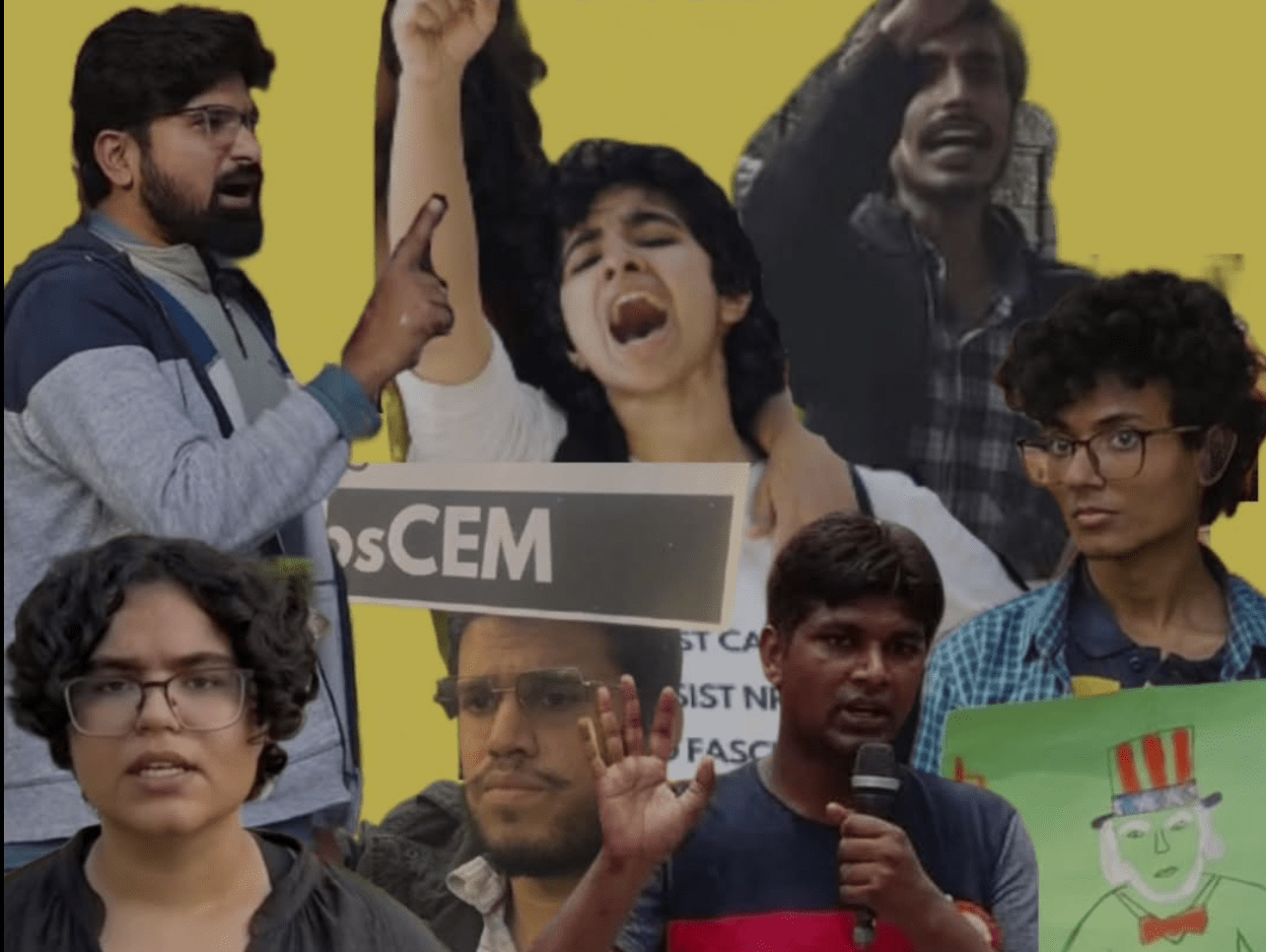
On 12 March, 11 student activists were abducted by Delhi Police’s Special Cell. They were held over two days and in that time they experienced verbal, physical and sexual torture at the hands of the police. The 11 activists came from a variety of backgrounds specifically attacked by the Bharatiya Janta Party (BJP) government, including Muslims, Dalits and labour organisers. Dalits are those deemed ‘untouchable’ within the Hindu caste system hierarchy.
All activists were part of organising an ‘anti-imperialist’ week that had been called by the Forum Against Corporatisation and Militarisation (FACAM). FACAM is a collective of 13 organisations across India, made up of students, workers, and academics. They joined forces in light of the increasing militarisation of policing and looting of mineral rich areas of India. FACAM’s anti-imperialist week included events discussing the Indian revolutionary Bhagat Singh and Vladimir Lenin which many detainees were specifically questioned about.
Most of those abducted on 12 March had previously been abducted by the same cell of the Delhi police, when they faced similar torture. All except one were released within 24 hours but this was due to their legal representation appealing to a judge. On both occasions police made the detainees sign blank pieces of paper which could later be forged into confessions, and one was made to sign a confession at gunpoint. The group of activists unlawfully detained and tortured are building a legal case against the Special Cell.
This happened in the context of wider repression as the pro-Hindutva BJP government of Narenda Modi reached its self-imposed deadline of 31 March to put an end to all left wing ‘extremism’ in the country, more specifically ‘Naxalism’. The Naxalite insurgency is a decades-long armed struggle by communist factions, particularly Maoists operating in central and eastern states (the ‘red corridor’), against the Indian government. ‘Naxalite’ has now become a right-wing term of abuse for anyone who opposes the BJP government.
This crackdown is led by Hindu-nationalist and minister of Home Affairs Amit Shah who said, ‘whoever picks up arms [against the government] will have to face the consequences’ and declared that Naxalism had been abolished. This has provided the pretext for a widespread crackdown on all anti-imperialists and socialists. Operation Kagar, an offensive operation supposedly against Naxalite forces across the west of India, has also been used to displace rural communities from their mineral rich lands.
India is facing a period of turmoil for the workers and activists across India as the government continues to stifle resistance efforts against the state. Over a thousand workers and bystanders have been arrested in the National Capital Region of India since a labour rebellion began in April. Workers are on strike demanding higher wages but were quickly deemed an ‘organised conspiracy’ by the Chief Minister of Uttar Pradesh, Yogi Adityanath.
The hypervigilance of the BJP government has extended into electoral politics. On 4 May the BJP won the West Bengal Legislative Assembly elections for the first time. Before the election up to nine million voters were struck from the electoral roll, that is nearly 12% of the electorate. This disenfranchisement came as a result of the Electoral Commission of India calling on around 80 million people in West Bengal to justify their right to vote. Critics have scrutinised the scheme for its underlying racism and classism but also because it imitates the National Register of Citizens which, if implemented, will leave millions of Muslims in India stateless (see FRFI 274). The incumbent left-wing party, Trinamool Congress (TMC), lost the election in West Bengal. Although voting suppression of voting rights may be the primary reason for the TMC’s defeat, the failure of the party to deliver better living standards for millions in both the countryside and city have also stirred the popularity of the BJP as an alternative.
The Revolutionary Communist Group signed a joint statement of May Day solidarity with the protesting workers across India. It also demands an end to the criminalisation of dissent and democratic protest. This statement was endorsed by Indian solidarity networks from across Britain, including International Solidarity for Academic Freedom in India (InSAF) which sees the illegal detention and torture of student activists as a persistent erosion of academic freedom. Events opposing ‘Operation Kagar’ are also being held in many cities across Britain. Communists and socialists across Britain must protest here as it was British colonialism and imperialism that is responsible for the underdevelopment of India. British rule in India (1858-1947) preyed upon and multiplied the ethnic and religious divisions that the BJP continues to propagate today.
India is at a divisive moment politically. Across the country the Hindu supremacist ideology grows stronger, and state repression tightens. But left-wing activists are prepared to struggle against this. The student activists are building a case against their illegal detention and are asking for international attention to be put on their cases, for people to write to their local MPs to challenge the Indian government on a public stage. There are also actions and workshops across Britain run by InSAF, India Labour Solidarity, and Fight Racism! Fight Imperialism! branches.