

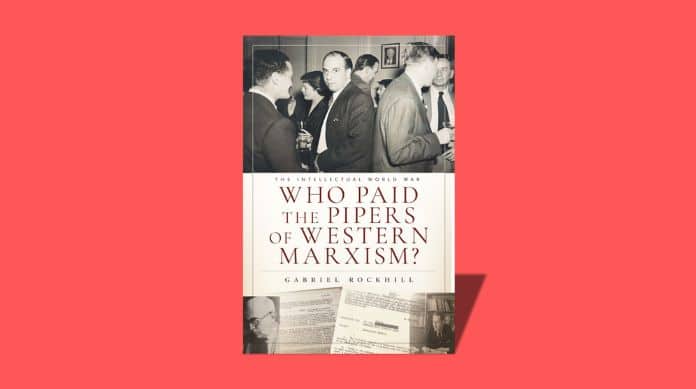
Who Paid the Pipers of Western Marxism? Gabriel Rockhill, Monthly Review Press, 2025, 416pp, paperback £22
The revolutionary pessimism in the imperialist countries over the past thirty years has pushed many young and aspiring Marxists to seek answers as to why the socialist movement is so weak. Who Paid the Pipers of Western Marxism? by Gabriel Rockhill has been latched onto by some as seemingly providing these answers.
Rockhill, a professor of philosophy and co-founder of the Critical Theory Workshop, has grown in prominence in recent years through widely shared online videos of his talks and lectures. Through these he has promoted his ‘Intellectual World War’ project, of which Who Paid the Pipers is the first instalment. The project presents the concept of the ‘compatible left’, a term which he uses to describe ‘left’ tendencies within the academia which Rockhill argues act in the service of imperialism. Rockhill’s book analyses the material basis of this, as well as examining case studies of ‘compatible left’ academics.
This conception of the ‘compatible left’ has become quite attractive to those seeking a simple and easy explanation for the failures of the contemporary left. However, social democratic outlets such as Jacobin (18 April 2026) have reduced Rockhill’s analysis to a crude and simplistic narrative: that the CIA simply paid off these academics and effectively invented various opportunist trends. Detractors of Rockhill’s work have also disingenuously presented this caricature as Rockhill’s actual analysis.
It is important to challenge this misrepresentation as it muddies an analysis that demonstrates how class divisions pervade academia. However, Who Paid the Pipers of Western Marxism? limits analysis of these class divisions to the academic world.
The bookpays homage to Frances Stonor Saunders’ 1999 work Who Paid the Piper? – The CIA and the Cultural Cold War. Saunders examined how the CIA manipulated art and academia to serve US imperialist interests, particularly through the so-called ‘Congress of Cultural Freedom’ (CCF). It is the CCF’s past role in academia that Rockhill is particularly interested with in his book.[1]
The Book
Rockhill also draws from Domenico Losurdo’s Western Marxism: How It Was Born, How It Died, How It Can Be Reborn, a scathing intellectual history (or ‘history of ideas’) approach to the political tendency of so-called ‘Western Marxism’ and its service to imperialism. Rockhill provided a lengthy introduction for the English language edition of Losurdo’s book, released a year before his own; Rockhill’s is clearly intended to be a complementary work.
Rockhill examines the relationship between the CCF and ‘Western Marxism’, as part of what Rockhill terms the ‘imperial theory industry’. He attempts to approach academia through a dialectical, historical materialist lens. He presents academic thinking as a form of commodity production, showing how this influences scholars, with particular focus on members of the 1930s Frankfurt School such as Herbert Marcuse and Theodor Adorno. He frames such distinct scholars as part of a ‘compatible left’, i.e. compatible with the interests of imperialism.
The term ‘Western Marxism’ is a vague term, coined by a former editor of the New Left Review, Perry Anderson, to contrast his preferred Marxist trends to the ‘Stalinism’ of the then various existing socialist states. It is used more derisively by Rockhill and Losurdo, who link it directly to political views arising in a privileged section of academia employed on conditions that Lenin identified in his Imperialism and the Split in Socialism,[2] although they largely limit their application of Lenin’s theory to North American and some Western European academia (German, French and some British).
All the CIA’s fault?
The meat of Rockhill’s book is a close examination of the relationship between the so-called ‘Western Marxists’, the US imperialist state apparatus and various bourgeois ‘private foundations’, all through the secretive CCF.
Saunders’ 1999 work, along with other journalists and scholars, exposed the by then discontinued CCF as a genuine CIA psyop that worked covertly to promote specific left-wing intellectuals – ideological opportunists whose ideas, if promoted, could undermine the international workers’ movement during the ‘Cold War’ period.
To his credit, Rockhill does avoid presenting this operation in a simplistic manner. He does not frame it as the CIA inventing ‘Western Marxism’ or paying people to become ‘Western Marxists’, he is certainly no ‘conspiracy’ theorist; though it is being presented as such by disingenuous readers.
Rockhill argues that ‘intellectual production is not the result of individuals thinking on their own or entering a free market place of ideas’ (p146), but a form of commodity production in the service of those willing and able to fund research. Academic work that better serves bourgeois/imperialist interests is far more likely to receive funding and thus ensure job security. Many of the Frankfurt School fled to the US from fascism but were at ideological odds with the Soviet project. During the Second World War, Frankfurt scholars began working directly for the US government, leading to them ‘opportunistically integrating themselves into the bourgeois order’, and ultimately becoming part of, what Rockhill calls the ‘US military-industrial-academic complex’ (p178), aiding the CIA in its conflict against the Soviet Union.
Rockhill describes these academics, acting in service of imperialism, as forming an ‘intellectual labour aristocracy’; describing them as having made careers by ‘proving their fealty to the establishment’ and having ‘made the greatest contributions to the ideological agenda of those who own the means of intellectual production’ (p146). In the introduction to Losurdo’s book, which he co-authored, he uses the term ‘new petty bourgeoisie’, framing this stratum as being within the imperialist social order and thus explaining why they are disposed towards imperialism’s thinking.
Regardless of the specific categories and terms used, Rockhill is identifying a class divide between the mass of proletarians and these intellectuals; a distinction and division of class interests. He therefore describes the natural development of opportunist thought in this academic world. This is to say that ‘Western Marxist’ intellectuals do not spring from nowhere, nor are they simply ‘created’ by some external force; but born of specific material conditions created by particular social relations. There is perhaps a limitation here, however, with the lack of clear and systematic reference to the imperialist super profits which not only provide the CIA with its substantive funding, but also facilitate the creation of a privileged section among the propertyless masses.
The narrative that ‘the CIA simply paid them off’ is a very reductive misrepresentation of Rockhill’s analysis. It is simply conspiratorial and so a diversion from explaining the material basis of this intellectual trend. However, this misrepresentation is not helped by Rockhill’s provocative title. Nor is it helped by Rockhill’s frequent use, and consequent popularisation, of the CIA’s term ‘compatible left’. The over emphasis of the US government’s role in the development of specific political trends fails to reveal the material basis of opportunism and thus limits our ability properly to challenge it.
Academia vs. Activism
Despite this criticism, Rockhill successfully presents a detailed description of opportunism within academia. Rockhill cannot be held accountable for the misrepresentation of his overall argument.
The book is rather densely written. It is an academic work, made available to a non-academic audience. For an educated working-class reader, it doesn’t serve a clear political purpose. However, for what it is, it is a solid contribution to the intellectual history of petty bourgeois political formulations.
At a time when people are struggling to come to terms with a stagnant workers’ movement, so thoroughly obstructed by opportunism, an in-depth, concrete analysis of the formation of ideas, building upon Lenin’s Split in Socialism, would be most important. Rockhill’s analysis doesn’t fill that void. It focuses on the academic world. It stops short of answering the broader political questions of the effect of imperialism upon the ideas of practical movements fighting against it.
[1] Renamed ‘International Association for Cultural Freedom’ (IACF) in 1967, this was dissolved in 1979.
[2] Available now as a pamphlet from revolutionarycommunist.org/shop