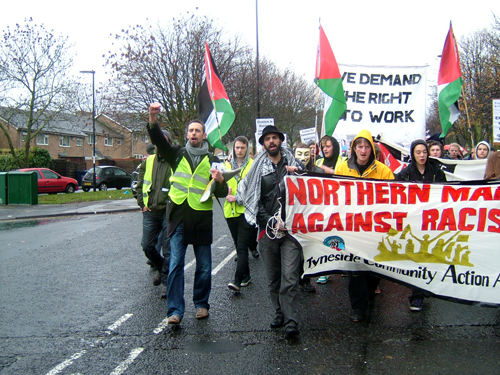
On Saturday 20 November, several hundred people participated in the Northern March Against Racism 2010 in Newcastle. The march was called by Tyneside Community Action Against Racism (TCAR), which members and supporters of the RCG were instrumental in founding in 2005. The march aimed to build links and solidarity between the struggles against Britain’s racist immigration laws, its detention centres and deportations, those fighting the racism of the British police and prisons and the criminalisation of Muslims through terror laws and anti-Muslim racism, and those struggling against street racism and the violence of groups like the English Defence League (EDL). The march was a resounding success, supported by over a dozen organisations and trade union branches from across the North of England and Scotland, and coinciding with demonstrations for asylum rights in Glasgow and Sheffield. Speakers at the rally and the post-march social repeatedly pointed to the international character of the British ruling class’s attacks on the working class and oppressed, and the need for people in Britain to make common cause with those who have been fighting back for years, from the DRC, to Nigeria, to Afghanistan, to Palestine, to migrant workers and refugees within Britain. This sent a clear, determined and principled anti-racist message, which has set the context for the emerging movements against the cuts in the region.
The march had to overcome many obstacles, including obstruction by the police, sectarianism from the left in the form of UAF/SWP, and opposition by organised racists. Northumbria Police initially demanded that TCAR pay thousands of pounds, including money to the council for a permit to close roads, which would then entitle TCAR to hire a private company to manage the road closure! After TCAR made it clear they would not back down, supported by a letter from the human rights organisation Liberty protesting against this grotesque attack on the right to protest, the police backed down and managed the traffic while the march went ahead.
Attempts to undermine the march were also made by sections of the British left. On 26 October Yunus Bakhsh, a leading member of UAF and the SWP’s full time regional organiser, was caught on a shop’s CCTV removing posters for the Northern March Against Racism and replacing them with posters for a UAF march in London on a different Saturday. He was seen doing the same in other shops on this and other occasions. The organisers of the Northern March responded to these acts of sectarianism with an open letter to UAF, but by the time of the march there had been no response from UAF, either locally or nationally. UAF ignored invitations to contribute to the march, and neither UAF nor SWP had any visible presence on the day.
The march also had to contend with opposition from racist and fascist groups. The National Front, who had mobilised against the two previous marches organised by TCAR, could only muster half a dozen people on this occasion, who stood behind a banner down the street from the rally but made no attempt to approach. The EDL mobilised from across the region, but only managed to assemble less than 30 people, who marched from another part of the West End to the Monument, and hurried past the Northern March rally as it was finishing. The rally easily drowned out their abuse with a defiant and principled opposition, chanting ‘Whose Streets? Our Streets!’ and speakers used the megaphone to expose the EDL for what they are – the boot-boys of British imperialism.
TCAR will continue its work to build alliances against all forms of racism, including the main defender of racism in Britain – the British state. To get involved contact: [email protected] or 07989 879310
This website uses cookies. By clicking ‘accept’ you accept our use of cookies.
Functional
Always active
The technical storage or access is strictly necessary for the legitimate purpose of enabling the use of a specific service explicitly requested by the subscriber or user, or for the sole purpose of carrying out the transmission of a communication over an electronic communications network.
Preferences
The technical storage or access is necessary for the legitimate purpose of storing preferences that are not requested by the subscriber or user.
Statistics
The technical storage or access that is used exclusively for statistical purposes.The technical storage or access that is used exclusively for anonymous statistical purposes. Without a subpoena, voluntary compliance on the part of your Internet Service Provider, or additional records from a third party, information stored or retrieved for this purpose alone cannot usually be used to identify you.
Marketing
The technical storage or access is required to create user profiles to send advertising, or to track the user on a website or across several websites for similar marketing purposes.