

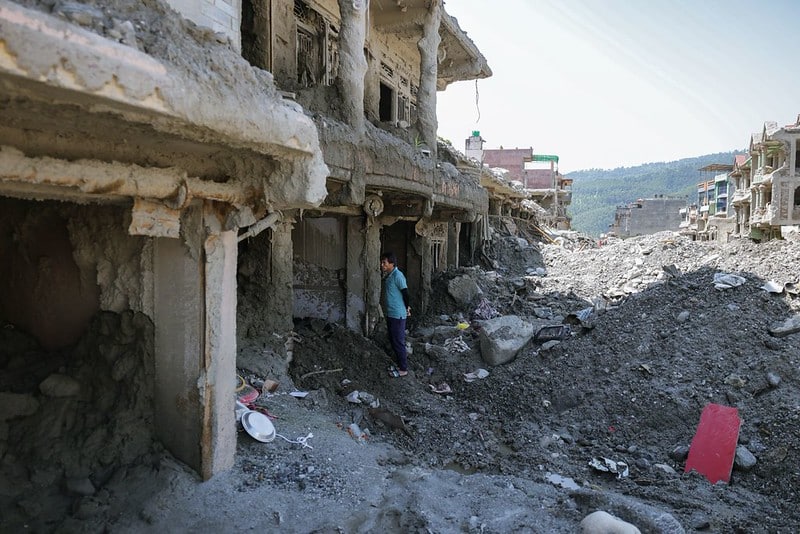
On 26 August, a glacier on Nepal’s Mount Langtang Lirung fractured at an altitude of 5,200 metres. This triggered an ice-rock avalanche that turned into a massive debris flow and swept along the Trishuli river through valleys along the border with Tibet. The resultant floods and landslides have killed more than 1,400 people; 6,170 are known to be missing. The Nepal glacier disaster shows how the ice melt that global warming causes threatens mountainous communities across the world and hundreds of millions living downstream.
The summer had brought exceptional warming to the glacier. Satellite images revealed significant snowmelt in the days leading up to the disaster. At the 5,200 metre elevation, average temperatures on the mountain between 21 and 26 August reached 4°C, the highest over 55 years of recorded measurements. According to AFP’s analysis of data from Europe’s Copernicus observatory dating back to 1970, this past summer was the Langtang region’s fourth-hottest on record. Robert Rohde, chief scientist at the independent Berkeley Earth organisation in California, who has studied temperatures in the region, was clear that ‘without the additional heat brought by climate change, a comparable temperature pattern would probably occur only once in a few thousand years’.
Yet for the region’s communities, such devastation will become routine as global temperatures rise. In 2023, the UN reported that Nepal had lost nearly a third of its ice over the preceding 30 years of climate warming. There are 40,000 glaciers in the Himalayan region, only 21 are being monitored. In India alone, 200 glacial lakes are assessed as being at high risk of bursting their banks, a quarter of them at very high risk. Glaciers across the region have been melting 65% faster between 2010 and 2019 than over the previous decade. These glaciers are the source of some of Asia’s most important rivers and provide water to almost 2 billion people. Glacier melt will not only trigger disasters such as that on 26 August, but as the glaciers disappear, so will key river systems dry out. Food shortages will threaten billions. In the Indus basin alone, up to 60% of pre-monsoon irrigation depends on snow and glacier melt, water on which 129 million farmers across the Indus and Ganges basins rely.
Nepal’s foreign minister, Shishir Khanal, has appealed to the UN’s Fund for Responding to Loss and Damage for $20m relief. This was set up by COP27 in 2022, and represents a fraction of the estimated $5bn that is required. More than 10,000 homes and Nepal’s national highway have been destroyed, and countless families have been left homeless. Since the establishment of the Fund, the UN has received 176 requests totalling $2.8bn for climate loss and damage support arising from global warming. To date, the international community has provided just $400m and only China has offered significant support. Nepal itself has contributed less than 0.1% of total global greenhouse gas emissions. This disaster was not natural, it is climate injustice occurring in real time, and capitalism is accelerating it.