

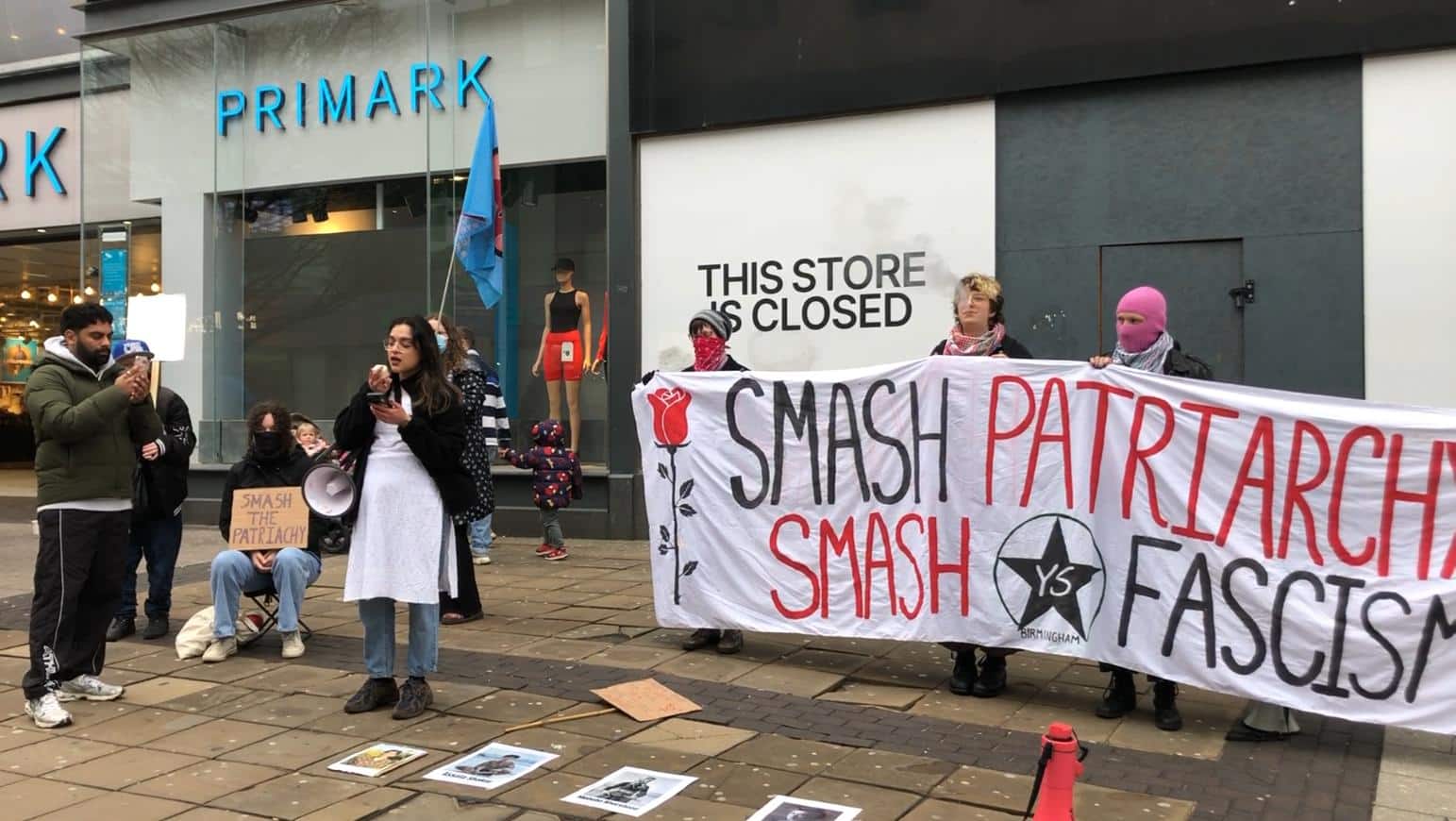
Below we publish a speech delivered by a supporter of the Birmingham branch of the RCG to an event celebrating International Working Women’s Day on Sunday 8 March 2026:
Thank you to Young Struggle for organising this rally. I want to extend solidarity to their member who was assaulted by Greater Manchester Police at a demo supporting trans youth. Her call to resist is ours.
I’m a supporter of the Revolutionary Communist Group, and I want to begin by telling you about the Mountain Woman.
A bundle of dried wood on her head,
she comes down the hill
Mountain woman
will go straight to the bazaar
and selling all her wood,
will quench the fire
of the entire family’s hunger.
Hanging on her back,
a child wrapped in a sheet
Mountain woman, planting paddy
planting her mountain of grief
for a blossoming crop of happiness
Breaking apart the stones of the mountain, she’s breaking
mountainous rituals and taboos.
Weaving mats on the mountains
passing her mountainously long day
This is the first half of a poem by Nirmala Putul, an Adivasi poet and activist from Jharkhand, India. I love this poem because it insists on the dignity and power in women’s daily struggle, and emphasises how their labour sustains family, community, and culture.
From the forests of India to the olive groves of Palestine, from the factories of Bangladesh to the mines of Congo, working women rise. Not as symbols, but as the first to bear imperialist war, feudal tradition, poverty, and trafficking. They carry children on their backs and the world’s hunger in their hands.
The working women inside imperialist countries are not spared either.
Under capitalism, many of us are forced to play a dual role as unpaid domestic labourers at home and as exploited workers in the workforce. As healthcare and state welfare are slashed, we are pushed further into carer roles. At the same time, the cost of living has become unaffordable, with soaring rents and childcare costs consuming entire wages. And, as always, it is racialised women who bear the brunt.
This economic exploitation cannot be separated from the social repression we endure. Our marginalisation is reinforced through attacks on our reproductive rights and escalating violence and sexual abuse. These are not random hate crimes but acts of terror designed to instil fear, silence and submission. When Keir Starmer invokes Enoch Powell’s ‘Rivers of Blood’, describing migrants as making Britain an ‘island of strangers’, the Labour Party’s position becomes unmistakably clear. The thugs on the streets are not acting outside the system – they are carrying the state’s logic to its conclusion. Women are targeted because the state not only tolerates violence against us, it promotes it.
Misogyny is entrenched at every level, with police perpetrating sexual violence against women and girls. Some of us have lived this firsthand. At the same time, our criminal justice system dismisses women who report rape with routine indifference. This institutionalised sexism finds its most brutal expression in the treatment of working-class women prisoners, especially political prisoners. For example, Qesser Zuhra, a Palestine Action activist who was on day 46 of her hunger strike at HMP Bronzefield, was taken to hospital only after a mass demonstration outside the prison. Or our comrade Sarah, of the SOAS 2, who was arrested in a dawn raid and charged under the Terrorism Act for defending the right to resist for Palestinians. This is imperialism at home.
When the same state that arms Israel with components manufactured in over 140 sites across this country tells women there is no money for crisis centres, for midwifery, for child support, this is imperialism at home.
When a Bangladeshi garment worker burns to death making clothes for Primark, and a working-class woman in Birmingham cannot afford those clothes without choosing between heating and eating, this is imperialism at home.
When the same Home Office, which hosts ‘International Women’s Day’ events, confines women seeking asylum in detention centres where they are strip-searched, locked in small cells for days, denied privacy, and treated as criminals for fleeing violence created by the ruling classes, this is imperialism at home.
When the British state freezes over two billion dollars of Venezuela’s gold in the vaults of the Bank of England and strangles its economy through sanctions, this is not foreign policy – it is class war across borders. And when British banks enforce the genocidal blockade against Cuba, blocking trade with a people who dared to build a society that prioritises life over profit, they expose the true nature of their so-called ‘rules-based order’. The same mechanisms used to punish Cuba and Venezuela are also turned against working-class people here. When our benefits are slashed, when our wages are driven down, when our communities are strangled by austerity, we face the same system, the same ruling class, and the same weapons. This is imperialism at home.
So where do we go from here?
First, we must expose the lie at the heart of imperialist feminism. We are told that invading, occupying, and slaughtering is done to advance women’s rights. Just last week, US-Zionist forces killed 165 schoolgirls in Iran in an effort to do exactly that. Imperialist feminism has spent decades selling the myth of a universal sisterhood that supposedly transcends class and empire, while masking the violence that sustains it. When Judith Butler, winner of the ‘Fanon Lifetime Achievement Award’ (make it make sense!), condemns Palestinian armed resistance while calling for peaceful cohabitation between a colonised people and their colonisers, she closes her eyes to material reality. There is no sisterhood with the oppressor. Solidarity that does not take sides with the colonised, the occupied, and the working class is no solidarity at all.
Second, we must recentre state racism and imperialism as the root of violence against women. You cannot address racism, sexism, homophobia, or transphobia without addressing the imperialist system that weaponises identity politics to claim it’s bringing liberation under bombs. Here in Britain, liberal, opportunist anti-racism disarms us by separating racism from imperialism, stripping it of its class content in the process. Our task is not to recycle moral appeals, but to build power with principled forces.
Third, we must learn from the countless brave women engaged in anti-imperialist resistance. When revolutionary Palestinian fighter Leila Khaled declared, ‘We are ready to pay blood and flesh to liberate this land’, she was not advocating abstract violence. She was pointing to the material reality that liberation requires confronting the systems that profit from oppression, not demanding inclusion within them. Here in Britain, we too cannot ask the state for protection. We must build power through a revolutionary working-class movement, because the liberation of women is inseparable from the struggle of our class against the ruling class.
Lastly, we must build solidarity with progressive forces in the Global South. The RCG stands with Cuba, where women have been central to revolutionary transformation, leading in politics, education, and mass organisation. The RCG stands with Venezuela, where women are active in communal structures and revolutionary reforms that expand their roles in society. These countries teach us that liberation cannot be achieved through the frameworks of the oppressor class.
I will now close by returning to the Mountain Woman…
She makes brooms
weapons to fight filth
Piercing the knot of her hair with a flower
She is piercing someone’s heart
She runs after the cows and goats, her feet
inscribe in the earth
hundreds of her innocent maiden songs
What I love about the second half of the poem is how the Mountain Woman refuses to wait for permission or protection. She makes her broom a weapon against anyone or anything that seeks to oppress or marginalise. She runs uninhibited, and so must we. We must use our labour and our voices for the advancement of women’s rights, because liberation will not be given to us. The women of the Global South are not waiting to be saved. They are on the frontlines, organising in villages, challenging patriarchal traditions, taking part in armed struggle, and fighting for a world without class and empire. Our duty here, in the belly of the beast, is to match their militancy, to organise our class with the same courage and determination, and to ensure that their struggle is our guide, our inspiration, and our call to action.
– Charan Kaur