

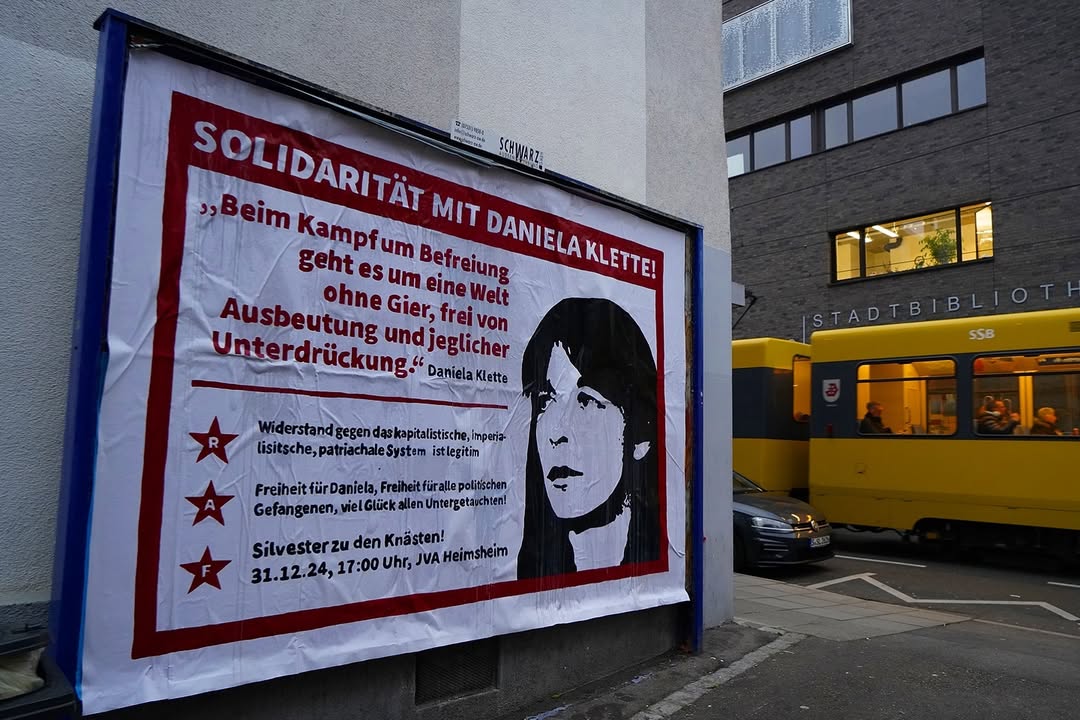
In February 2024, Daniela Klette, a member of the German urban guerilla warfare group the Red Army Faction (RAF), was arrested in Berlin after decades of evading capture. In May 2026, now aged 68, she was sentenced to 13 years imprisonment for a series of bank robberies during the period she was on the run. She has not as yet been prosecuted for any alleged activities during the 1970s and 1980s, and can no longer be tried for membership of the RAF, due to the statute of limitations deadlines under German law. Wearing a keffiyeh in court to make clear her support for the Palestinian struggle, Klette vowed to stay true to the fight against capitalism and imperialism, while supporters chanted ‘Freedom for Daniela’.
The RAF formed during the 1960s and 1970s, in what was then West Germany, during the Cold War between western imperialist states and the Soviet Union. Despite claiming to have carried out ‘de-Nazification’ after the end of the Second World War, US imperialism actively re-employed many known Nazis within the structures of the West German state and had shaped West Berlin into a front line of anti-communism.
Widely referred to as the Baader-Meinhof group after its founders Andreas Baader and Ulrike Meinhof, the RAF emerged from the radical student and anti-Vietnam War movement of the 1960s. Citing the words of Che Guevara regarding the need to create ‘two, three, many Vietnams’, it chose a strategy of direct armed struggle over other forms of protest.
For over 25 years the RAF carried out bombings, bank robberies and assassinations. Its primary stated aim was to provoke a wave of social repression from the West German state, in order to reveal its true fascist nature and thereby rupture the false consciousness of the West German working class and create conditions for revolution.
‘Against imperialism, Zionism and reaction’
In February 1970, the Popular Front for the Liberation of Palestine (PFLP) offered to train any revolutionary progressive forces who wanted to build a ‘world front against imperialism, Zionism and reaction’. That summer RAF members went to Jordan for training and committed themselves to the Palestinian cause, describing Israel as a ‘bellicose outpost and satellite state of American and European imperialism and colonialism’.
In June 1972, the RAF leadership (Baader and Meinhof, alongside Gudrun Ennslin and Jan-Carl Raspe) were arrested and interned in the notorious Stammheim prison. This is the same high security prison where now in 2026 the Ulm 5 pro-Palestine prisoners (see p5) are currently on trial in a high security court within the prison walls. With its founding members imprisoned, a new ‘second generation’ of RAF members became active. Although still committed to international revolution, their prime objective became the liberation of their imprisoned comrades.
In June 1976, members of the German ‘Revolutionary Cells’ and PFLP hijacked an Air France Airbus from Tel Aviv to Paris. The plane was flown to Uganda where the hijackers demanded $5m and the release of 53 political prisoners, most of whom were Palestinian, but also including the four RAF leaders. The West German government refused this demand and Israeli troops stormed the plane, killing the hijackers.
In September 1977, RAF members demanding the release of their imprisoned comrades kidnapped and killed German industrialist Hans Martin Schleyer, a second lieutenant in the Nazi SS, who had become a powerful industrialist and president of the Confederation of German Employers and Federation of German Industries.
In October four PFLP members hijacked a Lufthansa plane from Mallorca to Frankfurt, diverting it to Mogadishu, Somalia, demanding $15m and the release of 11 RAF prisoners from Stammheim. The following day Baader, Ennslin and Raspe were found dead in their cells, two of them with gunshot wounds. The authorities claimed that this was the result of a suicide pact but offered no explanation as to how guns were smuggled into a maximum-security prison. The RAF insisted that the three comrades, along with Meinhof who had supposedly hanged herself the previous year, were murdered by state agents to prevent further attempts to liberate them by such high-profile actions.
Over the following decades, the German state sought to completely eradicate the RAF and killed or imprisoned most of its members. Daniela Klette, who was part of the ‘third generation’ of the RAF, went underground in the 1990s, although she remained in Berlin, living openly under a false name. She was only recaptured due to the police receiving a tip-off, following investigations by German podcaster Khesrau Behroz and Michael Colbourne, a journalist for the shady Bellingcat media outlet, which claims to be independent but has been exposed as receiving funding from the US National Endowment for Democracy and other dubious sources.
Guerilla tactics
During the 1960s and 1970s a number of groups formed in western Europe to fight urban guerrilla warfare, in the belief that the capitalist class could be provoked into lashing out against the wider working class, which in turn would foment uprising. Except in the north of Ireland and Basque Country where the IRA and Herri Batasuna fought for national liberation while firmly embedded within the working class, these groups were composed almost entirely of radicalised students.
The RAF strongly believed that the central core of the revolutionary movement was not in Europe or North America – with a relatively economically privileged and there-fore largely compliant and obedient working class – but in Africa, Latin America and Asia, where imperialism revealed its true barbaric nature undisguised by so-called social democracy. It nonetheless believed that the tactics of, for example, Latin American guerrilla groups could be replicated in Europe to provoke class conflict and revolution. This adventurist thesis proved untrue and unworkable, as the reality is that small underground armed groups are incapable of provoking revolution without a substantial connection to the broader working class.
Nevertheless, Daniela Klette remains an inspirational figure who, despite having been sentenced to prison at approaching 70 years of age, still shows great defiance and determination to fight back. We encourage readers to show solidarity with Daniela by writing to her at: Daniela Klette c/o JVA Vechta, An der Propstei 10, D-49377 Vechta, Germany.