

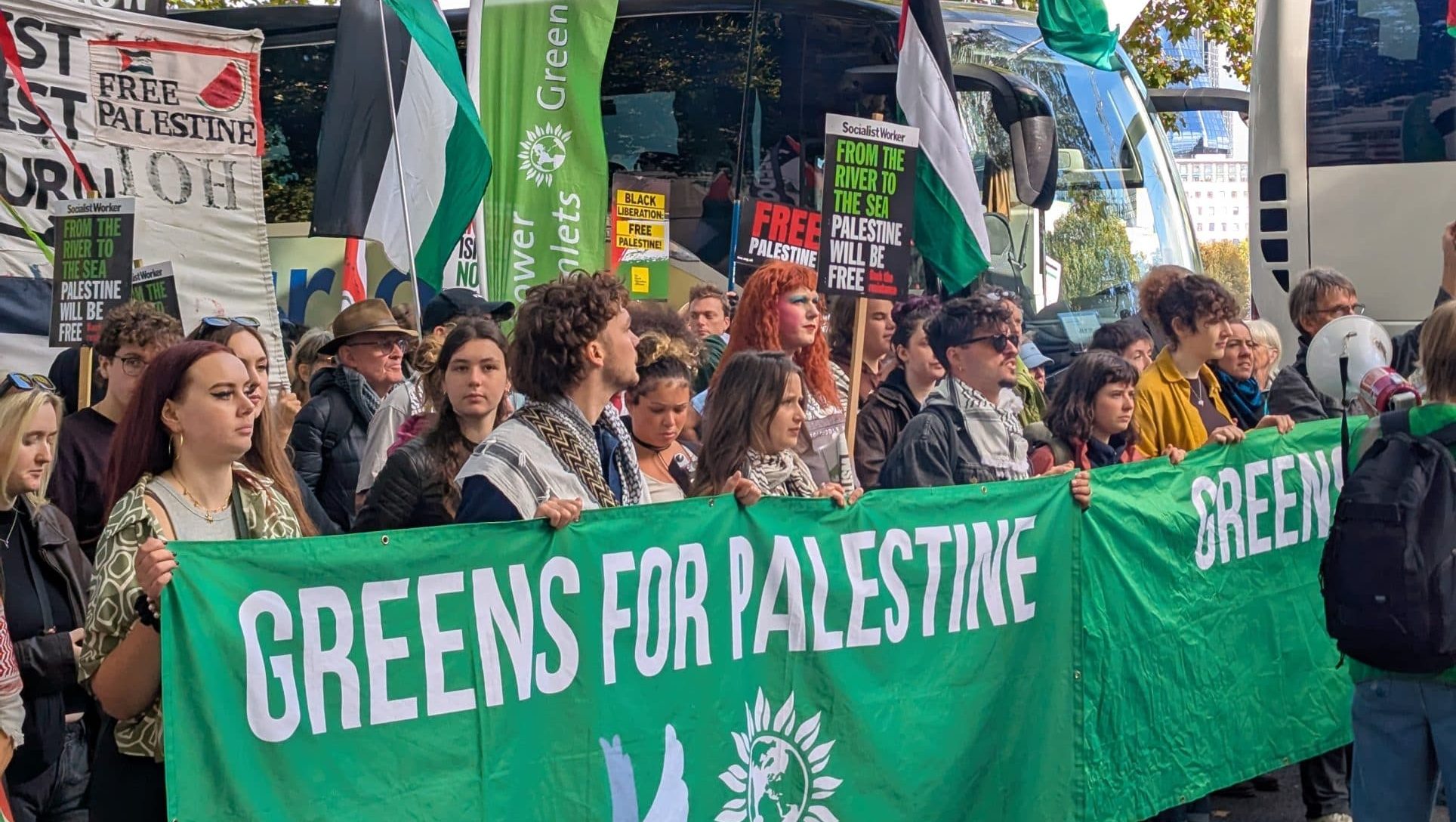
At its conference in Brighton on 4 October, the Green Party of England and Wales adopted a motion which declares that ‘Zionism is Racism’. This is the first time that a major political party in Britain has declared itself to be anti-Zionist. The ruling class reacted with cold fury at this delegitimisation of the state of Israel which is key to its imperialist interests in West Asia. WILL JONES reports.
Democracy in motion
The motion ‘Zionism is racism’ was moved by Lubna Speitan, a British-Palestinian activist and founder of Greens 4 Palestine, an interest group within the Green Party. It had been filibustered at the Greens’ April 2026 Conference, with the party leadership evidently anxious to keep a lid on it. On 4 October the motion passed by 1,022 votes against 813, at a conference attended by over 3,000 members.
The motion resolved that the Green Party:
- Declares Zionism to be racism
- Rejects attempts to conflate anti-Zionism with anti-Semitism
- ‘Supports the establishment of a single democratic Palestinian State in all of historic Palestine with Jerusalem as its capital, equal rights for all, and the right of return for Palestinians and their descendants’
- Affirms the right of the Palestinians to self-determination including the right to resistance and liberation from Israeli occupation by all available means under international law
- Heeds the call for boycotts and divestment from Israel similar to those applied to apartheid South Africa and calls on the British government to impose full embargoes and sanctions against Israel
- Calls for the release of all Palestinian prisoners of conscience, end of administrative detention and treatment of Palestinian prisoners of war in accordance with international law
- Calls for the deproscription of Palestine Action
- Calls for the release of all prisoners detained for non-violent direct action in support of Palestinian rights
The motion additionally states that ‘Zionism… will be treated as any other form of racism, and this motion will be implemented by the Anti-Racism Policy Working Group as appropriate and in accordance with its ordinary practice.’
Ruling class in a rage
The reaction of politicians, the media and other ruling class institutions in Britain and even internationally has shown the scale of their fear at what this motion represents:
- In response to attendees at the Brighton conference celebrating the motion by chanting ‘Say it loud, say it clear, Zionists are not welcome here’, a group of 18 Labour MPs wrote to Sussex Police demanding an investigation into whether the Public Order Act had been breached. They additionally demanded that the Equality and Human Rights Commission investigate whether the Green Party had breached the Equality Act 2010.
- Labour Prime Minister Andy Burnham told Sky News that passing the motion was a ‘completely wrong decision, terrible judgement’ and challenged the Green Party leadership to pledge that the motion would be reversed. Several Labour ministers ruled out any future coalition with the Greens.
- In a statement widely quoted in the British media, Chief Rabbi Ephraim Mirvis said the motion was a ‘threat to British Jews and to Britain’, calling the idea that Zionism is racist a ‘discredited and dangerous slander’ first promoted by the Soviet Union. Mirvis, a South African-born Zionist, is presented as a voice against prejudice despite the fact that every Zionist organisation in South Africa supported the racist apartheid system.
- Israeli Foreign Minister Gideon Sa’ar declared that Green Party leader Zack Polanski was banned from entering Israel.
The Green Party itself was riven by the result. Terrified at the damage it could do to a future electoral pact with Labour, four of the five Green MPs opposed the motion, with the only abstention being Hannah Spencer, the MP for Gorton and Denton. The chair of the Amnesty International UK charity and former Green candidate for Bristol Mayor, Sandy Ruthven, resigned from the Green Party, citing a ‘failure to confront prejudice’. Former Green Party co-leaders Adrian Ramsey and Carla Denyer immediately condemned it, with Ramsey saying the result was ‘deeply upsetting’ and Denyer blaming it on ‘entryism’.
Several Green-controlled borough councils distanced themselves from the motion; Tony Dyer, Green leader of Bristol City Council, said he felt ‘compelled to speak up on a personal level and on behalf of the council to express my opposition to the motion… the council supports the right of both the Palestinian and Israeli people to self-determination and strongly advocates for a two-state solution and the peaceful coexistence of Palestinians and Israelis’. James McAsh, Green Party leader of Southwark Council, said on 7 October: ‘Please know that neither I nor any member of the council’s Executive supported the national Green Party conference motion seeking to describe Zionism as racism.’ The council issued a ‘joint statement against anti-Semitism’ which McAsh described as ‘setting out our position’ though it makes no mention of the motion.
The European Green Party (EGP) turned on the Green Party of England and Wales: ‘The EGP has always supported a two-state solution…we unequivocally distance ourselves from [the Zionism is Racism motion]’. Meanwhile, numerous Green Party local branches and Green-led Haringey council in north London published statements supporting the motion.
On 7 October the Green Party of England and Wales launched an investigation into Lubna Speitan, after the Telegraph reported that she had been named in court documents as a close friend of Minh Quang Pham, who was jailed for 40 years in the US after pleading guilty to supporting al-Qaeda.
A racist ideology
The frenzied reaction of the ruling class is precisely because the Green Party motion reflects growing political consciousness of the nature of Zionism. It correctly defines Zionism as ‘a political ideology which called [sic] for the creation – and, now it exists, the continuity – of an ethnonationalist Jewish State in historic Palestine to the exclusion and/or domination of the non-Jewish population’. From the early 20th century the imperialist states, led first by Britain and then by the US, generously sponsored the Zionist project in order to secure their interests in West Asia. The Revolutionary Communist Group has always argued that Zionism is a racist ideology.
In 1975 the United Nations General Assembly adopted resolution 3379 which ‘determines that Zionism is a form of racism and racial discrimination’, recognising the ‘unholy alliance’ between Zionism and the Apartheid state in South Africa. The resolution was backed by the Soviet Union, non-aligned countries and former colonies. In 1991 when the Soviet-led socialist bloc collapsed, the imperialists moved successfully to have this resolution overturned. A few weeks later, Britain’s foreign secretary Douglas Hurd boasted, ‘We had no hesitation in co-sponsoring the repealing resolution and in mounting a world wide lobbying exercise’ (Declassified UK, 7 October 2026).
Green Party: the weakest link
Since October 2023 and the mass killing of over 100,000 Palestinians in Gaza by the IDF, popular anger at British support for Zionism has been searching for political expression despite constant suppression by the media and mainstream political parties. It led to an exodus of members from the left of the Labour Party, who defected via the failed experiment of Your Party to the liberal bourgeois Greens, which in 2024 already adopted a motion declaring Israel to be an apartheid state committing genocide.
Since late 2025 the Green Party has grown from 60,000 to 200,000 members, absorbing an influx of politically homeless Palestine supporters and young progressives. Zack Polanski’s populist leadership has sought to ride this tiger into Parliament, but the Greens’ adoption of a pro-Palestine facade is proving to be a potentially disastrous gamble, with the Greens 4 Palestine group clearly regarded as a rogue element. The party’s constitution institutes a member-led democracy, forcing the leadership to adopt policies passed by the conference where members do not act as delegates for the wider membership, but vote according to their own preference. This made it a weak link in the chain of Britain’s bourgeois parliamentary system.
Anxious not to split the party, Polanski called the Zionism is Racism motion ‘a mistake’ and an ‘unhelpful distraction’. He had called for it to be amended, including to remove the call for a unitary Palestinian state. On 17 September he even called on the party’s executive committee to vote to postpone the conference until after the 8 October Holborn and St Pancras byelection election in which he was running for Keir Starmer’s former seat, but was outvoted. Under pressure from the groundswell of support for the motion and for Palestine, Polanski opportunistically declared himself an anti-Zionist a few days later. But, once again, he avoided attending the Conference to vote.
In the byelection Polanski was defeated by the Labour candidate Sagal Abdi-Wali. On a turnout of just 38.8% of the electorate, the Green Party’s campaign for Polanski tripled the party’s share of the vote but still lost with 8,928 votes against Abdi-Wali’s 12,292.
Polanski has faced constant criticism from reactionary voices inside and outside his party for failing to use his influence to oppose the motion. The morning after the byelection he told the BBC that he would have voted against it. On 11 October The Guardian published an article by Polanski in which he made obvious his dismay that the motion had passed. He called it ‘a difficult moment for our party’ and warned that ‘our party has grown to a size none of us could have anticipated when I became leader. Our party democracy must now evolve to meet that – creating wider engagement for members, giving leaders more responsibility to set the party’s strategic direction’. This is a signal that Polanski is prepared to bow to the pressure of the ruling class which is furious that the Green Party’s structure allowed it to become a vehicle for anti-Zionist sentiment.
Seize the moment
The RCG warmly welcomes the passing of this motion and the crisis that it has created within the Green Party. The ruling class is working hard to push the genie back into the bottle. Now is the time to push back. While some backers of the Zionism is Racism motion in the party have sought to reassure the ruling class that it will have no practical consequences, Palestine supporters inside and outside the party see a new opportunity to seize political ground. We are prepared to support them to do this: Green-controlled local councils must be confronted with demands to repeal the pro-Zionist IHRA definition of anti-Semitism, and to boycott and divest from Israel.
Above all, the crisis of the Green Party is a continuation of the political crisis for British imperialism which started on 7 October 2023. No electoral party can solve this crisis in favour of oppressed and working class people. It must spur those who support Palestinian liberation to build a vanguard organisation capable of leading the masses to challenge state power and destroy British imperialism.