

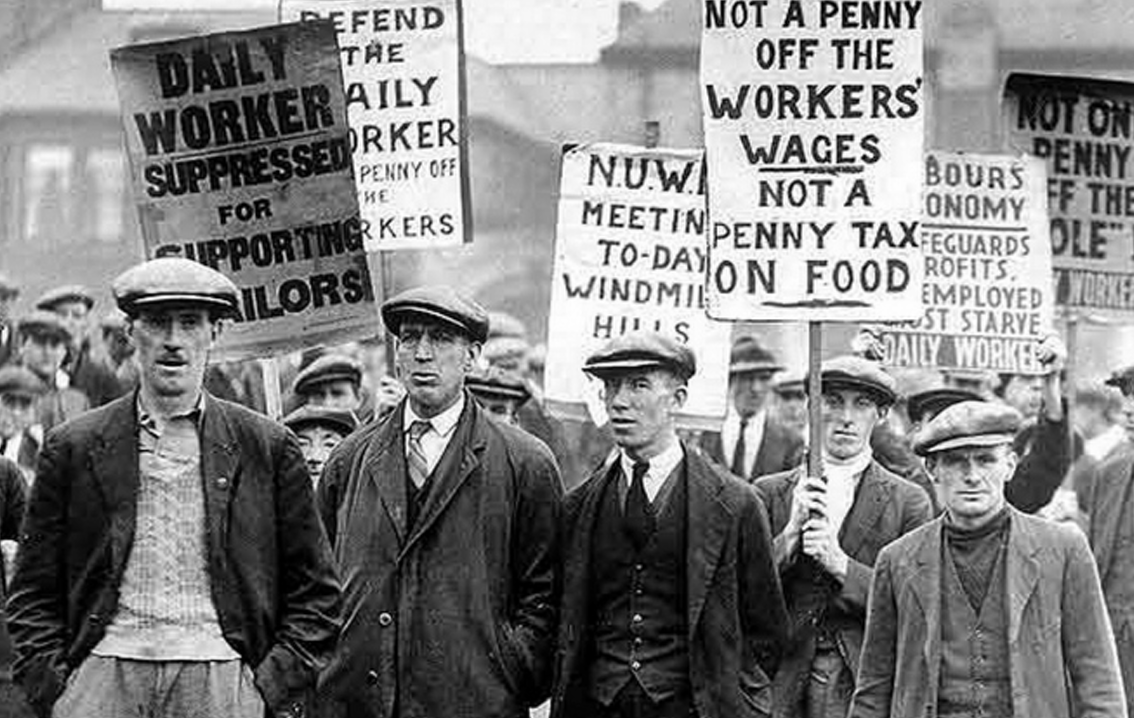
The failure of the British trade union movement to mobilise in any significant numbers in the recent period in defence of Palestine, Cuba, Venezuela, Lebanon and Iran has been stark – despite the insistence of union leaders and their acolytes on the British left on their centrality to the struggle. One hundred years after the defeat of the General Strike, these organisations represent today only the most privileged sections of the working class, failing even to defend their own members against the predations of the capitalist state. In a major article, ‘Communists and the trade union movement’, first published in FRFI 141, February/March 1998 we traced the increasing stranglehold of the labour aristocracy, a bastion of reaction that depends upon the plunder of imperialism for its existence, over the working class movement.
We republish here an edited excerpt examining the period leading up to the General Strike of 1926 and the role these elements played in crushing the emergence of any class conscious, militant trend within the trade union movement. The newly-established Communist Party of Great Britain (CPGB) attempted to work within the movement, in line with the Communist International view that: ‘To refuse to work in reactionary trade unions means leaving the insufficiently developed or backward masses of the workers under the influence of reactionary leaders, the agents of the bourgeoisie, the labour aristocrats… Millions of workers in England, France and Germany are for the first time passing from complete lack of organisation to the elementary, lowest, most simple and …most easily accessible form of organisation, namely the trade unions.’ This was where in this period the struggle against the labour aristocracy for the leadership of the working class would be played out.
By 1920, the post-war boom had turned into slump, with rising unemployment and falling wages. The sharpest crisis was in the coal industry, precipitating a conflict between the government and mine owners as well as with the miners. In February 1921 the government announced it would terminate war-time controls over the industry at the end of March. At the same time, mine owners demanded heavy wage cuts. The Miners’ Federation of Great Britain (MFGB) appealed for support from its partners in the Triple Alliance, the railway and transport workers. The government authorised a state of emergency under the Emergency Powers Act. A strike was called for Tuesday 12 April; on Thursday, the MFGB leader Frank Hodges made an unauthorised offer to MPs for a temporary settlement. National Union of Railwaymen leader JH Thomas seized on this as an excuse to abandon the miners, and on Black Friday, 15 April, the remaining leaders of the Triple Alliance followed suit. The miners were left to struggle alone for three months before being forced back to work.
Labour MP TE Naylor, secretary of the London Society of Compositors, told the House of Commons: ‘we want the government to realise… what would have happened supposing that there had been no trade unions to stand between the working class of this country and the revolution which would have undoubtedly broken out.’ At the end of 1921, the CPGB led the formation of the National Unemployed Workers Committee Movement. At the same time, it formed a British Bureau of the Red International of Labour Unions affiliated to the Communist International, which aimed ‘not to organise independent revolutionary trade unions, or to split revolutionary elements away from existing organisations of the Trades Union Congress (TUC)… but to convert the revolutionary minority within each industry into a revolutionary majority’. The Bureau’s September 1922 conference attracted over 300 delegates representing 176,000 workers. This was the germ of the Minority Movement. By 1923, the CPGB newspaper Workers’ Weekly was selling 50,000 copies even though party membership was only about 5,000. However the defeat of 1921 had allowed the labour aristocracy partially to consolidate its position in relation to the mass of the working class. Trade union amalgamation had been one step; the creation of the TUC General Council another. Meanwhile, the tentacles of the Labour Party spread throughout the movement, with a growth in affiliations from trades councils.
The labour aristocracy was transforming itself into a centralised force controlling a myriad of organisations which embraced a substantial proportion of the working class. But it could not as yet defeat its opponents. Oppositional movements grew, in particular the Minority Movement, officially launched in August 1924. 270 delegates representing a claimed 200,000 workers called for ‘the emancipation of the workers from oppressors and exploiters, and the establishment of a Socialist Commonwealth’. Yet at the same time it conceded that ‘While aiming ultimately at the complete overthrow of capitalism, the attention of the movement must necessarily be concentrated on the immediate struggles of the workers against their exploiters’. Put more simply: ‘Bread and butter problems first, high politics later, is the method to adopt.’
Yet this organisational approach ignored the need for the struggle against opportunism. At the 1924 conference, CPGB president William Gallacher argued that ‘The Communist Party does not attack the Labour Party. The Communist Party strives all the time to make the Labour Party a useful organ of the workers in the struggle against capitalism, but we do attack the leadership of the Labour Party and will go on attacking it until the Labour Movement has forced it either to prosecute a working class policy or to make way for a leadership that will do so.’
The Communist Party had lost sight of the split in the working class, of the existence of the labour aristocracy and its connection to imperialism. The centralisation of the trade union apparatus through the formation of the TUC General Council marked a tightening of Labour’s stranglehold over the trade unions and thereby the whole working class. To call for a further strengthening of this centralised power, as the Minority Movement did at its founding conference, reflected the overriding political failure of the CPGB to adopt a consistent anti-imperialist stance, and to connect that to the struggle against opportunism – the historic failure of British socialism.
The Minority Movement and Red Friday
The end of 1924 brought in the Tories, determined to restore British imperialism’s position in the world economy. The key to defeating the working class lay in smashing the miners, who made up one sixth of the male work force and nearly one in five trade unionists. On 30 June, the coal owners gave a month’s notice terminating all existing agreements, with drastic wage reductions, abolition of a minimum wage and reversion from national to local agreements. The Minority Movement prevented the trade union leadership from backing down at this point. On 30 July, the TUC called for an embargo on the movement of all coal, a move which would have precipitated a general strike. Unprepared for this resistance, the government backed down the following day – Red Friday – offering a nine-month subsidy to buy time and appointed a commission of inquiry under Sir Herbert Samuel.
It was clear, however, that once the subsidy expired, there would be either a capitulation by the TUC, or a general strike. As it turned out, it was both. Whilst the government made preparations, establishing the Organisation for the Maintenance of Supplies (OMS) and preparing for the movement of troops and warships, the TUC did absolutely nothing. At its second conference in August 1925, the Minority Movement found impressive support from over 400 organisations representing up to 800,000 workers. But the political level had not advanced: conference repeated the call for more powers to be given to the TUC General Council, although it did agree to set up local Councils of Action to co-ordinate future action.
The lack of any strike preparation by the TUC was an obvious attempt either to prevent the general strike from taking place, or to ensure its defeat. Meanwhile, at the Labour Party conference in October 1925, the right-wing made all the running, whilst the left-wingers on whom the Minority Movement and the CPGB had pinned their hopes remained silent. With the bourgeois press egging on the Labour Party to ban the communists, the conference agreed that no member of the Communist Party could remain a Labour Party member, and that trade unions should not appoint communist delegates. Two weeks later, 12 Communist Party leaders were arrested for sedition.
Notwithstanding, in March 1926 the CPGB and Minority Movement organised a special conference with nearly 550 organisations represented, including 52 trades councils, which would serve as the nuclei of Councils of Action. The 900 delegates represented 957,000 workers – a force which alarmed the ruling class as well as its allies in the labour movement. But with its iron grip on the General Council, the labour aristocracy was determined to crush this challenge.
The General Strike
The Samuel Commission reported on 10 March 1926 recommending, as expected, a cut in wages and longer hours. It was initially rejected by the TUC. But in negotiations with the coal owners and the government – which excluded the leadership of the MFGB – the General Council started to back down. On 16 April the coal owners announced a total lockout from 1 May. The TUC tried to force the miners to accept the 10% wage cut the Commission proposed, to no avail. On 30 April a Special Conference of TUC-affiliates was forced to issue a call for a general strike, starting on 3 May 1926.
Even before the strike had started, the TUC were back in Downing Street negotiating with Prime Minister Stanley Baldwin behind the miners’ backs, and agreed that they would urge the miners to accept the Samuel report. But the government was not satisfied, and when on 2 May members of NATSOPA, the printers’ union, refused to typeset an inflammatory editorial in the Daily Mail, Baldwin stopped the negotiations. He accused the TUC of supporting acts that grossly interfered with the freedom of the press, stating ‘Such action involved a challenge to the Constitutional rights and freedom of the nation’.
The TUC was thrown into panic: the government had now posed the strike in terms of state power, something they had never dreamed of. The leading Labour MP and trade unionist JR Clynes and his colleagues sought audience with Baldwin ‘to plead, almost on our knees, for a less cruel arbitration’. Baldwin dismissed them out of hand.
The first day of the strike, involving transport, printing, industrial, building and power workers, was solid. By the third day of the strike, the problem for the unions was to keep those workers scheduled for a second wave of action – shipyard, textile and light industry workers – at work. Meanwhile, local Councils of Action were taking over the arrangement of supplies. Mass pickets ‘arrested’ those suspected of breaking the strike or moving goods illicitly, impounding their vehicles. Road and rail transport ground to a halt; on Tyneside, the OMS had to negotiate with the strike committee to unload food supplies, agreeing completely to their conditions.
As control of the strike slipped from their grasp, the TUC accelerated moves to end it, entering into discussions on 8 May, once more behind the back of the miners. On 11 May, the TUC accepted a rehash of the Samuel Report. The MFGB rejected the terms, but gave space to the General Council to call off the strike. The next day, a deputation from the General Council went cap in hand to Downing Street to announce that the ‘General Strike is to be terminated forthwith in order that negotiations may proceed’.
This surrender was received with consternation; protest meetings were held up and down the country. Throughout, the strike had been solid. The Communist Party and its allies had played a leading role in the Councils of Action and mass pickets: of some 2,500 arrests, over 1,000 were of Communist Party members. As in 1921, however, the miners were abandoned and eventually forced back to work, defeated. The TUC was now free to move to isolate and finally crush the Minority Movement.