

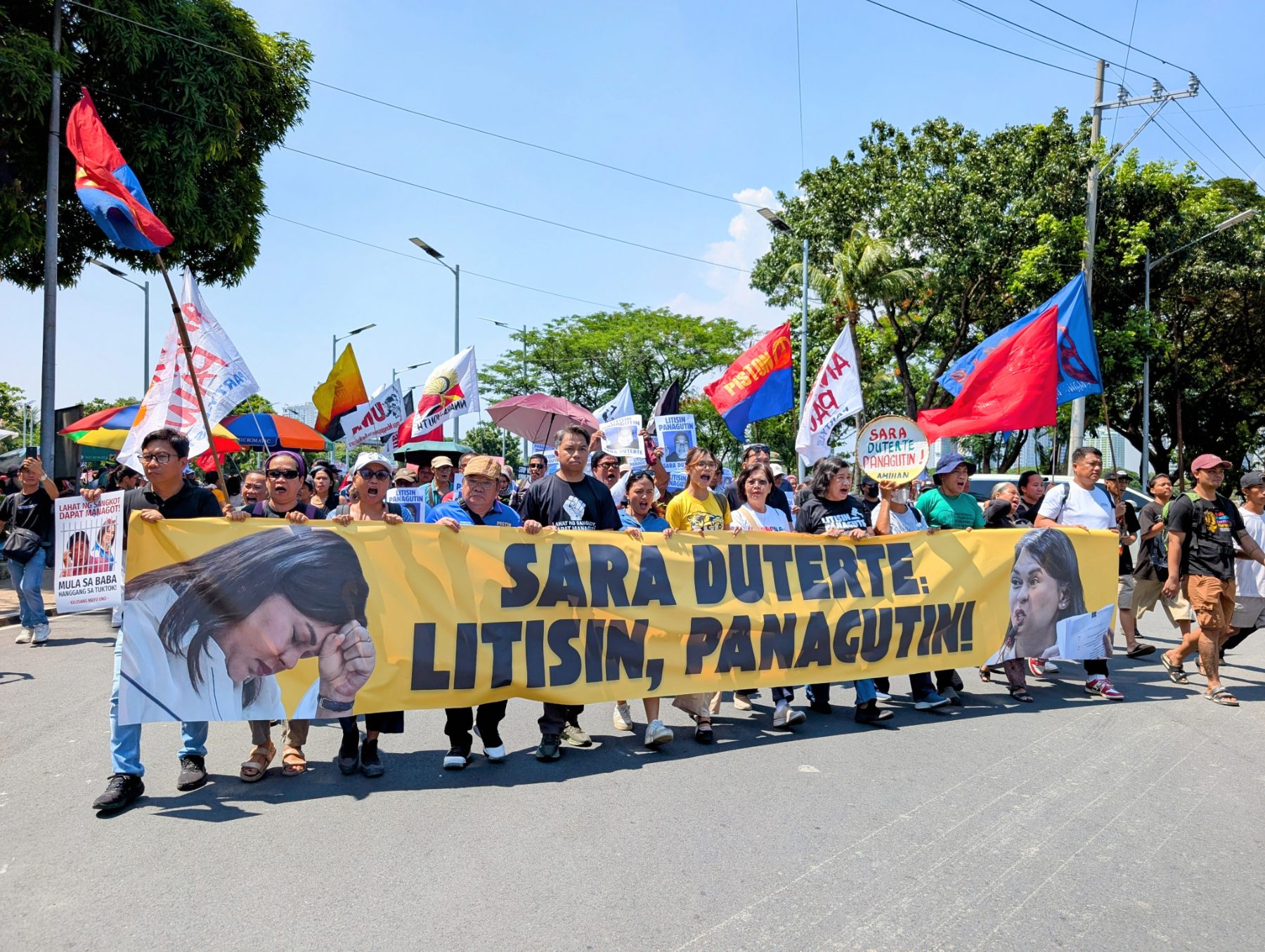
On 21 September, thousands of people took to the streets of the Philippines capital, Manila, in a protest marking the 54th anniversary of the imposition of martial law in 1972 by the dictator Ferdinand Marcos in an attempt to suppress communist insurrection in the country. The protest was also the second iteration of an anti-corruption movement sparked by a multibillion-peso flood control scandal. Protesters marched from Liwasang Bonifacio toward Mendiola Peace Arch, outside one of the gates of Malacañang Palace, demanding accountability for public officials accused of corruption. Martial law was formally lifted in 1981 and Marcos driven from power five years later – but brutal state repression of the working class and peasantry remains the norm today.
Five months earlier, on 19 April 2026, state troops killed 19 people in Toboso, Negros Occidental. The military claimed they were all combatants in the New People’s Army (NPA), the armed wing of the Communist Party of the Philippines (CPP). However, a national fact-finding mission led by human rights workers, politicians from the Makabayan coalition,* church leaders and journalists found that in reality, six of the dead were civilians including peasant advocates and community organisers. Witnesses testified that soldiers forcibly occupied civilian homes, fired indiscriminately near residential areas, and used a farmer as a human shield. The mission documented planted evidence and desecrated bodies: it was another massacre.
What is the NPA?
The New People’s Army was founded in 1969 by Jose Maria Sison and former members of the Hukbalahap, the peasant army that fought the Japanese occupation and later the landlord system. It is the armed wing of the CPP, a Marxist-Leninist-Maoist organisation that broke from the older, Soviet-aligned Partido Komunista ng Pilipinas in 1968.
The NPA fights a protracted people’s war, based in the countryside among the landless peasantry and indigenous communities. It sees the Philippines as a semi-colonial, semi-feudal state where power is held by a local class of landlords and comprador bourgeoisie, backed by US imperialism.
At its peak in the 1980s, the NPA had around 25,000 fighters. Today, the military claims its strength has been reduced to around 1,000, though the Armed Forces of the Philippines’ (AFP) own figures show over 1,100 ‘neutralised’ between January and August 2026 alone – a figure that includes surrenders, arrests, and killings, and which the military presents as proof of collapse.
The class structure
The Philippines ruling class is a comprador bourgeoisie whose wealth and power depend on serving foreign capital rather than developing a national economy. It is intertwined with a landlord class that still dominates the countryside. Peasants and farmers, roughly a quarter of the population, remain largely landless. This class structure was forged under Spanish and then US colonial rule and perpetuated by political dynasties: the Marcos family, the Aquino family, and the Duterte family. These dynasties are also the political representatives of the comprador-landlord class.
The working class that this system produces is fragmented and super-exploited. Manufacturing accounts for less than 10% of employment, and what exists is concentrated in export processing zones where wages are kept low and union organising is systematically suppressed. A far larger section of the class works in services (call centres, retail, domestic work, transport) much of it informal, without contracts, benefits, or security. For millions of Filipino workers, the only viable option has been labour export: over two million Filipinos leave the country each year to work abroad, their remittances accounting for roughly 9% of GDP. It is a safety valve for a system that cannot provide work for its own people, and it feeds a global supply of cheap, disciplined labour for imperialist economies — including Britain, where Filipino care workers and NHS staff face the hostile environment and deportation.
The landlord class, meanwhile, continues to block meaningful land reform. The Comprehensive Agrarian Reform Programme, passed in 1988, has failed to break landlord power; over 70% of marginal farmers and farm workers remain landless, and land conversion for mining, tourism, and now AI infrastructure continues to displace rural communities.
Systemic repression
The massacre at Negros is not an exception. The University of the Philippines Third World Studies Centre recorded 390 deaths from state-related violence in 2025, including 175 civilians. Since the election of Ferdinand ‘Bongbong’ Marcos Jr (the son of Marcos Sr) in 2022, counter-insurgency operations have intensified.
From July 2022 to June 2026 there were 147 extrajudicial killings, 892 illegal arrests, 15 enforced disappearances and over 67,000 victims of indiscriminate shooting under counter-insurgency operations. More than 11 million people were subjected to threats or harassment, and over 45,000 forcibly evacuated.
The violence is targeted at the organised resistance of the working class and peasantry. Negros Island has been a particular target since the 1980s, when chronic land disputes fuelled the insurgency. Rights groups call it the Philippines’ ‘massacre capital’, documenting at least five mass purges of farmers and activists since 1985.
The Anti-Terrorism Act
The Anti-Terrorism Act (ATA) of 2020 was signed into law by then President Rodrigo Duterte, notorious for overseeing a drug war in which thousands of people were killed. He is now facing trial at the International Criminal Court (ICC) for crimes against humanity. The ATA continues to be aggressively enforced under Marcos Jr. Modelled on US and British counter-insurgency doctrines, it allows warrantless arrests, 14-day detention without charge, and designation of individuals and organisations as ‘terrorists’ by an unelected council.
The human rights organisation KARAPATAN has recorded 256 activists, trade unionists, indigenous leaders, and journalists charged or designated under the ATA. Those designated include members of the National Democratic Front of the Philippines – peace negotiators supposedly protected under agreements with the government – as well as indigenous Cordillera leaders who defended their people’s land.
The resistance continues
However, the ruling class has not succeeded in crushing dissent. Alongside the armed struggle, a broad legal mass movement organises millions through Anakbayan, Kilusang Mayo Uno, Gabriela, and Bayan Muna; and they will keep mobilising. The resistance is diverse: Indigenous communities defending ancestral lands, farmers opposing land conversion, fisherfolk protesting the militarisation of their waters, youth and students organising on campuses. They are fighting for their land and sovereignty, and they recognise the corruption of imperialism.
The demands remain explicit: repeal the terror laws, free all political prisoners, end US military intervention, and recognise the Filipino people’s right to self-determination.
* Makabayan is the largest progressive political coalition in the Philippines, composed of groups including Bayan Muna, Gabriela, ACT Teachers, Kabataan, and Anakpawis. It represents the legal, parliamentary wing of the national democratic movement. The state routinely red-tags it as a ‘communist front’ to justify the repression of its members.
Pax Silica
The US exerts heavy military and economic influence, the Philippines hosting nine US military bases under the Enhanced Defence Cooperation Agreement (2014). The Philippines is a member of Pax Silica, the US-led coalition designed to secure imperialist control over semiconductors, artificial intelligence (AI), and critical minerals. The coalition, launched in December 2025 by the US, Japan, South Korea, Australia, Singapore, the UK and Israel, now has 25 signatories.
The centrepiece of the Philippine component is a 4,000-acre ‘Economic Security Zone’ (ESZ) planned for New Clark City in Tarlac. It is situated within the Luzon Economic Corridor (LEC) – a trilateral US-Japan-Philippines framework launched in 2024 that links the former US military bases at Subic Bay and Clark through Manila to Batangas; an area accounting for approximately 50% of Philippine GDP and handling 80% of Philippine port traffic. The LEC is explicitly designed to support American military presence and projection, with the ESZ serving as a pilot for similar Pax Silica hubs globally. Left-wing coalitions have protested that the zone will ‘cede Philippine sovereignty’ instead of offering the industrialisation that is promised.
An economic corridor is not a neutral infrastructure project and is defined by Oxford Public International Law as ‘geographical areas, such as overland, riverine, or maritime routes served by infrastructures that connect economic centre’ – a ‘spatial development model aimed at fostering economic integration that combines a physical dimension (infrastructure) with a functional dimension (laws, regulations, and governance frameworks)’. In practice, corridors are instruments for restructuring entire regions in the interests of capital.
The LEC is structured against the working class and peasantry in three ways. First, it prioritises foreign capital. The Philippine government will allow rent-free use of 4,000 acres of land, grant an income tax holiday of at least 6-7 years with deductions or lower taxes for up to 27 years, provide VAT exemptions, allow duty-free imports, and offer other incentives – all to attract foreign firms. The Filipino people will get no say in how the land is used.
Second, it dispossesses communities. The site is home to about 1,000 Aeta indigenous people, who received a letter from the Bases Conversion and Development Authority (BCDA) in July warning that the project ‘could affect your occupied lands’. They were offered just 30 pesos (roughly 36p) per square metre for their ancestral land. All refused. ‘Our lives, our livelihood and our culture are tied to this ancestral land,’ said tribal leader Petronila Muñoz. ‘Land is more important. Money runs out.’ Advocacy groups estimate that up to 20,000 Aeta and Abellen indigenous peoples, along with 15,000 local farmers face serious risks of land conversion and displacement.
Third, it extracts resources and exploits labour. The ESZ will require an estimated 130 million litres of water per day (equivalent to the daily consumption of 600,000 households) and 3 gigawatts of power, approximately 16% of the entire Luzon grid’s current capacity. The expansion of mining for gold, chromite, nickel, and copper to feed the supply chain promises further ecological destruction and super-exploitation of labour. As the peasant movement Kilusang Magbubukid ng Pilipinas (KMP) has argued, Pax Silica will ‘intensify mining expansion, land grabbing, and ecological damage,’ turning the Philippines into ‘a supplier of cheap raw materials and low-value processing like assembly, testing, and packaging, while technology, control, and profit go to them’.
The state violence is compounded by climate catastrophe. Between August and September 2026, successive typhoons and the enhanced southwest monsoon devastated Luzon. At least 39 people were killed by landslides, electrocution and drowning. Some 9.4 million individuals were affected, with 178 areas and provinces declaring a state of calamity. Infrastructure damage reached P6.27 billion, while agricultural losses climbed to P2.84 billion. Tarlac – the province where Pax Silica’s Economic Security Zone is to be built – declared a state of calamity after severe flooding damaged two bridges and disrupted major roads. In Pampanga, over 228 villages were inundated, affecting more than 860,000 residents, with agricultural damage exceeding P508 million. These floods are the consequence of decades of land conversion, deforestation, and the failure to invest in flood defences; failures that are themselves products of the comprador-landlord system. These communities, already dispossessed and displaced, are now being rendered even more vulnerable to the land seizures and resource extraction that Pax Silica will demand.
Bayan UK is planning to bring the campaign against Pax Silica to Britain. Britain is a founding member and active financier, having joined the LEC in May 2026 and providing £6.8 billion in export finance. British companies – HSBC, Knight Frank, Arup, and ARM Holdings – are the commercial infrastructure of the empire, profiting from the plunder. British capital is embedded in Philippine extractive industries; FCF Minerals Corporation and Woggle Corp, whose exploration licences have been met with anti-mining protests and arrests, operate with British and Australian backing.
Resistance is growing. On 31 August, 70 organisations – Indigenous peoples, farmers, scientists, environmental advocates, students – launched the Network Opposed to Pax Silica (NO to Pax Silica) on National Heroes Day, in which they declared: ‘We must prioritize the people, not foreign profits.’ On 10 September, protesters rallied outside the LEC Forum, Taguig, where Marcos Jr was meeting 600 investors for the project. Police arrested five paralegals and injured at least 27 people. The protesters described the forum as a ‘US-backed open house for the plunder of Philippine resources.’ The National Union of People’s Lawyers condemned the arbitrary arrests as a clear violation of the people’s right to peaceful protest.
Tybalt Askal