

In the third instalment of this series, WILL JONES examines how the opening of China to capitalist social relations from the late 1970s onwards, and the ‘normalisation’ of relations with imperialist states, sharpened class contradictions in the People’s Republic. This raised a serious challenge to the Communist Party of China (CPC)’s founding ideology and monopoly of state power.
The ruling classes of the imperialist countries faced a resurgence of global capitalist crises in the 1970s-80s and desperately sought new markets and sources of profit. Although the Soviet-led socialist bloc was weakened, liberation movements continued to threaten imperialist interests, from the reignited South African anti-apartheid struggle to the 1979 Sandinista revolution in Nicaragua, to the 1987 Palestinian First Intifada. Shocked by its defeat in its war on Vietnam (1965-73), the US was in no position to conquer or break up China due to the strength of the CPC.
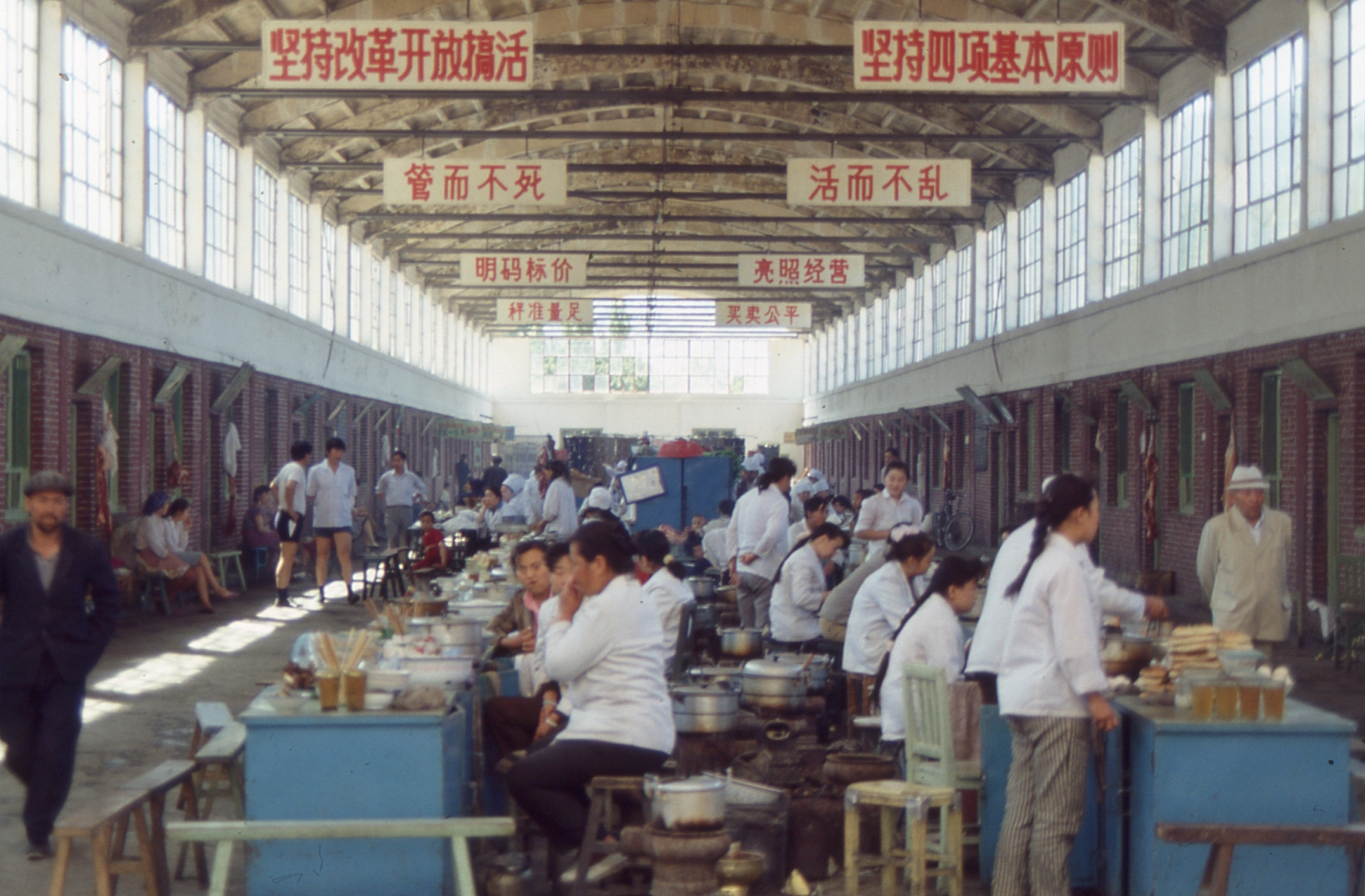
The CPC’s authority officially rested on a class alliance against imperialism that underpinned the PRC – peasants, workers, petit bourgeoisie and ‘national capitalists’ who accepted communist leadership. However, the final defeat of Mao Zedong’s trend in 1976 was a signal to pro-market forces to assert themselves with roaring confidence.1 From 1978 under Deng Xiaoping’s leadership the CPC implemented ‘Reform and opening up’: large-scale decentralisation and privatisation of the economy. To sustain economic growth to improve general living standards, the CPC chose to invite investment from the imperialist states.
Foreign firms were guided into joint ventures with the Chinese state in key industries and the state monopoly on foreign trade was surrendered. Rural communes were dismantled, although the land continued to be owned by the state. While many peasants prospered under the new market-driven system, others had no choice but to migrate to the cities for work. The so-called ‘Iron Rice Bowl’, which had guaranteed employment and welfare for millions of workers, was smashed. Within a decade, state enterprises’ share of employment fell from 85% to less than 40%. Hong Kong, still a British Crown colony until 1981, then a British dependent territory until 1997, became an offshore free-trade zone and continued to grow as a centre for finance capital in east Asia under Deng’s ‘one country, two systems’ policy.
Deepening contradictions
Deng’s ‘Four Modernisations’ in agriculture, industry, defence and science/technology required a burgeoning layer of teachers, academics, researchers, administrators and managers educated to a professional level. From around 250,000 admissions in 1977, Chinese university enrolment rose sevenfold in the 1980s.
The early PRC had adopted the gaokao (Higher Examination) system for university entry. Gaokao entrants competed for places according to academic ability and cultural refinement, a competitive system which en-trenched inequality. In the Cultural Revolution (1966-76) the gaokao was abolished to open universities to more workers, peasants and soldiers. Prospective students were required to perform manual labour and demonstrate to revolutionary committees an understanding of Marxism. Overall, 17 million youth worked alongside farmers and labourers.
With the defeat of the Cultural Revolution, in 1977 the gaokao examinations system was reintroduced. In the 1980s less than 20% of entrants passed the exam, and the elite universities of the east coast set annual quotas of a few thousand students. Chinese youth could again study abroad after limited student exchanges had stopped in 1966. In 1978-79 an agreement was signed between the PRC and US ministries of education for 500-700 Chinese students to study in the US. Similar agreements followed with Britain, Canada, France, West Germany and other imperialist states. In 1989 over 20,000 mainland Chinese studied at US universities, surpassing Taiwan. Those who studied in the US encountered the privileges and liberal capitalist culture of the world’s chief imperialist power. GDP per capita in the US was over $20,000 in 1985, while in the PRC the figure was closer to $200.
Students in the PRC were now also exposed to consumerism and economic competition; under Deng’s reforms, wage scales and bonuses based on seniority were modelled on foreign capitalist enterprises. Many university students were enticed by the possibilities of a middle-class lifestyle that had been restricted in the previously fully planned economy. A pro-western liberal tendency among urban youth found its sharpest expression in a student ‘democracy’ movement, which erupted in a series of confrontations in the 1980s.2
Tiananmen Square, 1976
The development of a liberal ‘democracy’ movement in the PRC gained momentum with the waning of the Cultural Revolution and the political defeat of Mao Zedong’s trend. In April 1976, following the death of Chinese premier Zhou Enlai that January, thousands of Zhou’s mourners in Tiananmen Square began a mass protest against the policies of Mao’s close allies, the so-called ‘Gang of Four’. The ‘April 5th Movement’ rioted and burned police vehicles before being cleared from the square by militias. Deng, removed from the party’s upper ranks the previous February, was blamed for stoking the unrest.
After Deng assumed the CPC leadership in 1978, the Central Committee reversed an earlier verdict which had condemned the April 5th Movement as counterrevolutionary. Deng’s leadership rehabilitated party members whom Mao had condemned as ‘capitalist roaders’. Hu Yaobang, for example, became General Secretary of the CPC in 1982. Zhao Ziyang, who had experimented with the privatisation of rural communes and other market reforms as Party Secretary of Sichuan, was chosen as Premier. Hu and Zhao would spearhead Deng’s ‘Four modernisations’ programme through the 1980s, while Deng headed the military commission.
In 1986 a dissident academic, Fang Lizhi, toured university campuses; he gave a speech at Tongji University stating that ‘socialism has failed’ and that, with respect to the imperialist states, ‘our so-called “genuine” democracy is not nearly as good as their “sham” democracy’. A month later, large scale protests broke out at campuses in Hefei, spreading to Wuhan, Beijing and Shanghai. One student leaflet declared: ‘What is China’s way out? The system of private ownership! The private ownership of a free economy and a society based on a free economy.’3
The student movement was exposing a contradiction between pro-capitalist reforms and the proletarian form of political leadership which the CPC continued to exercise. In theory the economic reforms in China were bounded by certain red lines, ‘Four Cardinal Principles’, adopted by the CPC in 1981 and enshrined in the PRC’s Constitution a year later: the socialist road; Marxism-Leninism-Mao Zedong thought; the leadership of the CPC; and the people’s democratic dictatorship.
In practice, the CPC’s presentation of Marxist thought was distorted by revisionism as it justified its turn toward the capitalist road – which would quickly prove to be potholed with contradictions. Zhao’s ‘preliminary stage theory’ which reconciled socialism with a market economy was officially adopted by the CPC National Congress in 1987. Yet most of the CPC’s leadership were not prepared to dilute Communist Party control of the state and thereby abandon the notional class alliance which upheld the PRC. These were the real red lines which the student movement and its sympathisers in the party would eventually overstep by falsely equating ‘modernisation’ with imperialist-inspired ‘democracy’.
A report to the politburo laid the blame for the 1986 campus protests on high-ranking party members: ‘since comrade Hu Yaobang and other comrades continued to retreat before such a trend of thought, the demand for liberalisation was raised to high levels’. Hu was removed from his position as General Secretary in 1987, replaced by Zhao Ziyang. Further escalation of the student movement followed. An indication of the character of some of the student leadership was revealed in 1988 when protests in Nanjing demanded the expulsion of African students from campuses.
The ‘turmoil’
On 15 April 1989 Hu Yaobang died. The Hong Kong press invented the story that leftist criticisms had caused Hu’s heart attack, a rumour which spread to mainland China. 2,000 student demonstrators marched to Tiananmen Square, carrying banners that read ‘Forever cherish the memory of Yaobang, the soul of China.’ Hundreds remained encamped in the square.
Within days the encampment swelled to thousands, egged on by imperialist outfits such as the US-based China Democratic Alliance and Voice Of America radio station. On 19 April, 5,000 students demonstrated, with some attempting to storm the CPC headquarters. A 26 April editorial in the People’s Daily offered the official party position that the movement was well-intentioned but manipulated by forces that intended to destroy socialism and the CPC.
On 4 May, General Secretary Zhao gave a speech to the Asian Development Bank in which he contradicted this message, describing the student protesters as ‘patriotic’. Zhao’s speech was aggressively disseminated by his allies. Beijing’s Mayor Chen Xitong later lamented, ‘Comrade Zhao Ziyang’s speech on 4 May was the turning point in escalating the turmoil.’ The crowds in Beijing grew to hundreds of thousands; on 17 May, one million people were demonstrating. Protest leaders advanced demands to establish a ‘Beijing Regional Government’.
Their ranks were joined by disaffected workers and state functionaries, angry at corruption and rising food prices, and taken in by apparent socialist agitation. Even the arch-reactionary Fang Lizhi encouraged the adoption of opportunistic slogans such as ‘Oppose Privilege’. The Washington Post quoted one student leader, ‘Many of us want democracy along Western lines. But we know we cannot criticise the Communist Party publicly. So we wave the red flag to criticise the red flag.’
On 19 May, Zhao and Premier Li Peng went to speak to the Tiananmen Square demonstrators. Zhao tearfully apologised: ‘we were too late in coming. I’m sorry…Your criticism of us is justified.’ Zhao was placed under house arrest hours later and would never return to public political life. The next day the Chinese government declared martial law, and sent People’s Liberation Army divisions to restore order, but they were impeded by student roadblocks; meanwhile the student camp shrank to a hard core of 20,000. As the numbers of soldiers in Beijing increased, violence began to break out; students attacked military vehicles with petrol bombs on 3 June, seizing weapons, beating soldiers and militia, many of whom were unarmed. Following further incidents of fighting, mechanised infantry ordered the students to evacuate Tiananmen Square, before removing the encampment. Street fighting continued elsewhere as the student movement was driven off the streets.
Fang Lizhi hid in the US embassy, was spirited out of the PRC and received the Robert F Kennedy Human Rights award later that year; 400 other student leaders fled via Hong Kong as part of the MI6 and CIA-organised ‘Operation Yellowbird’. Nonetheless, while condemning the events at Tiananmen Square, western imperialist states would not sanction the PRC, which had become too important for the global economy. Imperialism had been forced into a stalemate with China.
‘June 4th Incident’
At the time, FRFI strongly criticised the use of indiscriminate force by the PLA, a tactic which led to the deaths of possibly hundreds of civilians, while placing it in the context of ‘the crisis of communism in China, and of the failure of the CPC to give leadership in the struggle for socialism.’4 The full consequences of the defeat of the pro-imperialist trend represented by the student movement and its party sympathisers would play out in the decades to come.
Following the collapse of the USSR and socialist bloc in the late 1980s and early 1990s, the PRC did not suffer the same shock therapy as those former socialist countries where the communist parties had been broken. Class struggle would remain largely dormant in China as a new middle class emerged and extreme poverty was eliminated for the great majority of workers and peasants, even as Chinese capitalists and western multinationals alike reaped rising profits. Only the retreat of globalisation, and renewed US economic aggression, has now begun to disturb this apparent peace.
1. See FRFI 310, ‘China and imperialism part II: the enemy of my enemy’.
2. See Mick Kelly, ‘Continuing the revolution is not a dinner party’, Freedom Road Socialist Organisation, 1990 for a contemporary account from a US-based pro-CPC perspective. Republished 2009 at Marxists.org.
3. Quoted in Kelly op cit.
4. Trevor Rayne, ‘Crisis of socialism in China’, FRFI 88.