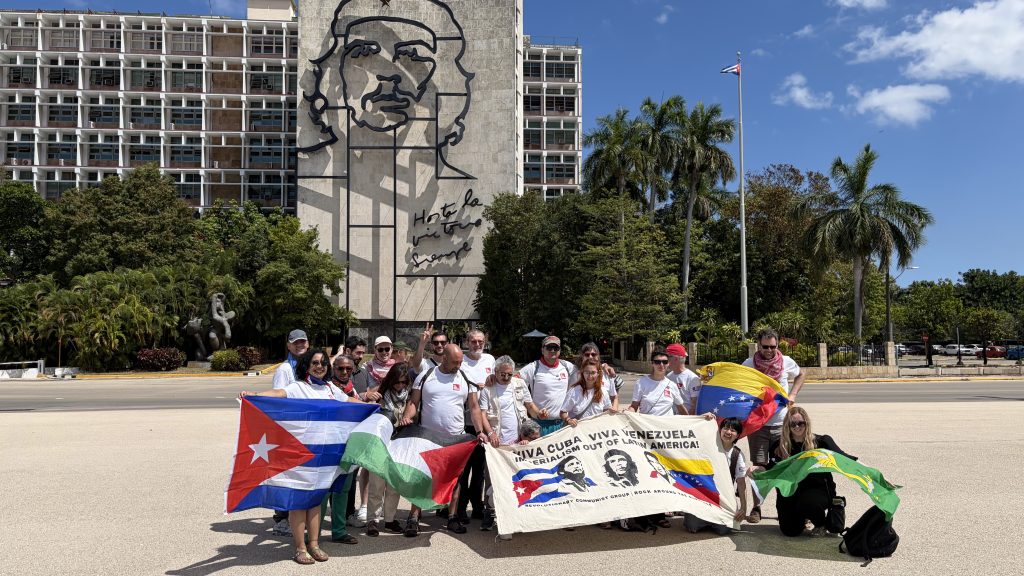

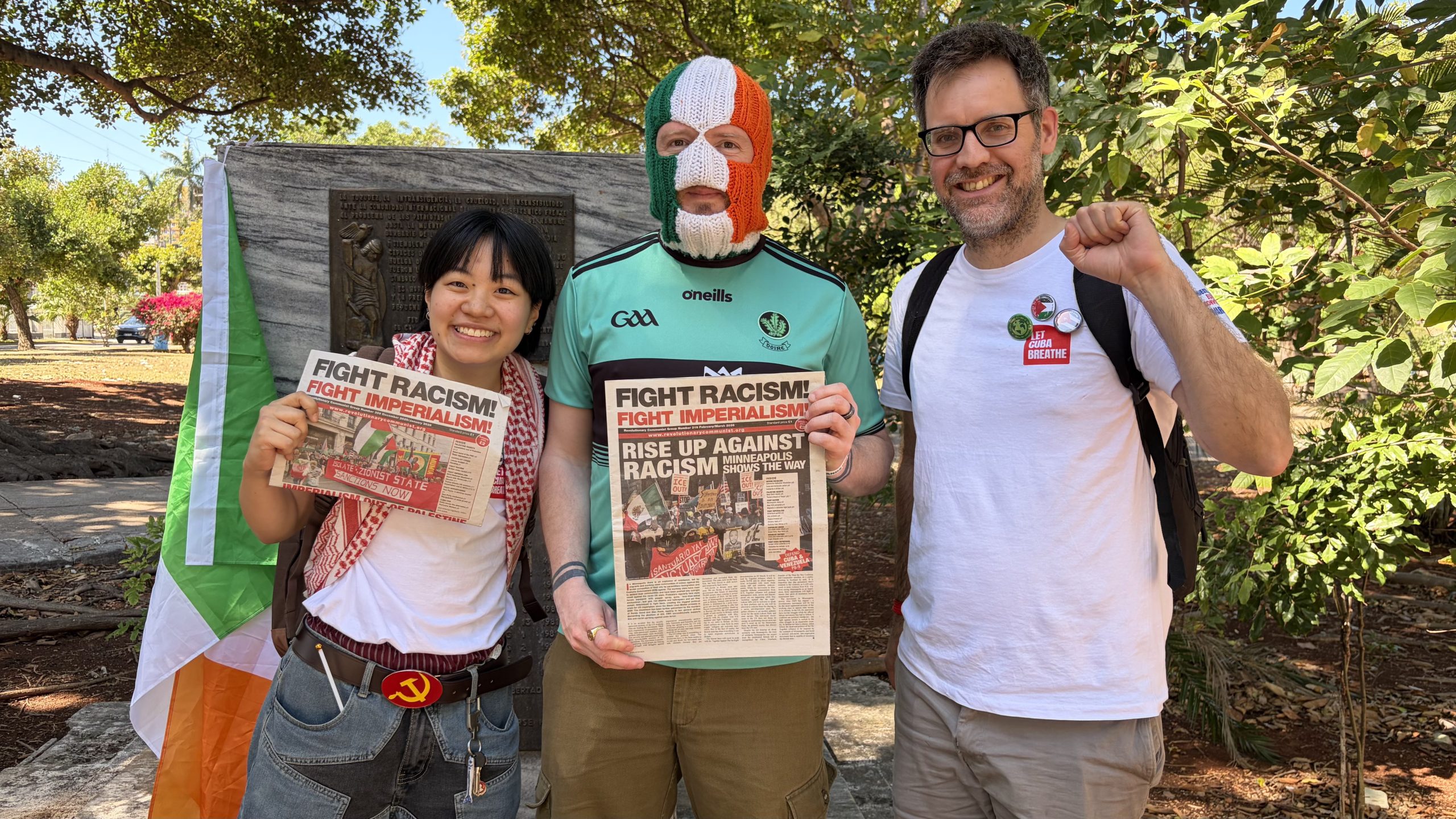
In March, the Revolutionary Communist Group (RCG) sent two comrades to Cuba as part of the Nuestra América mission transporting medicines and vital equipment to Cuba. The European contingent, consisting of 120 activists from over 30 political organisations, joined a 600-strong convoy from around the world. Organised by Progressive International and Italy’s Agency for Cultural and Economic Exchange with Cuba, high profile activists and artists joined this gathering in Havana, including Amazon trade unionist Chris Smalls and Irish hip hop band Kneecap.
‘We as Irish people were Britain’s first colony, we have grown up our whole lives with an understanding of colonialism and oppression and also forced starvation… It’s time to break the siege and stand up for Cuba, as they have stood up for us.’
– Kneecap
The convoy gathered on 24 March at Havana’s Sierra Maestra port terminal to welcome the first of a flotilla of boats transporting supplies by sea from Mexico. In total, Nuestra América delivered over 30 tonnes of aid, including that collected by the RCG, sourced by volunteers mobilising in working-class communities across the world.
While in Cuba, we experienced one of the nationwide blackouts that have been afflicting the country. But during the blackout we also saw Cubans defiantly organising morale-boosting dance parties in the dark streets, powered by portable sound systems. We spoke with individuals affected by soaring prices, struggling as free items distributed through the ration book run out. We spoke with doctors whose patients’ lives hang in the balance as ventilators threaten to fail. But we also learned how the socialist state prioritises the most essential services, ensuring that schools and hospitals have backup generators. Throughout seven decades of blockade, the socialist system has guaranteed free education, free healthcare, and access to housing for all.
‘When you block people who are building vaccines, who are building technology for the Third World, for poor people, you are not just blocking Cuba, you are blocking the entire world.’
– Rubén Sánchez Rivero, Cuban computer scientist
Socialist Cuba has always stood firmly with the international working class, sending teachers and doctors wherever they are needed in the world. The convoy’s Italian members ex-plained that Cuban medical brigades have been operating in Calabria since 2022, so the mission was a way to respond with solidarity, not as payment of a debt, but as part of a collective working-class movement against imperialist aggression.
Scientists at Havana’s Centre for Genetic Engineering and Biotechnology (CIGB) explained that the blo-ckade already made it challenging for Cuba to share its medical breakthroughs with the world, but since 29 January it has become all but impossible for CIGB to manufacture new stocks, and there is extreme pressure from the US on countries and institutions to break off relations with Cuba. Measures being taken by the biotech industry to compensate include expanding the development of indigenous plant-based medicines and strengthening alliances with friendly international institutions.
Confronting the oil blockade, Cuba is accelerating its development of sustainable alternatives. Energy re-searcher, Laura Beatriz, explained that if the socialist state had not already implemented its Tarea Vida 100-year strategy for tackling climate change, the country would now be in a state of permanent blackout. Cuba is working towards completely breaking its dependency on fossil fuels, expanding solar power as a proportion of total energy production from 5.8% to 20% in the last year. The convoy’s donations included solar panels to support this effort.
‘In us and most of the Cuban people is the belief that we can overcome. We [scientists] go to work every day smiling and with optimism because we believe even in this worst period we can survive and overcome.’
– Yassel Ramos Gómez, deputy director, CIGB
On Cuba’s internationalism, Mariela Castro, director of CENESEX, one of the organisations championing women’s liberation and queer liberation in Cuba, told us that sovereignty is the only path to the emancipation of all Palestinians, including women and queer people. As a formerly colonised nation, the people of Cuba understand the need for Palestinians to break the chains of imperialist occupation.
At a conference on 20 March welcoming the 600 convoy activists, Cuban president Miguel Díaz-Canel paid tribute to the 32 Cuban soldiers killed defending Venezuelan president Nicolás Maduro, kidnapped by the US military on 3 January. Díaz-Canel also lauded the five Cuban coastguards who prevailed against an invading US-registered speedboat earlier this year, despite being outnumbered and outgunned. He emphasised that any attempt at imperialist military intervention will be met with ferocious resistance by the Cuban people, who will defend themselves and their homeland until their last breath rather than live on their knees.
‘Cuba is not a failed state; it is the blockade that has failed!…The convoy is a symbol, but it is also a commitment to continue building a better world, a world dreamed of by José Martí, Simón Bolívar, and Fidel Castro…In the one hundredth year of Fidel’s birth, we will not let his legacy die.’
– Miguel Díaz-Canel, First Secretary of the Communist Party of Cuba and President of the Republic
A one-off shipment of aid is not enough. Returning to Britain our task is clear: build political consciousness in solidarity with Cuba; stamp out the lies of our imperialist media; expose the complicity of Britain in the extra-territorial application of the blockade – from blocking financial transactions to military collaboration with the US, targeting tankers bound for Cuba. Ultimately the highest form of political solidarity we can contribute is the building of a movement that can overthrow British imperialism and replace it with socialist revolution.
Get organised and join the struggle! Viva Cuba Socialista! Abajo el bloqueo!