

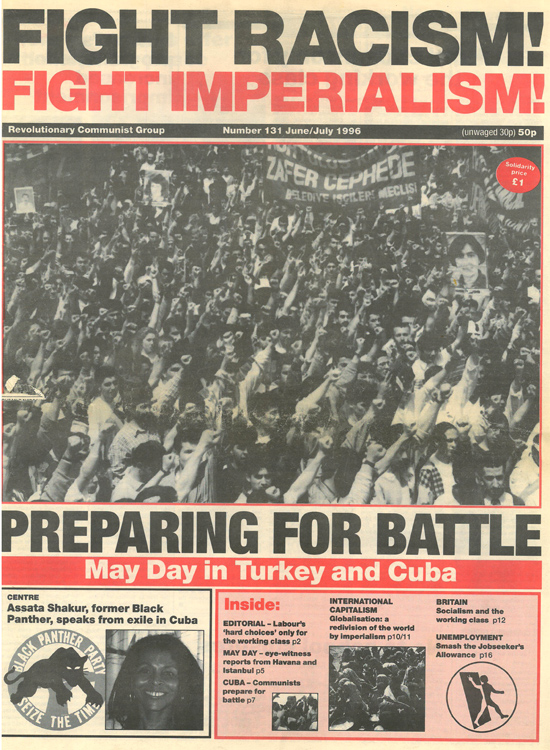
We republish below two articles from Fight Racism! Fight Imperialism! issues 130 and 131, published in 1996, in light of the recent escalation of US attacks on Cuba using the downing of two planes that year by the Cuban air force as a pretext for this renewed aggression.
US steps up aggression against Cuba
FIGHT RACISM! FIGHT IMPERIALISM! APRIL/MAY 1996
On 24 February Cuban exiles from the counter-revolutionary Brothers to the Rescue deliberately flew into Cuban airspace in defiance of previous Cuban warnings. It was an open secret in the Miami exile community that something was going to happen. After issuing warnings, Cuban MiG fighter planes shot down two of the three pirate Cessnas. Four pilots died, sacrificed to the cause of tightening the blockade against socialism in Cuba. KATHY FERNAND and CAT WIENER report.
The exiles’ aim was to ensure the anti-Cuban Helms-Burton Bill got through. Their provocation was timed to coincide with the US election Primaries. Unwilling to alienate the important exile vote in Florida and New Jersey, President Clinton dropped earlier reservations about the Bill, and announced further sanctions against Cuba. Predictably, on 6 March, the Helms-Burton Bill was passed in the House of Representatives by 336 votes to 86. Brothers to the Rescue had achieved their immediate aim.
Prior to this, to the dismay of the reactionary Cuban exile groups, the Clinton administration had seemed to be adopting a more softly-softly approach against Cuba. There was even talk that the blockade might be lifted if Clinton was re-elected in the autumn. This reflected growing pressure from sections of US business who were establishing potentially profitable contacts with Cuba.
However, the US was prepared to let Brothers to the Rescue continue its harassment of Cuba, with 20 illegal flights into Cuban air space in the last 20 months. The Cuban government made repeated protests about these flights to the US government and the Federal Aviation Administration of the US. The US failed to act. After two incursions in January 1996, when thousands of leaflets were dropped over Havana, the Cuban government warned next time it would act. After the planes were shot down in February, the Cuban government immediately issued a statement regretting the loss of life, but emphasising its determination to defend its national integrity at all costs. Castro pointed out in an interview in Time magazine, ‘All these attacks against Cuba are done with civilian planes… we had warned US officials time and time again… We had been patient, but there are limits.’ Such flights are also suspected of being used for drug trafficking.
US attempts to bully UN
Clinton’s entourage immediately claimed the planes were shot down over international waters; Secretary of State Warren Christopher condemned Cuba’s ‘murderous acts’ against ‘innocent civilians’. Cuba has agreed to participate in a UN inquiry to prove the planes were within its territory.
Within hours of the shootdown the US convened an emergency session of the UN Security Council, where it attempted to bully unprepared delegates to condemn Cuba as ‘a threat to international order’ and its action as an ‘unlawful use of force’. Requests that the session be delayed until Cuban Foreign Minister Roberto Robaina could get there were ignored. However, resistance by China and Russia to US railroading tactics ensured that what was finally agreed was a watered-down presidential statement ‘deploring’ the Cuban action. The statement was passed at 3.30am. Roberto Robaina was granted a US visa an hour later.
The US dirty war against Cuba
The reality is a history of constant harassment of Cuba by the United States and counter-revolutionaries based in Florida, which the US has done nothing to prevent. Responsibility for the shooting must lie squarely at their door. It is no coincidence that the flights were timed to coincide with a scheduled meeting in Havana by the dissident group Concilio Cubano — which receives funds from Brothers to the Rescue. In Time, Castro stated: ‘In addition to these flights, there was also interference by the US Interests Section failed [in Havana] in our internal affairs… giving money and paying the bills of dissidents… visiting the provinces and promoting opposition to the government under the pretext of checking on rafters returned from the US… it was intolerable.’
There is nothing ‘humanitarian’ about Brothers to the Rescue. They were set up in 1991 by Bay of Pigs veteran and fanatical anti-communist Jose Basulto with the sole aim of overthrowing the Castro government. Two days after the shooting they were denounced on Cuban TV by former Brothers pilot and Cuban agent Juan Pablo Roque as terrorists who had plotted sabotage and assassinations against Cuba.
Cuban ‘Liberty and Solidarity’ Act
Immediately after the incident, Warren Christopher warned that Clinton held military action ‘in reserve’. The Brothers would undoubtedly like to provoke all- out military action against Cuba. However, under a Democratic President they will settle for all-out economic assault. The Helms-Burton Bill — now the Cuban Liberty and Solidarity Act (!) — is the most far-reaching attack on foreign trade with Cuba to date. Its main provisions enshrine in law sanctions imposed by Presidential order, give Cuban-Americans and other US citizens the right to sue foreign companies using property confiscated by the Cuban revolution, and suspend visas from anyone involved in companies subject to an expropriation claim.
Cuba’s trading partners in Canada, the European Union and Mexico will challenge the Act’s extra-territorial provisions, taking the US to the court of the World Trading Organisation. The EU described US attempts to limit their trade as ‘completely unacceptable’. They continued: ‘We and the Americans share the same goal – establishing democracy in Cuba – but we differ about the best means to achieve that.’
The economic measures adopted by Cuba to beat the blockade, including joint ventures and increased foreign investment in the economy, are bearing fruit. Nickel production is up to its highest levels ever, tourism is the fastest-growing sector and the sugar harvest looks set to reach the target of 4.5 million tons for 1996 – a 30% increase on last year. But capitalist companies, in seeking to maximise their profits, will inevitably conflict with and attempt to undermine Cuban socialism. Communists support Cuba’s right to trade with whoever it wishes to defend the gains of the revolution. But our campaign cannot be based, as the Cuba Solidarity Campaign in Britain wishes, on a defence of British trading rights. Our priority must be to build an active, popular movement in defence of Cuban socialism and against the blockade. ■
Cuban internationalism
On 27 February, 96 Cuban doctors arrived in South Africa to fill posts left empty by a ‘medical brain drain’ of doctors lured away to higher salaries by countries like Britain. There are 2,000 unfilled posts in South Africa, and only 22,000 doctors for the 43m population. The doctors were greeted by cheering crowds who chanting ‘Down with America’ and ‘Viva Fidel Castro’, and banners reading ‘Hands off Cuba!’ and ‘End the blockade!’. Cuba has more doctors working in developing countries than the whole of the World Health Organisation.
Cuban communists prepare for battle
FIGHT RACISM! FIGHT IMPERIALISM! JUNE/JULY 1996
The Communist Party of Cuba is preparing to do ideological and political battle against a growing internal threat to the revolution. The very measures that Cuba has been forced to adopt in defence of the social gains of the Revolution are producing class forces hostile to collectivism and egalitarianism. EDDIE ABRAHAMS comments on a 23 March speech to the Communist Party Central Committee, where Raul Castro, head of the Cuban army, sets out to: ‘examine the political and social situation in the country in order to derive from this analysis the ideological work our Party has to carry out during these times of the special period.’
This work is of particular urgency. While the Cuban economy has made a significant recovery, huge problems remain. These are exacerbated by the continuing US blockade, with the latest Helms-Burton Act amounting to a ‘criminal plan of action to make our people surrender out of starvation and disease.’ The US has adopted a twin-track strategy against Cuba. ‘Track One is the blockade, seeking economic asphyxiation. Track Two is the idea of internal subversion, to eat away at the country from within.’ In the coming period US attempts to ‘sow confusion’ and ‘create discontent’, and ‘disorder’ will increase.
The Cuban Revolution is engaged in ‘life or death battles’ which will only be won by convincing the working class, in practice, that only socialism and not a return to capitalism can solve the economic and social problems they face.
The social situation
The collapse of the socialist bloc and the tightening US blockade has created enormous economic and social dislocation. ‘Hardships continue to affect the vast majority of our people’ with shortages of foodstuffs, power supplies, medical equipment, transport and an ‘almost total absence’ of clothes and footwear, and an aggravation of the housing problem.
The resulting widespread discontent has created fertile ground for the activities of anti-socialist forces. Even more dangerous, however, is the development of a social class whose form of economic production makes it absolutely hostile to socialism. In the current world situation:
‘the only form of socialism possible in Cuba today (requires) us to assimilate such difficult factors as mercantile commercial relations and even certain elements of capitalism, and to reinsert ourselves into the world economy dominated by the monopolies of the imperialist powers.’
To sustain economic production the state, besides encouraging imperialist investments, has permitted the development of internal private production in the country and small-scale private production and trade in the towns. Thus has emerged the ‘strata of nouveau riches’ consisting of prosperous farmers, sections of the urban self-employed and their intermediaries.
Alongside the rise of this class there has been a relative shrinkage of the working class – due to a partial or complete closing down of activities in state enterprises related to production and services. In the countryside a large portion of the agricultural working class from all state-run sugar plantations and most of the state farms has gone into workers’ cooperatives. In addition today more than 200,000 people now make their living through self-employment. This is an official figure. The real figure is much higher.
Raul Castro points out that:
‘The psychology of private farmers and self-employed workers in general, because of the nature of their work, which is carried out on an individual basis or in conjunction with the family, and because of the source of their income – private trade of the product or service they render – tends towards individualism and is not a source of socialist consciousness.’
This new proto-capitalist class can become a vanguard of counter-revolution, to which end it will ruthlessly exploit popular discontent. Individual economic production ‘can lay the foundations for the formation of groups, organised associations and actions which are divorced from the state’, and ‘can constitute the breeding ground for the subversive work of the enemy.’
The work of this stratum, in alliance with corrupted state officials and international capital, is facilitated by the negative by-products of current economic policy which permeate society as a whole. A ‘loss or reduction of work for hundreds of thousands’ and ‘an increase in unemployment among young people’ produces crime and corruption. The decriminalisation of dollar possession ‘allows those who receive this money to achieve a better economic position, which implies an element of inequality’. The search for dollars and the very presence of capitalists in Cuba undermines socialist values as ‘bribery and corruption are part and parcel of business under capitalism’.
Whilst the development of tourism has tremendous significance for Cuba’s economic revival it ‘has an undeniable (negative) influence… since (tourists) from capitalist countries bring with them ideas about consumer society.’ The ‘appearance of jineterismo (prostitution) is the most visible and humiliating’ side-effect of tourism.
‘These material difficulties have been augmented by feelings of depression and political confusion resulting from the disappearance of socialism in Eastern Europe and above all, by the disintegration of the Soviet Union and a parallel increase in psychological warfare mounted by the major superpower in a unipolar world.’
However without imperialist assistance, the internal counter-revolution would be helpless. By means of money, material aid, gifts, favours and promises, the US hopes to create an organised political movement against Cuban socialism. The US government, foreign capitalist firms, international agencies, various Non-Governmental Organisations and religious missions are acting as a ‘Trojan horse to foment division and subversion here’. They seize on difficulties and popular discontents to spread capitalist propaganda, encourage the internal opposition, bribe it, organise it and extend its influence.
This work amounts to a veritable ‘ideological offensive’ against socialism in the intellectual, educational and health fields and ‘among young people and sectors they consider most vulnerable’. The political and ideological struggle against these emergent anti-socialist forces is the critical task of the day. ‘Never before’ says Raul Castro, ‘has there been such a need to raise the Party’s ideological work to the levels of the country’s combat missions.’
The ideological battle
In their work Cuban communists begin from a position of strength, for:
‘Without any doubt, US imperialism has failed to transform the profound economic crisis the country has been experiencing for over five years into the destabilising situation so indispensable for its plans to destroy the Revolution.’
And the reason is simple:
‘In spite of the economic crisis in Cuba and thanks to the activity of the socialist state, not one single school, hospital, day-care centre or senior citizens’ home has been closed.’
Nevertheless, with the continuing economic difficulties, the Cuban Communist Party cannot afford to ‘underestimate’ the ‘scant elements that attempt to appear as an internal opposition’ because they could ‘become a virus’: ‘We must convince the people or the enemy will do it.’ Communists reject the selfish, individualist methods proposed by the pro-capitalists as solutions to the people’s problems:
‘The neoliberal capitalism so in vogue solves this (economic) problem mercilessly: “every man for himself” is its formula. Our system would fail to be socialist if we did not concern ourselves with the fate of each of the 11 million Cubans.’
Starting from the needs of the people as a whole, communists, Raul Castro argues, must as a ‘concrete defence of our ideology’ set about solving the food problem. This is ‘the population’s number one daily concern’ and is therefore the ‘priority problem’ for the Communist Party. The needs of the Cuban people as a whole are the foundation for all aspects of policy – even when such policies appear to encourage a privileged and prospering minority.
For example, hard currency stores have been encouraged even though they are accessible only to people with dollars and create some rich people. However:
‘With the profits gained from the sale of $5,000 worth of products in our hard currency stores, we obtain the resources needed to purchase the powdered milk required to provide one litre of milk for one day for 10,000 children.’
The shortage of hard currency is one of the main problems for the national economy, therefore ‘it is of the utmost importance to increase our exports of sugar, nickel, tobacco, seafood, citrus fruit, medications, coffee and rum etc.’ Some individuals will benefit disproportionately from this. But it is legitimate ‘to bring in hard currency with the greatest possible profit margin, for use in solving the people’s problems.’
However, and here lies the decisive importance of the Party’s ideological campaign: defending working class interests whilst having to ‘adopt certain elements of capitalism’ and ‘reinsert ourselves into the world economy’ requires a permanent and ‘tenacious struggle’ to tightly control anti-socialist forces and compel them to ‘strictly abide by the law’. Such control can only be exercised by the working class itself, organised on a mass basis on the principles of socialist democracy and through its exercise of state power. Whilst the ‘market is part of the solution’, the ‘national economic plan is the key’. And this plan cannot function ‘without the pre-eminence of the state that guarantees it’.
But, as socialists have always maintained, the socialist state does not stand above or separated from the working class. It can function as a working class state only on the basis of mass popular participation and mass political organisation. Without the mass of people organised as a state force it will be impossible to defend the collective interests of the working class against the predatory individualism of the anti-socialist forces.
Thus the campaign against them must take place first and foremost in peoples’ assemblies, in the workers’ parliaments where millions of workers will have ‘the chance to reflect on and discuss the issues’. Such participation will ensure the ideological struggle and concrete measures necessary to defend socialism become a ‘mass movement, a work of the masses’. This movement will be a movement of the people, not of the privileged minority. The minority will not be allowed to exert any influence over it. It will ‘exclude the minority of rich people who serve the enemy, the annexationist traitors, the troublemakers’.
At the head of this movement must be the working class organised in a political party:
‘As a result of the detailed analysis carried out, now more than ever, the main objective of all of us has to be working so that, in the midst of the changes and the old and new problems we are facing, the leading role of the party is preserved. Everything the enemy does on the ideological front is aimed at weakening just such a guarantee of the scientific and at the same time revolutionary and heroic leadership of our people.’
Such are the terms in which the Cuban communists are setting out to defend socialism. The least we can do here to support their struggle is to step up our anti-capitalist work and our activity in support of Cuba. ■