

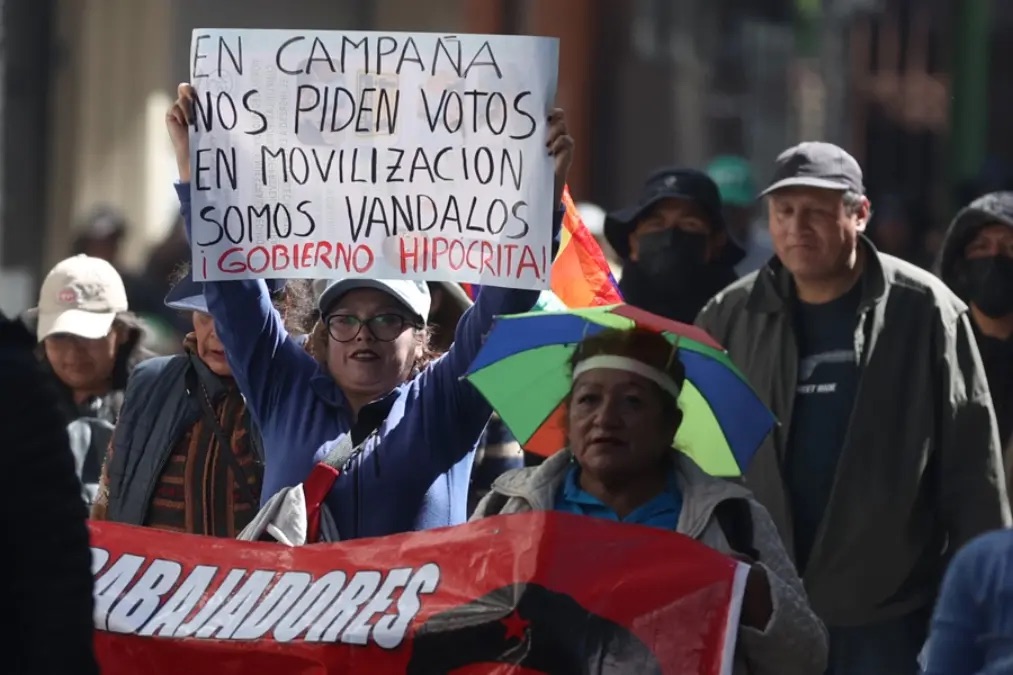
As we go to press, Bolivia’s indigenous majority and working class have brought the nation to a standstill demanding the resignation of right-wing President Rodrigo Paz. Since April, anger amongst trade unions, agricultural workers, and indigenous forces has erupted in protest. All two million members of the Bolivian Workers’ Central (COB) trade union federation are on indefinite strike. Over 150 roadblocks and barricades have been erected across the country, and huge marches of rural workers have amassed in the capital, La Paz. At least seven protesters have been killed and scores injured as riot police responded with tear gas. The Paz government has enacted Law 1732, repealing previous restrictions on the use of force, greenlighting the deployment of the armed forces and providing for their immunity. The state is preparing for a bloodbath.
In December 2025, in an attempt to reduce Bolivia’s fiscal deficit, Paz eliminated the fuel subsidies which had long shielded the poorest workers and farmers. As a result, gasoline prices increased by 86% and diesel by 160%, driving cost hikes for food and public transport. Barely six months after he assumed office, Paz’s aggressive economic reforms have triggered mass discontent. Protests have swept rural and urban areas, with miners occupying the streets of La Paz with shovels, picks and dynamite, rural transport workers and campesino farmers blockading routes into the cities and the indigenous ‘Red Poncho’ militias expelling police blockades from key neighbourhoods in La Paz.
Central to this resistance is Evo Morales, Bolivia’s first indigenous president who was in power between 2006 and 2019. For two decades, Morales’ left-wing Movement for Socialism (MAS) government challenged imperialist exploitation. It kicked out the multinationals pillaging Bolivia’s gas and water, nationalised hydrocarbons and mining to divert revenues into sorely-needed poverty reduction programmes, redistributed over 35m hectares of land to landless farmers and enshrined the rights of Bolivia’s indigenous majority in a ‘plurinational constitution’. In November 2019, Morales was the target of a US-backed coup which installed the far-right government of Jeanine Áñez. This government carried out violent repression against the working class and indigenous population. Facing a popular insurrection by forces loyal to Morales, the coup government was forced to hold elections the following year, resulting in MAS returning to power in November 2020. With Morales still in exile in Argentina, his former finance minister Luis Arce assumed the presidency.
Once Morales returned to Bolivia, a split developed between Arce, representing better-off urban workers and investors, and Morales, representing indigenous and campesino sectors. This escalated into a battle over who would lead MAS into the 2025 election, culminating in Morales being banned from running. In protest, huge sections of the indigenous and working class boycotted the election. Without Morales, MAS’s electoral support collapsed to just 3% of the vote, resulting in the neoliberal candidate Rodrigo Paz winning the presidency. Paz pledged ‘capitalism for all’ and began reversing the gains of the MAS years, releasing those imprisoned for coup activities, arresting Arce and attempting to overturn agrarian reform. Backed by the US, and far-right presidents in the region including Argentina’s Milei and Chile’s Kast, Paz has now set his sights on the capture of Morales who is wanted for a string of politically-motivated charges.
Morales is currently in the department of Cochabamba, surrounded by indigenous and campesino activists who have pledged to prevent his capture as part of their resistance to the dismantling of the social and constitutional achievements of the Plurinational State he once headed. The Paz government cut off electricity to Cochabamba in retaliation, amidst reports of armed forces advancing through the jungle around Chapare. Coordinating the blockade of key highways into the region, prominent campesino leader Vicente Choque declared ‘The government is coming to murder us, it is coming to kill us, but we will not surrender. The mobilised people have never surrendered and will never surrender’, whilst a mass mobilisation of indigenous women took to the unlit streets on 27 May, marking Bolivia’s Mothers’ Day with a show of defiance.
The working class and indigenous movement has overthrown right-wing regimes before. The writing is on the wall: Paz’s days are numbered. Jallalla Bolivia!
Jacob Dexter