

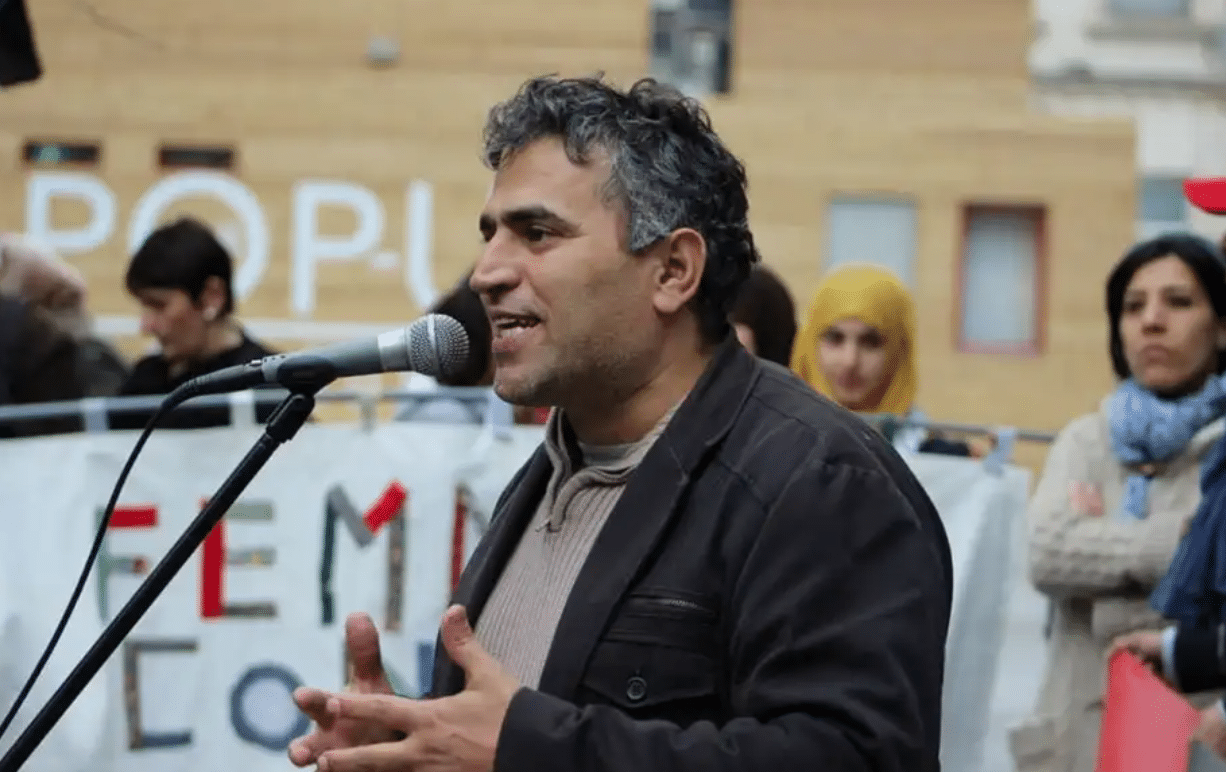
We are pleased to print this interview with our longtime comrade Khaled Barakat, an executive committee member of Masar Badil, Palestine’s Alternative Revolutionary Path movement.
Masar Badil has faced down ‘terrorist’ designations and smears in Europe and North America and organised its international conference in Canada this November. Comrade Barakat spoke to us from Lebanon, where Hezbollah and the resistance continue to defy Zionist colonisation plans and Palestinian exiles engage in a process of political reorganising. The RCG sends solidarity to Masar Badil and thanks comrade Barakat for this discussion.
FRFI: Firstly, let’s look to the regional context surrounding the Palestinian struggle. The failure of the imperialists to defeat Iran has again seen the imperialists turn to Gulf reactionaries but the status quo is seriously threatened. The US and its allies are clearly facing huge difficulties and, though they can claim gains in Syria, the resistance remains in Lebanon and the Yemeni front is again heating up. How do you assess the prospects of the resistance forces in the region? And what can be said of the ability these fronts to provide support to Palestinian struggle?
KB: The resistance in the region has been at the forefront, developing and deeply engaged in the struggle, for decades. We cannot assess, for example, the resistance in Lebanon simply by reviewing the past few years. One of the characteristics of these resistance forces is that, after every confrontation, they re-emerge strongly, whether we are discussing Lebanon, Gaza, Yemen or even Iraq. At the same time, these are not copies of one another; each resistance movement and each country has its own experience.
However, over the last three years, since the glorious operation of 7 October, the Zionist entity has not simply suffered a huge blow, it has been shaken to its foundations. For the colonialist powers and the reactionary Arab regimes, this meant that the resistance posed an existential threat not only to the Zionist entity but also to the presence of colonialism and imperialism itself in the region. We think that without the presence of this resistance, there can be no real understanding of the type and nature of the conflict in our region.
It is no secret that when the ceasefire happened, it was not because ‘Israel’ was generous, but because of the strength of the resistance and the casualties inflicted upon the Zionist forces. Where does the resistance gain its experience and accumulate power? Through confrontation with the enemy. Between confrontations, the resistance is busy accumulating its strength, and weapons manufacturing proceeds 24/7 because it understands that the next confrontation is imminent. The resistance has no time to spare. In some ways, it is busier during periods of ‘calm’ than during periods of direct confrontation on the battlefield. We may ask: Did Hamas get weaker after the battles of 2008, 2012 or 2014? What we have seen in reality is that the resistance grows stronger and accumulates greater strength.
Take Yemen, for example. Today the resistance in Yemen has gone through so many confrontations. In 2015, over 70 countries were backing the so-called ‘Alliance’ led by Saudi Arabia. Through direct assaults and a brutal siege, the Saudi-led alliance killed and injured over 400,000 Yemenis. But the resistance became stronger, not weaker. Then the Western powers led their own coalition, directed by Britain and the US, which also failed. The US, the leading imperialist power, then attacked Yemen directly. However, the result was the strengthening of the Yemeni resistance, which holds state power for the vast majority of the Yemeni people and directs the armed forces.
In Iraq, they kept the resistance occupied with ISIS. But after the defeat of ISIS at the hands of the resistance—not Trump and the United States—we are talking today about 360,000 fighters with over 12 years of direct experience on the battlefield and, more importantly, a great deal of political maturity that has come with that experience. When people in the West speak of the resistance, they think mainly of armed resistance. But it is very important to remind ourselves that armed confrontation is only the most visible aspect of the resistance. It is what we call the popular incubator, or the popular cradle, of the resistance that allows the armed resistance to be revived even in the most devastating circumstances.
FRFI: While the ‘Board of Peace’ (BoP) flounders and Zionist violence endures across Palestine, Gaza’s resistance retains its weapons and organisation. At the same time, the resistance factions are engaging in the negotiations process, vocally putting faith in ‘brotherly’ regimes that are anything but, while seeming to trust the Zionist entity’s backers to safeguard its withdrawal from Gaza. How do you and Masar see the machinations of these negotiations? Does the resistance have a longer-term strategy where liberation remains the goal?
KB: This is a central question because it deals with the political administration of the battle, the political leadership of the resistance, and how that leadership carries out its responsibilities. In our discussions between Masar and the resistance forces, we always make this point, and they understand it. We have always said, not just about the resistance today but historically, that political action and political struggle must match the level of resistance on the battlefield. This means that the political leadership should not concede to the pressures placed upon it.
The enemy’s violence, in the final analysis, is also a form of pressure, and a very harsh form of pressure. Those so-called ‘brotherly’ regimes are also exercising a form of pressure that is actually an effort to finish the job of the occupation. However, they do this through a softer form of pressure, disguised as ‘concern’ for the future of the Palestinian people.
The strategy of the resistance today is to prioritise the needs of the people subject to genocide. Therefore, the priorities are breaking the siege, rebuilding Gaza, and rebuilding the Palestinian institutions—health, education and infrastructure—that have been demolished. The bleeding of the Palestinian people is not limited to the damage caused by the war. There are many unseen and hidden wounds that are also a priority today.
The resistance understands that this war is continuing and that it therefore needs to be ready for the next phase of struggle. Notice that we are not only fighting Israel. There is a very strong camp that stands behind Israel, providing all the means for the Zionists to continue their ongoing genocide, and the resistance understands this as well.
Now the resistance is engaged in a political battle, but sometimes this is more dangerous than the military one, because the kinds of landmines placed in our way can take us in different and devastating directions. It is for this reason that Masar Badil calls for a unified resistance front, so that our political actions as a people and a nation can be coherent with, and match, the bravery of the military actions.
To be frank, the forces that lead the resistance today sometimes do not view the class conflict or the role of the regimes in the same way that we do, nor express these issues in the same way that the revolutionary left does. But that does not mean they do not understand which camp these ‘brotherly regimes’ stand in. This knowledge has been gained through years of bitter experience, and so we trust that they are focused on the needs of the working class and popular masses of the Palestinian people.
FRFI: There is a degree of focus on the Palestinian Authority (PA) general election, due to take place in November 2026 but now postponed to September 2027. The PA has acted under Mahmoud Abbas’ Fatah leadership to try and exclude any anti-imperialist forces from participation. Hamas and Islamic Jihad are reportedly uniting with a faction led by the reactionary former Fatah official Mohammed Dahlan, to try and beat Abbas at his own game. What relevance do PA elections have at this point? And why are the resistance forces engaging with the PA machinery established by the 1992-95 Oslo Accords?
KB: From the point of view of the resistance forces, this process will buy them time. They are engaging in it because they want to buy time. They do not believe in the Palestinian Authority elections, nor do they believe that Fateh and Mahmoud Abbas want these elections to happen. They are also under pressure from regional forces, particularly Egypt, Turkey and Qatar. The second reason is that they do not want to be seen as blocking national unity or national participation.
We must understand that the situation of the Palestinian Authority itself has changed from the 1996 elections to the 2006 elections and now to today. Fatah is no longer united in one bloc. Today, there are many Fatahs, and some of them are entering into an alliance with the resistance for these elections. This is not necessarily a strategic alliance, but rather a ‘coalition of necessity.’ This is especially the case regarding the Dahlan trend in Gaza or the supporters of Marwan Barghouti in the West Bank. These are sections of Fatah that view themselves as the victims of the Palestinian compradors. Today, the Palestinian comprador is running the political process and the political scene within the Authority, rather than Fatah as the political organisation we knew before 2000.
We also need to understand that the regional powers are participating in these elections. We have the UAE competing with Saudi Arabia, and not just Dahlan competing with Abu Mazen [Abbas]. It is sometimes complicated, but the intervention of Arab regimes in the Palestinian political system is not always visible to many Palestinians themselves. Arab regimes are competing for influence in ‘administering the Palestinian file.’ They appear and become active after the battle, but during the battle, they are silent and await the results. They have been absent throughout the genocide, and now they want to direct the situation according to their interests.
There is another factor in these Palestinian elections, and that is the Western imperialist powers. We have seen how Britain, Canada, France and Australia view themselves as having a voice in the Palestinian elections. They want to ensure that the ‘reforms’ they envision are solely in favour of the occupation, transforming the PA under Mahmoud Abbas into an even worse regime, more subordinate to the occupation and the Europeans. They know the Authority has no popular support, and so they want to reproduce its legitimacy. When it comes to ‘Palestinian elections,’ Palestinians do not really have a say. The process is orchestrated by Arab regimes and Europeans.
The final factor in the elections is ‘Israel.’ One of the Zionist talking points in the past was that ‘we allow Palestinians to have elections and to elect their government.’ But today, the Zionists are carrying out a genocide and do not want to see any form of Palestinian identity, even in the fake and distorted form of the Palestinian Authority. They want to eliminate any form of recognition of Palestine as they seek to uproot the entire Palestinian population.
FRFI: The situation in Lebanon now appears to be as polarised as any time before, between the pro-imperialist government and the Hezbollah-led front of resistance confronting the Zionist invasion. The resistance has suffered numerous losses – not least the leadership of Sayyed Nasrallah – but the Israeli state and its backers have ultimately failed in their mission of pacifying Lebanon. Do you agree with this sentiment? What is your view of the current situation in Lebanon?
KB: The current situation in Lebanon is an intensified political battle between two camps, as you stated in your question. The reactionary forces in Lebanon view the resistance as weak, or at least weakened, so they are constantly attempting to incite the popular base of the resistance against it through campaigns of demoralization. They tell people that their suffering is due to Hezbollah and not to the Zionist entity, claiming that Hezbollah ‘gambled with their lives.’ And these are the same people who advocate not just negotiations with ‘Israel,’ but submission to and normalisation with it.
We have seen this before. In fact, Lebanon officially signed a ‘peace treaty’ with Israel on 17 May 1983, and it was brought down through a popular intifada and resistance action. Today, the US-Zionist camp inside Lebanon wants to see the defeat of the resistance.
On the other hand, the Hezbollah-led camp has managed to inflict serious damage on the occupation forces on the battlefield, making Zionist commanders think twice before attempting to advance and instead rely solely on air power. The reason the battle is in the South, while the rest of Lebanon is living a semi-normal life, is the strength of the resistance. In my view, the US-Saudi camp has failed to incite the popular supporters of the resistance against it, despite its media machine. It has also failed to extract political concessions from the resistance, and this is very important.
Zionist political and military officials—Netanyahu, Katz, and others—continue to threaten Lebanon in order to strengthen the reactionary camp and arm it with a pressure campaign against Hezbollah. They want to say, ‘You see, Israel is threatening us because of you.’ But the trend that engaged in negotiations with ‘Israel’—what did they gain? What were they offered by ‘Israel’? Zero. Absolutely nothing.
I have no doubt in my mind that an escalation is going to happen, perhaps even before this is published. It could be even greater than what we have witnessed previously, but I am certain that it will lead to no surrender by the resistance, and it will once again prove futile for the Zionist forces. People in Lebanon understand that ‘Israel’ wants the land of the South. And the Zionists are not hiding their project of settlement, occupation, and land confiscation, or their goal of reoccupying the South.
We must also address the situation of Palestinians in Lebanon, who are in the weakest position when it comes to economic and social conditions. They are besieged. Every day, they confront a new racist law or measure. The vast majority of Palestinians stand with the resistance, both in Lebanon and in Palestine. The Palestinian nurses and doctors who serve in the South—not a single one has left, and they continue to carry out their duties and responsibilities. This is something that reminds us of Gaza.
We have also begun to see youth organising in the camps. Recently, for example, there was a youth conference in Saida where participants discussed the role of Palestinian youth in Lebanon in confronting the corruption of the Palestinian Authority elections. At the same time, we have begun to see greater unity, a sort of coalition of the oppressed. We in Masar believe that this should take shape as a Palestinian-Lebanese front.
Palestinians are also facing very harsh conditions in terms of education and health, although we are also seeing more people raising their voices and speaking out. We see hundreds of activities across the camps confronting UNRWA’s service reductions and cuts. Some Western intelligence proxy organisations come to Lebanon and seek to investigate why Palestinians in Lebanon continue to stand firmly with the resistance despite their circumstances. Masar Badil firmly believes that it is time to organise our people in the refugee camps and rebuild their institutions so that we can free ourselves from the chains of so-called ‘foreign aid,’ from the same parties responsible for our dispossession, on the road to liberation and return.
FRFI: Internationally, the forces of anti-imperialism and revolutionary socialism are under brutal siege. Having withstood 67 years of genocidal blockade, Cuba faces even tougher sanctions from the US, and Latin America is again in the clutches of imperialist interests. At the same time, we can take inspiration from Cuba’s revolutionary steadfastness, and varying acts of resistance, from Palestine and Iran, the African Sahel states, to Ireland and the anti-ICE movements in the US. How do you see the global balance of power and the potential for the reemergence of renewed anti-imperialist struggle?
KB: What is needed now, perhaps more than at any other time in our history, is a global anti-imperialist revolutionary front. The regions you mentioned are the hot spots, but these struggles exist elsewhere as well, on a global level. People struggle every day in Africa, Asia, Latin America and inside the imperial core. However, these struggles are fragmented. It is as if they want to put us on islands, where each struggle is separated from the others and from any form of common organisation and unity.
We lack a revolutionary centre for this global resistance. And by a centre, I do not mean a particular state. I mean a revolutionary alternative that could act in a more united and cohesive way. This is why 7 October was very important in terms of bringing out the outrage and anger of the masses globally against imperialism and Zionism. But Gaza alone cannot carry the burden of being the centre. We see the confrontations in the streets today in France and Belgium, but they are not capable of serving as the centre. We see the heroic Yemeni resistance, but Yemen cannot stand alone at the centre of a global revolutionary movement. We need more than one centre to lead the struggle, especially when confronting siege, genocide, and a high level of criminalisation.
The second point is that there is a lack of meaningful dialogue and too much factionalism within the revolutionary left and among anti-imperialist forces. We struggle in different arenas, but we are fighting the same enemy. Unfortunately, our enemy understands this, so they are constantly working to develop strategies together to attack all of us. They want us permanently on the defensive and unable to move onto the offensive. In order for us to fight such a huge enemy and such powerful states, our first duty as revolutionaries across the globe is to begin that process of dialogue among the revolutionary forces combined with escalated action.
FRFI: Finally, can we speak about the role of revolutionaries in the imperialist heartlands. Organising in North America, Masar Badil boldly defies repression, while in Labour-run Britain, our SOAS 2 comrade Sarah recently won a resounding victory based on the right to stand with Palestinian armed struggle. As internal repression intensifies, what optimism do you have that the tide can be turned in the belly of the imperialist beast?
KB: As long as imperialism exists, repression will exist, prisons will exist, and occupation, hegemony and genocide will exist. There will always be pockets of resistance upholding the principles and values of humanity. But we do not want to congratulate ourselves. It is important to see how the struggle manifests itself—through stories like Sarah’s, and through the banning, designation, and proscription of organisations and movements as ‘terrorist.’ These are manifestations of the political battlefield taking place in prisons, in courts and through financial warfare.
The repression we do not hear about is greater than what we do hear about. The confrontation is even wider than what we see. Think of the Tunisian masses coming out in 2011 because of a police officer slapping a street vendor: a seemingly small act that resulted in a mass uprising. But of course, it was not the act itself, but what it represented. Because of repression, there is a fire burning beneath the surface, like a volcano. We do not hear about the six young men whom Saudi Arabia just executed, because there is a struggle in the heart of Saudi Arabia by poor people and oppressed groups in the Arabian Peninsula.
The situation in Bahrain is boiling. The situation in Egypt is boiling. In order to survive, these regimes use repression, whether through ICE or the Egyptian or Bahraini security services. Repression does not end revolutionary movements. Small victories happen, like the one achieved by comrade Sarah. I saw her posters in Palestinian refugee camps in Lebanon. When they designated Samidoun, it did not end the struggle or the work of Samidoun. Even the Zionists are complaining more after the designation. When they place comrades on the so-called terrorist list, those comrades become unofficial spokespersons of the resistance. When they jail Palestinians in Germany and Italy for supporting their people in Gaza and Lebanon, those prisoners become part of the struggle in Germany and Italy, not solely part of the Palestinian cause.
I would like to take this opportunity to commend the Masar Badil comrades who took a stand and continue organizing their conference after the US designation of the movement, because it is in these times that we need to take a principled stand. The goal of oppression is to make you change your stance, retreat from your position, alter your language, and adapt to and adopt the discourse of the liberal forces. They want to convince you that what protects you as a Palestinian in Canada, the US or France is to advocate for the ‘two-state solution.’
But if you raise your voice and say, ‘From the river to the sea, Palestine will be free,’ and you support the resistance, you will be a target. This is an individual choice and an organisational choice. Many people remain firm in their positions, while others fall away. As the Palestinian revolutionary Abu Ali Mustafa said, the revolution is like a train: martyrs, fighters, and prisoners will continue until the end, and some will leave the train, but the train will reach its destination, and victory is certain. The tool of the oppressor is fear. Fear is a powerful weapon. This is why revolutionaries must also plant fear in the heart of the oppressor.