

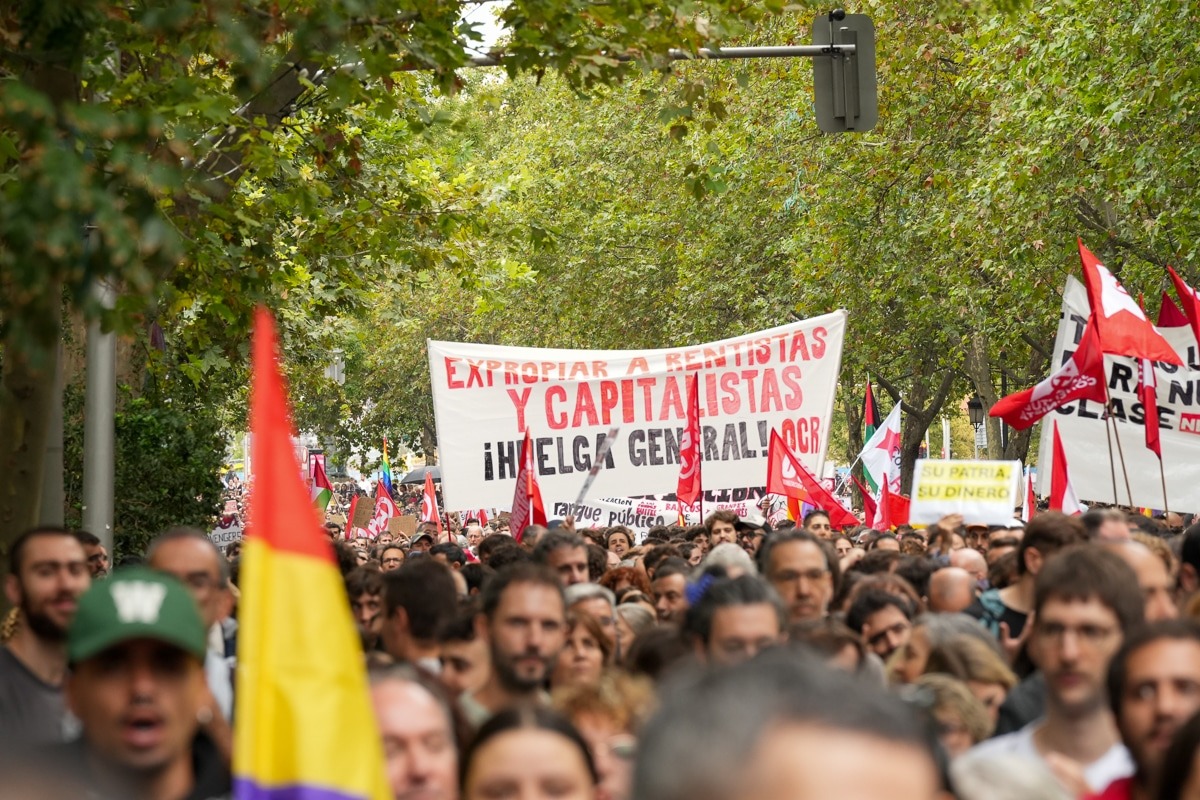
A wave of uprisings has spread across Europe, following protests against the state of public education started in France. Across the continent, workers and students are fighting back – not only against cuts which have worsened conditions for large swathes of the working class, but also against racism and police brutality, and in solidarity with Palestine.
In Belgium, teachers had been mobilising since 10 September, particularly in Liège, demanding better working conditions. Following the example of the student movement in France, young people in Belgium joined teaching staff and began picketing their high schools and taking to the streets in protest. In French-speaking Belgium, thousands of high school and university students shut down their institutions, responding to the announced €500m cuts to public education by 2029 and increases in university tuition fees, as well as the already miserable conditions of state schools. In Liège, where the protests were most intense, gatherings of more than three people in the city centre were banned for a period of 10 days throughout October. Police across Wallonia repressed protest using the same methods seen in France: with batons, tear gas, and flash-balls.
In Austria, a ban on headscarves in schools for girls under 14, effective since 1 September, led to approximately 5,000 students striking from 9 October across Vienna, Innsbruck, Graz, Linz and Bregenz. This is the first time the country has seen an action of this size against right-wing, liberal and social democratic parties alike. On 22 October, led by the Austrian National Union of Students, between 20,000 and 30,000 people opposed further plans to see €1bn in cuts across the next three-year budgetary period.
In Italy, the protests – which had initially focused on funding for education and against worsening school conditions – later formed wider mobilisations against rising fuel prices and the cost of living. ‘No Meloni Day’ (referring to Prime Minister Giorgia Meloni) on 16 October saw demonstrations take place across Rome, Milan, Turin, Florence, Venice and other cities, coinciding with climate crisis mobilisations involving ‘Fridays for Future’. This followed school occupations and student-organised actions protesting against the conditions of educational facilities and government measures to limit foreign students in classrooms.
From 17 October, sections of the protests, led by groups such as the people’s sovereignty movement Italia in Piazza, broadened their demands to encompass wider economic discontent. The wider social climate in Italy saw lorry drivers and farmers protesting and striking over diesel costs and the cost of living overall.
On 30 October, responding to international calls for a dockworkers’ strike against the arms trade and imperialist war, ports across Italy, Spain, France, Greece, Portugal, Sweden and Turkey were shut down by workers. In total, strikes disrupted operations at over 100 ports.
In Greece, students began protesting on 13 October in Syntagma Square, Athens, over student housing costs and lack of funding for public education. Tents were erected outside the Greek Ministry of National Economy and Finance, and the Hellenic Parliament, both as a blockade and to visualise the demonstrators’ point about lack of access to affordable housing. By 20 October, the protest had gained increased visibility, with nationwide demonstrations planned for 21 October in which at least 10,000 (according to police figures) took part.
Spain has been suffering a housing crisis from as far back as 2008. The eviction and subsequent death of 87-year-old Maricarmen Abascal, and the suicide of Olga Matute following her eviction, sparked renewed protests over lack of access to affordable housing, gentrification and landlord harassment. The Madrid Tenants’ Union (Sindicato de Inquilinas de Madrid), had organised eviction resistance in support of Abascal and called for a demonstration on 26 September which saw up to 300,000 people pave the way for spontaneous tent blockades in the middle of Puerta del Sol Square. Protests then spread across cities including Barcelona, Seville, and Zaragoza. By 30 September there were over 1,200 tents in Puerta del Sol and new encampments were set up in Barcelona and Málaga.
On 3 October demonstrations were held in over 50 Spanish cities, increasing demands for action against the housing crisis, whilst the General Confederation of Labour called for a general strike. A snap election has been called for 29 November, and a general strike from 11 November, supported by Workers’ Commissions, General Union of Workers, Galician Unions’ Confederacy, Basque Workers’ Solidarity and the Nationalist Workers’ Committees trade unions. Other less radical trade unions such as the Workers’ Trade Union (the third largest union in the country) and the Independent Trade Union of Civil Servants have opposed the strike, citing concerns about its ‘political nature’ and its timing, taking place 18 days before elections.
In neighbouring Portugal, what’s been described as one of the worst housing crises in Europe has also paved the way for protests, under the slogan ‘We can no longer live like this’. On 10 October, a camp was set up in Porto by Movement for Housing (Movimento pela Habitação), but by 12 October police had intervened to remove them. On 14 October, over 500 protesters collectively decided through a popular assembly to set up the encampment again with at least 20 tents. The police have continuously taken action to violently remove the camps and disperse protestors, with 13 arrested and dozens injured on Sunday 1 November alone.
In Germany, mobilisations took place in over 30 cities on 31 October. Nearly 200,000 people marched across the country, protesting against cost of living, education cuts, and the very real threat of compulsory military service. In Berlin, Cologne, Frankfurt and Hamburg, protests continued late into the evening, with young people directly confronting the police.
Across Europe, conditions leading to widespread protest are necessitated by the ruling class’s constant drive to protect capital, at the cost of working class living conditions. Unsurprisingly police in every country have acted in their role as protector of the state, using violence to protect the interests of the national ruling class. Despite repression, these movements can only grow as capitalist states show their utter inability to provide even half-measures in response to the basic demands of protestors. A spectre is haunting Europe – these are the forces which can destroy imperialism and smash the capitalist system.
Solidarity with the protesters! Power to the people!