

The British state is being repeatedly hammered in court in its attempts to criminalise pro-Palestine protesters. Jury after jury has refused to convict those who speak up for the Palestinian resistance or who carry out acts of direct action and civil disobedience against the Zionist war machine. On 21 August, veteran Jewish anti-Zionist Tony Greenstein – who had been charged under section 12 of the Terrorism Act in relation to tweets allegedly supporting Hamas – was declared Not Guilty by a jury at Kingston Crown Court. And on 16 September, Dutch activist Olax Outis – who in February spray painted ‘Free Palestine’ and other slogans on the statue of Winston Churchill in Parliament Square – was unanimously acquitted of criminal damage at Southwark Crown Court.
The state is desperate and constantly seeking new ways to curtail protest and criminalise solidarity. It is clearly a policy decision that on any occasion when a jury fails to reach a verdict, despite the cost and the strong possibility of repeated defeat, the Crown Prosecution Service will immediately demand a retrial. Among those currently waiting to be tried for a second time are Hanin Barghouti, Majid Freeman and Urslaan Khan, all charged under s12 of the Terrorism Act, as well as eight of the Filton 25 whose case ended in a hung jury in August this year. Across the country, in less high-profile cases, the picture is similar. The state is determined to get its pound of flesh from anyone who stands up for the Palestinian people, but is struggling to get the convictions it seeks.
Not content with trials and retrials, many other legal devices are employed in an attempt to exhaust and deter the pro-Palestine movement – remand in custody for lengthy periods, complex and draconian bail conditions, house raids and impounding of devices, contempt of court charges against barristers who stand politically with their clients. New laws and tightened amendments to existing laws appear all the time. Access to jury trial is under sustained attack, with the Courts and Tribunals Bill due for its final reading in the House of Commons on 13 October. If passed in its current form, this Bill, put forward by then Labour Secretary of State for Justice David Lammy, will greatly restrict the right to elect for jury trial in the case of alleged offences which could be tried either in a Crown or Magistrates’ Court, keeping some within the Magistrates’ Courts setting and instituting a new form of ‘non-jury’ Crown Court trial in front of a single judge. All this is designed to remove the input of working class people from the criminal justice system, leaving both determining guilt and sentencing in the hands of the generally right-wing judiciary.
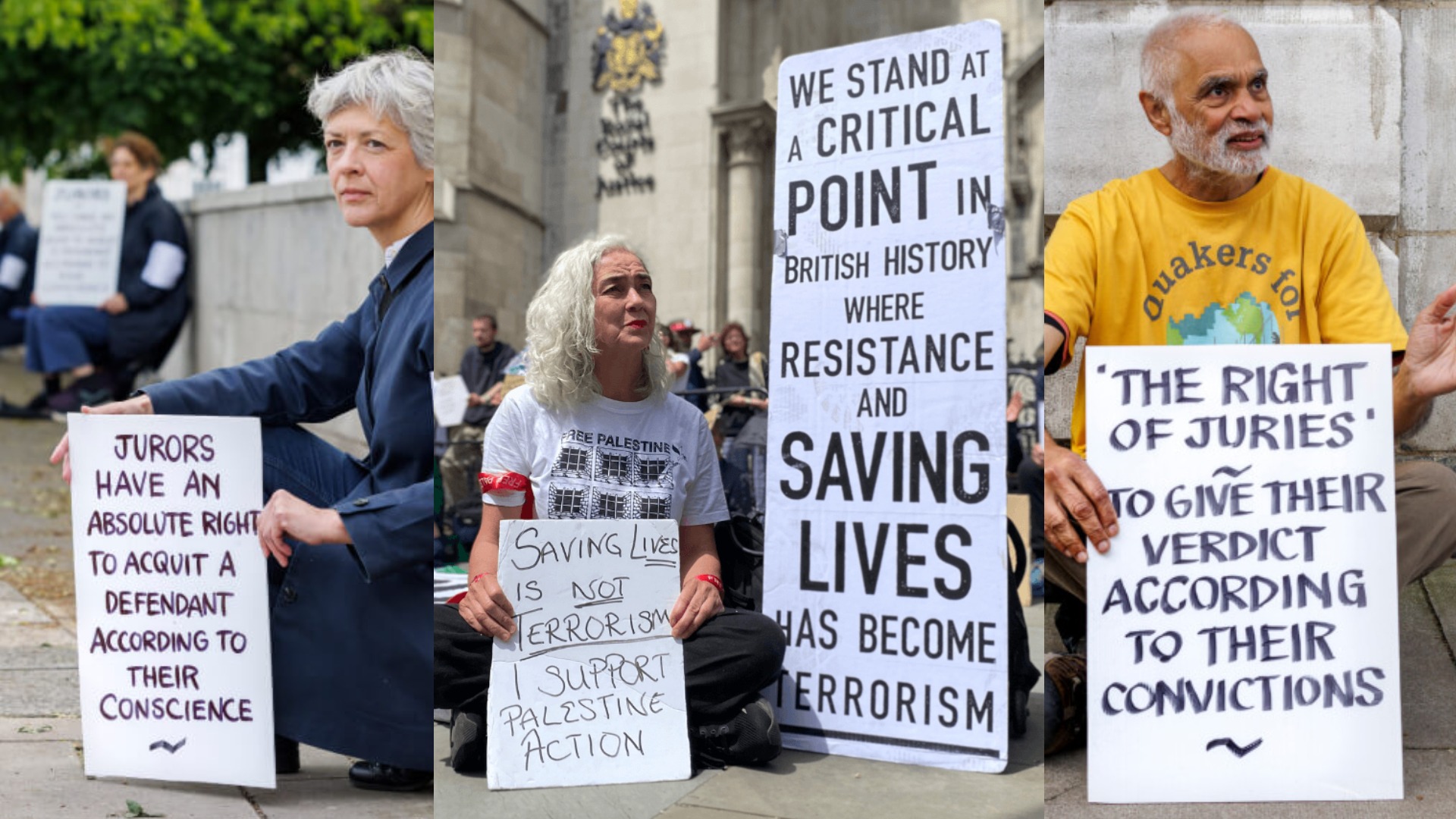
While the democratic space in which to organise is being constantly narrowed, the movement in solidarity with the fight for Palestinian liberation continues. Despite the pro-scription of Palestine Action under the Terrorism Act in July 2025, new direct-action protests take place weekly, while thousands of mainly elderly people have been prepared to put themselves on the line at protests organised by Defend our Juries in opposition to the ban on Palestine Action. As we go to press, the third Filton 25 trial is beginning at Woolwich Crown Court, and the Supreme Court is due to hear the final appeal against the proscription of Palestine Action. FRFI will be among those protesting at all these hearings, as we continue to make a stand for the right to defend Palestine.
Nicki Jameson