

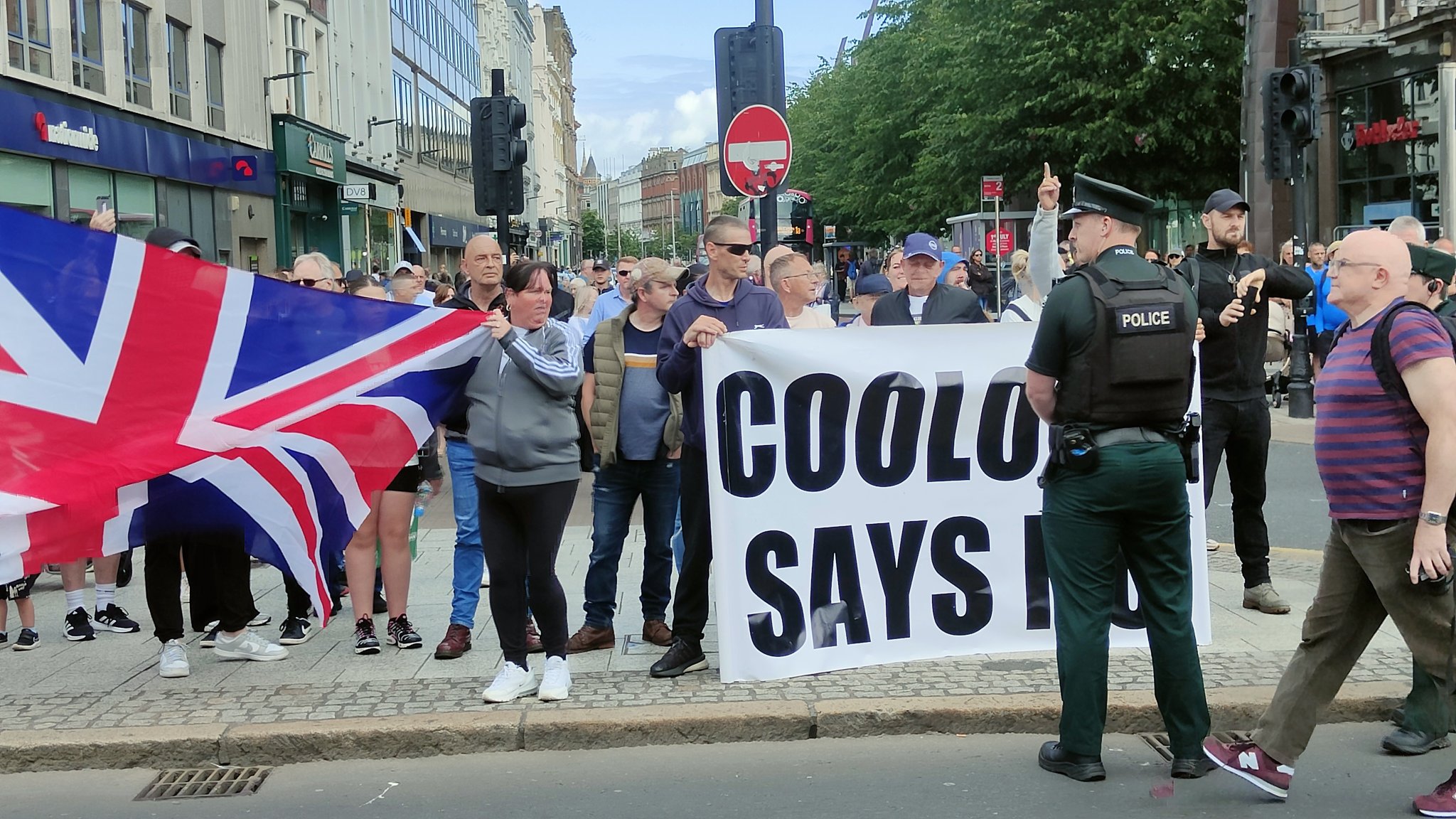
A spate of racist violence across the north of Ireland in June once again demonstrated the reactionary character of Loyalism and the refusal of the northern statelet to protect those under attack. Following a widely-publicised assault by a Sudanese man in a Nationalist area of Belfast on 8 June, protests and riots spread across towns and districts. Racist thugs attacked and burned homes of suspected asylum seekers and damaged vehicles. Migrant families were forced to flee for their lives. Images of burning houses flashed around the world.
This pogrom was concentrated exclusively in Loyalist areas, where the Protestant population identifies itself as British and not Irish. Reports emerged that the Police Service of Northern Ireland was aware months ago of a list circulating within Loyalist circles identifying migrant homes; the list included multiple occupancy housing and student accommodation. There have also been reports of minority ethnic healthcare workers being advised by the police to show identification to masked men operating illegal Loyalist roadblocks. Despite several nights of disorder, by 13 June just 23 arrests were made. No official accounting has yet taken place as to the number of homes attacked, vehicles destroyed or people displaced.
For Irish Republicans and Nationalists, the scenes evoked memories of earlier Loyalist pogroms against Catholics. The targets may have changed, but the methods are familiar: intimidation, organised violence and attempts to drive vulnerable communities from particular areas.
Twenty years ago, FRFI warned that racism was becoming an increasingly prominent feature of Loyalist politics. In 2004 FRFI argued that Loyalist racism could not be understood separately from the Partition of Ireland in 1921 into the ‘Free State’ south and occupied north, and the political tradition cultivated by British imperialism to maintain its rule in Ireland. In 2006 we wrote that ‘the intolerance and hatred directed at the Nationalist minority for generations is now also being aimed at anyone who looks or sounds foreign’. The events of recent weeks have once again confirmed that analysis.
Immigration to the north of Ireland
The latest attacks have been accompanied by a familiar political response. Rather than confront organised racism, Unionist politicians have sought to shift attention towards immigration itself. Calls have been made for stricter controls and for the reintroduction of a hard border between the north and south of Ireland. In doing so they legitimise the central claim advanced by the racists: that migrants are somehow responsible for the economic and social problems facing working-class communities.
Before the 1990s peace process, which ended the armed liberation struggle in Ireland, the north attracted few migrants. Immigration increased following the enlargement of the European Union in 2004 and growing demand for labour. Between 2001 and 2023 an estimated 293,000 long-term international migrants arrived in the north. Yet it remains the least diverse region of the United Kingdom. According to the 2021 Census, only around 6.5% of residents were born outside Britain and Ireland, compared with 16.8% in England and Wales and 13% in Scotland.
These figures undermine claims that immigration is overwhelming society or fundamentally altering the character of the north. The growth of racist politics in Loyalist areas cannot be explained by the scale of migration. It reflects deeper political and economic contradictions within sections of the Protestant working class. Migrants occupy some of the most difficult and poorly paid jobs in the economy. Around one-third of all jobs held by non-EU migrant workers are concentrated in health and social care alone. Far from undermining local workers, migrant labour has become an essential prop for significant sections of the northern economy.
To understand the present situation, it is necessary to understand the changing material foundations of Loyalism itself. For much of the 20th century sections of the Protestant working class enjoyed tangible advantages arising from the structures created through Partition. Access to housing, employment and political influence was shaped by systematic discrimination against Catholics. Loyalism emerged as the political defence of this privileged position.
The Civil Rights Movement of the late 1960s challenged the most blatant forms of discrimination. Subsequent decades of deindustrialisation destroyed much of the industrial base upon which working-class Protestant communities had depended. Manufacturing employment contracted, wages stagnated and many communities experienced long-term decline. More recently austerity, housing shortages and precarious employment have deepened insecurity.
The result is a profound contradiction. Sections of the Protestant working class continue to identify with a political tradition formed during an era of relative advantage while increasingly experiencing the insecurities associated with contemporary capitalism. Loyalism has no answer to this reality. It cannot restore the industries that have disappeared or reverse decades of economic decline. Instead, it seeks new scapegoats, directing anger towards some of the most vulnerable and exploited sections of the working class.
Republican response
The response of the constitutional Nationalist parties has been equally limited. Sinn Féin, like the other bourgeois parties, has condemned the pogroms but called for greater police intervention. Having accepted the institutions of the northern state, they can offer little beyond appeals for calm and confidence in policing. Yet recent events raise fundamental questions about the role of the state itself. How were Loyalist roadblocks permitted to operate? What action was taken when reports emerged of lists identifying migrant homes? Why were there so few immediate arrests despite the scale of the disorder?
More encouraging has been the practical solidarity shown by Republicans, socialists and anti-racist activists. In the hours and days following the attacks, support networks emerged to assist families forced from their homes and offer protection to those under threat.
The response of the Irish Republican Socialist Party (IRSP), however, revealed a deep rot in the movement. While correctly condemning the attacks, the IRSP argued in a statement on Facebook that immigration and ‘demographic change’ had exacerbated pressures on housing and public services. Housing shortages, underfunded services and social inequality are indeed real problems affecting working-class communities throughout the north, but they are the product of decades of capitalist development, austerity and political failure, not immigration. To present immigration as a factor contributing to social crisis is to give ground to racism.
Racism will be strengthened, not fought, through concessions to chauvinism or by scapegoating migrants for problems created by capitalism. A serious anti-racist movement must reject all attempts to divide workers, oppose Loyalist intimidation and challenge the economic and political conditions that breed insecurity and resentment. The fight against racism cannot be separated from the struggle against Partition, British imperialism and the system that continues to divide working-class communities.
With the 12 July annual Orange Order sectarian celebration approaching, minority communities will once again be bracing themselves for the possibility of intimidation and attack. Their security will depend not upon appeals to institutions that have repeatedly failed to protect them, but upon the strength of collective solidarity, organisation and community self-defence.
Paul Mallon