

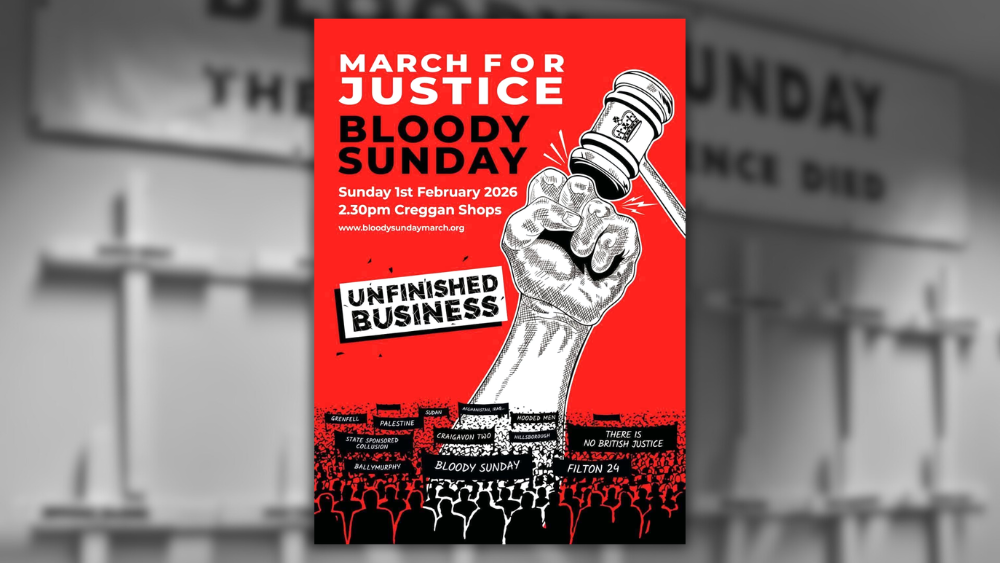
Another insightful ‘Bloody Sunday weekend’ in Derry took place between 30 January and 1 February 2026. Two FRFI Scotland supporters attended with FRFI papers and a banner.
This year was busier than last year with many young people, some of whom we know from our Palestine campaigning in Scotland, attending. In general, the event has become a popular gathering point for activists and groups from across Ireland, Scotland, England and Europe, making it a good opportunity to network, maintain and build new relations, as well as hear updates about campaigns for justice and different perspectives on local and world events.
This year marked the 54th anniversary of the 30 January 1972 massacre, when British paratroopers opened fire on a peaceful civil rights march against internment, taking the lives of 14 marchers, with over a dozen more injured by British gunfire and armoured cars. The only British military figure to have ever been put in the dock for this, ‘Soldier F’, was found not guilty of the murder of two marchers and the attempted murder of six more marchers by a single judge (non-jury trial) in Belfast Crown Court in October 2025.
The people of Derry are clear that the order for this murder went to the top of the British military/state. It was an attempt to terrorise a rising people off the streets at a moment of insurrection against the sectarian state. That there is ‘no British justice’ was a common theme of the weekend. Despite the hostility of Sinn Féin (and the SF-aligned ‘Bloody Sunday Trust’) to the annual march organised by the Bloody Sunday march committee, which they attempted to end in 2011 (here), it continues to attract popular community and international support, retracing the footsteps of the 1972 march and serving as a focal point for ongoing demands for justice, solidarity and support for resistance in Ireland and around the world. Palestine and Venezuela flags were among the flags we saw flying.
We attended book launches including those of the elderly Eugene Reavey (here) and also the former IRA volunteer and H Block prisoner Seamus Kearney (here). Both spoke engagingly and informatively about their families’ harrowing experiences and brave struggles, presenting new evidence of British state collusion with loyalists and British-recruited agents in the IRA. We were told many of the files held by the British authorities relating to the murders of Catholic and Protestant civilians, IRA volunteers and even the deaths of certain British military figures (here), have a British Government order on them which means they cannot be accessed for 80 or even 100 years. Kearney described how his efforts to find out more information about the execution of his brother – an IRA volunteer smeared as an informant – by what he believes were British-recruited agents in the IRA (Freddie Scappaticci or ‘Stakeknife’ was involved), were blocked by both the British and their Sinn Féin/Provisional allies.
One of the Dundee Palestine campaigners whom we attended the weekend with, a Dundee SPSC member facing Section 13 terrorism charges for holding a placard, is hoping to organise a Reavey book launch in Dundee.
As comrades noted, the ruthlessness of the British state in this period and its ultimate success in defeating the revolutionary war in the Six Counties, does not mean that they were or are all-powerful. The risen people of the Six Counties fought heroically and intelligently, threatening at times, particularly in the 1970s, to uproot the British state’s presence and imperialist interests in Ireland.
Another event we attended, on state violence against women, heard reports from an independent community worker from the working-class estate of Creggan on the ‘political policing’ of the community; recent statistics expose the sectarian nature of policing by the PSNI – the repackaged RUC – in Derry today. Police stop-and-searches, armed raids on the houses of activists, use of spit hoods, etc, are disproportionality concentrated in republican working-class areas. Harassment of the families of activists, covers everything from denial of welfare to social workers at schools and personal bank accounts regularly and permanently closed. The oppressive reality was made clear.
We also heard from the Dublin sex worker group Red Umbrella about the harassment women face struggling against state harassment, male/police violence and poverty. Other speakers we heard from across events included the father of Jordan Devlin, one of the Filton 24; a representative of the Hillsborough families; Irish comedian and recent Gaza flotilla participant Tadgh Hickey, and more. Some contributions were of more interest to us than others. Independently organised events by Irish republicans, which tend not to feature in the Bloody Sunday March Committee programme owing to the involvement of reformist figures like Eamonn McCann, were also held throughout the weekend eg the Kearney book launch was organised by the 1916 Societies and there was an Irish Republican Prisoners Welfare Association meeting.
Prisoners for Palestine organisers, including former political prisoner Francesca Nadin who was interviewed in FRFI, were at the weekend too. The book fair was lively and busy, with a mix of anarchist fringe events, and republican and internationalist literature.
The march on the Sunday was attended by what must have been over 3,000 or 4,000 thousand people. We marched with our Dundee banner reading Fight Racism! Fight Imperialism! workers and oppressed of the world unite which despite dating from the 1980s remains in better condition than some of our more recent ones!