

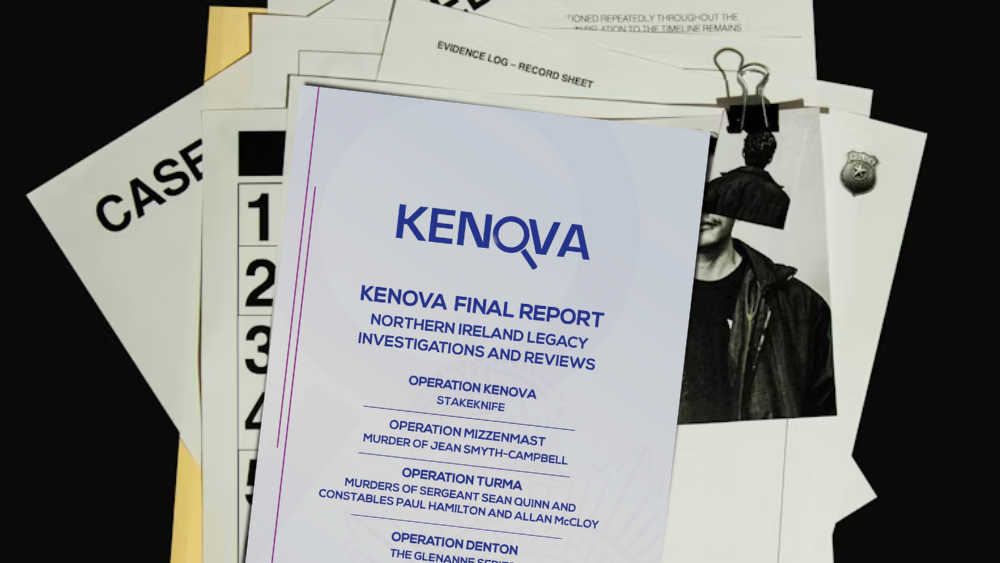
The Operation Kenova Final Report, published on 9 December 2025, is the outcome of a nine-year investigation, examining the activities of a senior British agent, run at a high level inside the Provisional Irish Republican Army (IRA), who was involved in multiple killings, and assesses whether British state agencies committed criminal offences in the course of handling him.
The report was released with the full choreography of state authority: sombre press conferences, tightly controlled media briefings, and renewed speculation over whether the British government would finally name the agent long known by the codename ‘Stakeknife’. The Kenova report was presented as a moment of reckoning – a careful, victim-centred attempt to confront the darkest practices of Britain’s intelligence war in Ireland. Yet it was never designed to explain that war. Its function was instead to manage how British imperialism’s conduct of the war against the Irish people is remembered and ultimately to neutralise it in the public mind.
What Kenova was set up to do – and what it was not
Launched in 2016, Operation Kenova was given a tightly defined remit. It was tasked with assessing whether there was evidence of criminal wrongdoing by the agent, and whether members of the British Army, intelligence services, or other state bodies had committed offences in relation to his activities.
What Kenova was not asked to examine is just as important. It was not mandated to investigate the political objectives of British rule in Ireland, the logic of counter-insurgency, or the role of policing and intelligence in defending partition. It was instructed to examine conduct while excluding purpose.
As the Peadar O’Donnell Socialist Republican Forum observed in its response to the report, ‘The Kenova report itself is an MI5-driven smoke screen, designed to hide the involvement of the highest echelons of the ruling class. Those at the political top must be protected at any cost.’
The machinery of British rule
From 1969, when the Labour government sent troops into the north of Ireland, until signing of the Good Friday Agreement in 1998, British rule in the Occupied Six Counties was enforced through a dense apparatus of military, police, and intelligence bodies. Central to this were the Royal Ulster Constabulary (RUC), a heavily armed police force overwhelmingly drawn from the unionist population, and the Ulster Defence Regiment (UDR), a locally recruited regiment of the British Army deeply implicated in sectarian violence.
These institutions did not operate at the margins of policy. They were its frontline. Alongside them sat Special Branch, military intelligence units, and the security services, whose task was not simply information-gathering but the penetration, disruption, and management of resistance.
Kenova acknowledges the existence of this apparatus, but only in fragments. It documents failures of oversight while refusing to examine the political project those failures served.
Collusion as structure, not aberration
Kenova concedes that collusion occurred at the level of individual officers within the RUC, the UDR, and the British Army. It acknowledges flawed investigations, lost evidence, and an institutional reluctance to confront loyalist paramilitary violence. Yet it insists that it found no overarching state policy of collusion.
This claim does not withstand scrutiny. Multiple official inquiries have established systematic cooperation between state forces and loyalist death squads. Intelligence was passed directly to gunmen. Weapons were facilitated. Suspects were protected. Investigations were obstructed or abandoned.
The Glenanne network, involving members of the RUC, UDR, and loyalist paramilitaries, was responsible for more than 120 murders of people in the Irish nationalist community. To deny that this constituted strategy is to deny the logic of counter-insurgency itself: terrorise communities, fracture social support, and isolate resistance.
Stakeknife and the narrowing of responsibility
By focusing on one agent, Kenova invites moral outrage while obscuring the wider system through which British intelligence operated. Intelligence work does not function through isolated individuals but through networks designed to penetrate organisations, influence decision-making, and reshape political outcomes.
There has long been credible speculation that other high-level agents remain unnamed. This is the logic of deep penetration: longevity, influence, and strategic access. The 2002 IRA break-in at Castlereagh police barracks, where classified intelligence files were removed from one of the most secure sites in Europe, reportedly revealed a level of infiltration that was profoundly destabilising.
Infiltration was not incidental. It affected internal debates, generated mistrust, and weakened organisational cohesion. The aim was not simply surveillance but the shaping of political direction.
British counter-insurgency did not rely solely on armed penetration. It cultivated agents of influence – individuals positioned to guide political development and manage outcomes. Kenova cannot address this terrain without exposing the political strategy underpinning the so-called peace process. It therefore avoids it entirely.
Continuity, not exception
The doctrines espoused by General Frank Kitson – pseudo-gangs, deniable units, controlled agents – structured British operations from Kenya to Belfast. Kitson’s thinking permeates the conflict and is crucial to an understanding of the role of Stakeknife and other such agents; yet Kenova never names him.
The current Undercover Policing Inquiry (UCPI) has shown how British police infiltrated anti-racist campaigns, trade unions, tenants’ groups, and left-wing organisations, using deception and long-term surveillance to disrupt political activity. Policing in Britain is always political policing: ‘a system designed to monitor and contain political opposition, not respect it’.[1] The UCPI has confirmed this: officers stole identities of dead children, formed sexual relationships with activists, sabotaged campaigns, and lied under oath for decades. These are not police excesses; they are imperialist techniques. British imperialism applies the same logic everywhere: identify dissent, infiltrate it, fracture it, neutralise it.
Why Kenova matters now
Kenova’s publication coincides with the British government’s 2023 Legacy Act, which restricts investigations, weakens inquests, and centralises control over historical truth. Together they represent a reorganisation of impunity: acknowledgment without accountability, process without justice.
Our task is the opposite: to name British imperialism, expose its methods, connect the dirty war in Ireland to political policing in Britain, and build the movements capable of challenging it.
Justice will not come from inquiries designed to paper over the past. It will come from struggle – conscious, organised, internationalist, and fearless – against imperialist power.
Paul Mallon
[1] Jane Bennett, ‘Justice? Only Under Capitalism’s Terms’, FRFI No. 149, Aug/Sep 1999.