
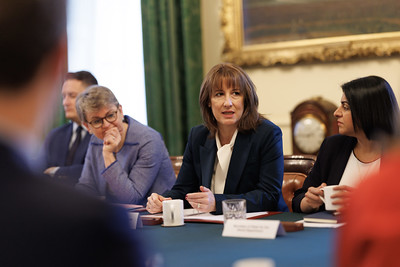
Chancellor Rachel Reeves’ Budget Statement of 26 November spotlighted a government trapped between the deepening poverty and frustration of a growing mass of the working class, and their opponents, the owners of capital pursuing their profit-making interests. The median standard of living of workers in Britain has not risen from that of 15 years ago, while British capitalism struggles desperately to accumulate more wealth for itself. The fundamental contradiction of capitalism between workers’ needs and production for profit is highlighted for all to see. The budget shows how impossible it is for the state to moderate this deepening contradiction, so that the attack on the working class by the state is now being extended to the once-protected middle classes. JAMES MARTIN reports.
After 16 months of twists and turns, Reeves has raised taxes again. She faced three options as she battled to contain fractures in the Labour Party and make concessions to business: she could (a) borrow in breach of her fiscal rules, both to prevent further deterioration of state welfare provision and to subsidise businesses short of capital, small or large; (b) cut spending, fracture the Labour Party and lose her job; or (c) increase taxes, risking vote losses from the working and lower middle classes. International lenders have blocked the first option, after all, the task of the bourgeoisie is to spend money as capital not on unproductive consumption by workers. This left Reeves with ‘options’ two and three.
The key budget announcement was the extension of the existing freeze on personal tax thresholds for three more years. This sneakily takes advantage of the workers’ fight-backs against inflation, so that as money wages rise these workers find themselves paying some or more tax. By 2029-30 a quarter of taxpayers will fall into the higher and additional tax bands, which will raise almost £8bn a year. An additional 5.2 million employees will have been affected overall.
Reeves’ second key political step was to abandon the 2015 (effective 2017) two-child benefit cap in the face of the anxious concerns by Labour MPs over the threat to their seats coming from this cruel policy. This will cost £3bn per year and remove 450,000 workers from the official poverty statistics. However, the change only comes into effect next May, after nearly two years of a Labour government’s pitiless delay. In any case this £3bn will be taken from the tax extracted by freezing the tax thresholds and so is simply transferring more of the employed workers’ already stagnant real wages to their unemployed and impoverished fellows. The wealth of the ruling class remains untouched.
These decisions sat among a panoply of some 75 tax changes, in a combined effort to offend as few of those Labour MPs with small electoral margins as possible. A year after delivering a large tax-raising budget she had no choice but to renege on her promise not to take more.
An inevitable assault
In its attempts to muffle working class protests and quieten private investors, the British state has imposed 15 years of austerity yet accumulated a mountain of debt: from 60% of GDP in 2010 to 96.4% of GDP (1 November 2025). It is determined to reduce it. As soon as possible, in November 2024, Reeves removed pensioners’ winter fuel allowances and in March 2025 she also attacked health related benefits but was forced by Labour Party dissidents to rescind or delay parts of both those assaults on the working class. On the other hand, she reluctantly antagonised employers by raising their National Insurance Contributions (NICs) and the minimum wage, and so raised £40bn, filling the ‘black hole’ of £21bn ‘discovered’ in the previous government’s plans. However, this left her with very little room for manoeuvre if she wished to keep to her key fiscal rule: that the current budget should be on course to be in balance or surplus by 2029/30 (‘stability rule’). She also promised to reduce net financial debt as a share of the economy in 2029/30 (‘investment rule’) and pointedly, must hold roughly half of welfare spending below a pre-specified level (the ‘welfare cap’). Better economic growth was essential for her to keep to these rules and prevent disproportionate amounts of more debt interest being paid to international lenders. Finance capital had demanded Labour ‘balance the books’ at the expense of the working class, by imposing the highest interest rates of any G7 country, recently touching 5.6%.
Middle class workers, and those who aspire to be such, are now also being targeted by the tax increases and spending cuts. Previously announced cuts to central government will see, for example, 1,000 privileged Foreign Office staff made redundant, and the imminent sacking of 18,000 health administrators (saving £1bn). New tax rates will apply to landlord rents, dividends (from 2026-27) and savings income (from 2027-28). Allowances for some pension and other schemes are restricted. The so called ‘Mansion Tax’, a new supplement to the Council Tax, will fall mostly on three London boroughs. Other measures such as reducing electricity bills by the cutting of green levies, or taxing road use by electric vehicles, is no surprise, simply more of the same desperate juggling in the face of a virtually stagnant capitalism and widespread discontent with the entire system.
The law of profits
Britain has the lowest share of investment when compared to GDP among the G7 countries in 24 of the last 30 years. Britain’s non-financial companies’ profit rate – even at inflated prices – has fallen over the last decade and is now at 8.8% compared to 12% in 2014. To renew accumulation – ‘economic growth’ – profits must rise. For this, the ruling class must constantly reduce the proportion of the value of the economy’s total output returned to the working class. This is the rule of capital, the law of profits. The cuts already imposed over the last 10 years are demonstrated by our poorer diet, poorer accommodation, ever less secure employment, longer waits for medical treatment, crowded and decrepit school rooms, failing social care for children and the elderly, heavily indebted further and higher education, disastrous local authority finances and bursting prisons. This budget confirmed the rule: net taxes will rise, and by 2030 the government will not spend all that it receives. For the moment then the stock markets rose cheerfully, but the future is very uncertain. The critical question is can the rate of capital accumulation be levered up?
Leaks and squabbles
On 27 October, a leak from the Office for Budget Responsibility (OBR) showed its estimates revised down for the GDP growth rate over the next five years; down by 0.3 percentage points to 1.1%. That created a speculative £7bn to £21bn public ‘hole’ in future government finances. A supposed deficit figure of £30bn was then quickly spirited up in the ruling class press (£50bn for The Metro paper) to prepare everyone for a rise in income tax, contrary to Labour’s election promises. Reeves allowed the inference that income taxes would be raised by 2 pence in the pound (with NICs cut by 2 pence). Being ‘tough’ would please the financial markets.
However, by 12 November, after bitter rows in the Labour Party – including speculative threats to Keir Starmer’s leadership – the OBR ‘discovered’ that matters were not so bad after all! It suddenly indicated a budget deficit of nearer £21bn rather than the previous dramatised £30bn-£50bn. The income tax threat was withdrawn. By budget day other leaks and announcements had all but revealed all Reeves’ key plans, which were then presented in full in a premature publication by the OBR, 15 minutes before her speech.
Poverty
Reeves had no choice but to remove the two-child cap on universal credit or tax credits. The number of people in poverty in working families had dramatically increased as a proportion of all impoverished workers since the 1990s. Conditions of child poverty have reached critical levels with 4.5 million children (31% of all children in Britain) in poverty in 2023/24, a record high and a rise on the previous year. 72% of these are in working families, demonstrating the extent of poverty wages. 3.1 million of these children are in families with incomes below 50% of the median income, an increase of 200,000 from 2022/23. The poverty rate is higher in households with three or more children (44%) and in lone-parent families (43%). The average person in poverty had an income 28% below the poverty line between 2021 and 2023, up from 23% in the mid-1990s. Reductions in benefit entitlements since 2010 pushed this disastrous trend, as well as rising unemployment among the young. From July to September 2025, 702,000 young people aged 16 to 24 were unemployed, 60,000 more than in 2024, with an unemployment rate of 15.3%, up from 14.8%.
Fake optimism
Reeves made optimistic references to lower borrowing costs, since the rate of inflation has reportedly fallen to 3.6% (though not for food costs at 4.9%) but is still higher than in the EU (2.6%). Awkwardly referring to international trade deals signed (forced by Brexit and Trump’s tariff war), she could not disguise the difficult position the British ruling class now finds itself in. From 1997 the overall balance of trade in both goods and services has been negative, and the deficit has consistently increased. This presents a serious foreign currency problem ‘solved’ by encouraging the import of capital through the sale of local assets. Brexit has proved an additional economic disaster at a long run cost of 4% to GDP. Britain has been a net borrower from the rest of the world, in a position of international financial debt, every year since 1984.
None of Reeves’ measures have avoided the reality that the government debt will continue to increase, despite the Chancellor’s belief that it will begin to fall at the end of the next five-year period. Spending has been frontloaded and taxes will bite in the two years before the next election. Politically it is certain that taxes will have to be increased further and/or state spending cut in the next budget. As capital accumulation continues to stall, trapped between international creditors and the demands of the working class, the attempt by the state to support British capital cannot proceed without a more intense attack on the working and lower middle classes.
Who pays?
The source of all taxation is the fresh value added daily to existing capital by the working class. Only part of this newly added value is returned as wages. The rest is kept by the owners of the means of production. The claim that employers are making a personal sacrifice when paying some of this as taxes is therefore nonsense. All taxes are ultimately paid by labour. Finding temporary fixes to the subsequent redistribution ‘problem’ – after the original theft from workers of the results of their labour at work – is the purpose of the annual budget.
In October, the UN special rapporteur on extreme poverty and human rights, Olivier De Schutter, in the face of rising ‘right wing populism’, anxiously stressed that welfare payments are an ‘essential tool to maintain the social fabric of society, rather than a cost to be reduced’. He fails to grasp the outdatedness of this strategy for British capitalism. The ruling class is determined to cut back state welfare to reduce spending on capitalistically unproductive work, as it struggles to boost its wealth. An ideological assault has been launched on migrants to promote nationalism and flag-waving racist chauvinism across all imperialist states to strengthen compliance with state authority, necessary for the intensification of domestic exploitation of workers as a whole.