

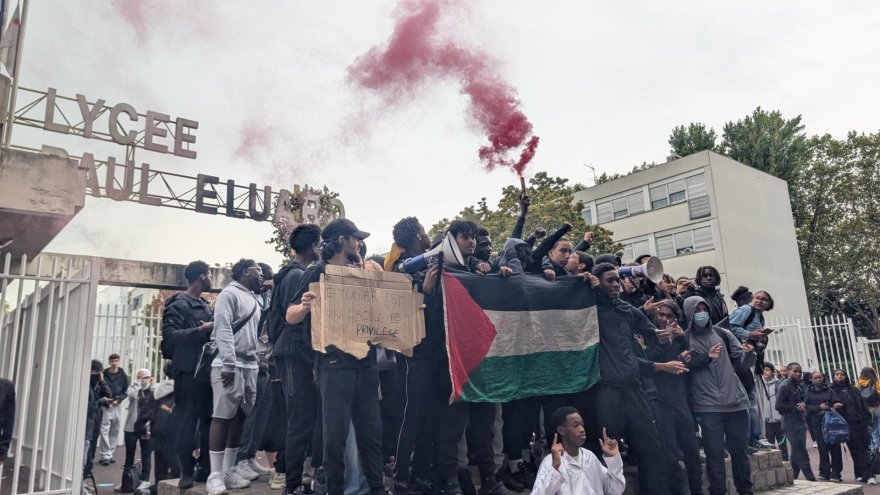
Since late September, secondary school students across France have risen up in protest against the state of public education, left crumbling after years of cuts and ‘efficiency’-maximising reforms. They have walked out, blockaded entrances and even set fire to school buildings.
Over a matter of days, mobilisations spread to hundreds of schools involving tens of thousands of young people, most under 18 years old. Led by the most oppressed among them – Black and Arab youth in deprived suburban estates, the banlieues – these demonstrations have taken on a radical anti-imperialist and anti-racist character. Faced with brutal repression from the police, French youth have doubled down on their demands, linking their struggle for education to the fight against racism, against capitalism and the movement in solidarity with Palestine. They are showing young people everywhere what it means to fight for your future.
Students organise
The protests of the past weeks began with a handful of school pickets on 18 and 21 September. Secondary school students refused to go to class, choosing instead to blockade their buildings, demanding better learning conditions, more resources, and the abrogation of parcoursup, the French equivalent of UCAS, which leaves upwards of 10% of school leavers with no place at university every year. These first pickets took place in Parisian suburbs; areas which rank among the poorest in the country, and the most diverse in terms of migrant communities. Schools in these areas have never received the resources necessary to support their students, and cuts over the past years have made a bad situation worse.
On 28 September, mobilisations were taking place at over 300 schools across the country. A 29 September public sector strike, in which many professors joined their students in protest, spread the protest movement further. By 2 October, nearly a third of all of France’s high schools had been affected by the movement, and university students were joining, picketing their own institutions.
Despite government attempts to placate the movement by offering ‘consultations’, student organisations have pledged to continue protesting. More mobilisations took place over the weekend of 4-5 October, and a mass demonstration is planned for 6 October. Students are organically making links between their movement to broader issues; recognising the need for an alternative system which can actually deliver what they are demanding.
Police repression
The state, struggling to contain the righteous anger of mobilised students, has resorted to brutal and bloody repression. Over five thousand people, most of them minors, were arrested by French police over one week – more than at the height of the Gilets Jaunes movement of 2018-20 or even the May 1968 protests. In Tours, a 16-year-old boy lost use of his right eye after being hit by a flashbang grenade. In Lens on 5 October, a 15-year-old student had his hand blown off by a police grenade. In St-Ouen-l’Aumône, near Paris, police fired a tear-gas grenade launcher into a 14-year-old boy’s face at point-blank range, and in Blanc-Mesnil, a student was hit by an officer on a motorcycle. Images of the scale and violence of repression have received thousands of views on social media. Yet in the face of such repression, youth remain undeterred.
Alongside the savagery of the police, the government and reactionary political forces have done everything they can to attack and delegitimise the movement. Local authorities have preemptively shut down public transport and closed schools to prevent protests. Preparing for the aftermath, the government is attempting to rush through Parliament an anti-rioting law which could see protesters fined up to ten thousand euros simply for being part of a protest which resulted in damage to property.
Liberal and social democratic politicians have claimed to understand the legitimate demands of the students, while attempting to sow division between the ‘good’ peaceful protesters and the ‘bad’ violent ones – a racist narrative pitting youth from the banlieues against their more privileged counterparts. Against this, students have continued to present a united front, calling out the racism of the French state and asserting the legitimacy of the banlieues’ resistance.
An example to follow
The protests are about much more than just learning conditions. They are the expression of young people’s anger in the face of environmental catastrophe, bleak employment prospects, war on the horizon, and the daily reality of state racism. Leading the way, students have left the ‘traditional’ organisations of the left in the dust as they struggle to match the militancy and energy of the youth.
Here in Britain, the situation of young people is no better. The British ruling class has made clear its intentions to make further cuts on public spending and shove young people into low paid, low skilled work. The response of French youth to the crisis of capitalism must inspire us all: if we want a better future, we will have to fight for it.
Sarah Guebre-Egziabher