

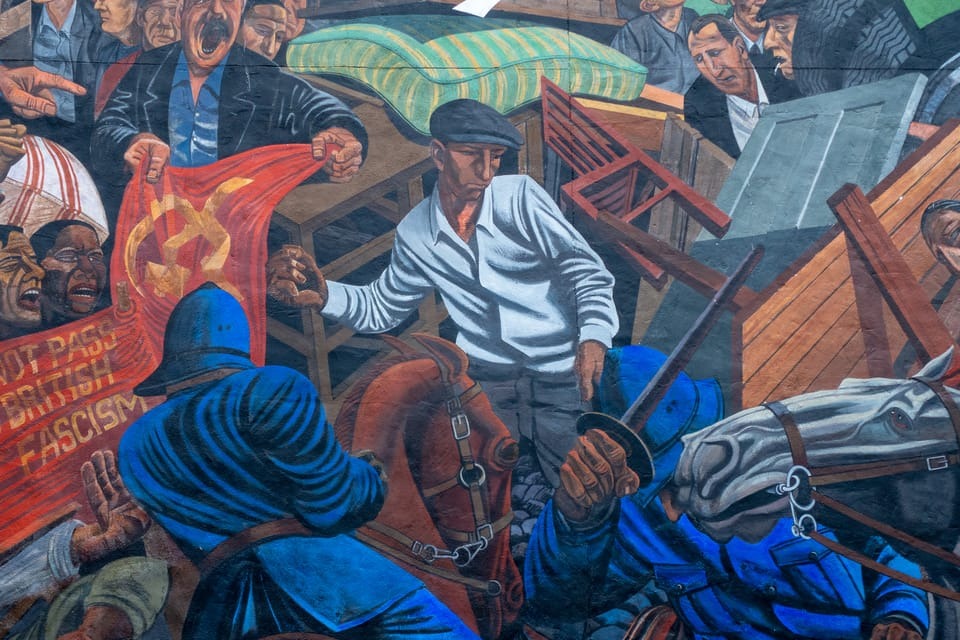
4 October 2026 is the 90th anniversary of the iconic Battle of Cable Street, when the united working class of London’s East End decisively saw off the attempt of Oswald Moseley’s fascist blackshirts to march through their area. FRFI spoke to Janet Simon, the daughter of Joe Jacobs, the East End communist whose meticulous history of the Cable Street period is documented in the book Out of the Ghetto, which we reviewed in 1992. Janet is currently active with the International Jewish Anti-Zionist Network in solidarity with the struggle of the Palestinian people against oppression and genocide.
FRFI: Please tell us something about Joe, your dad. What were the principles that guided his political life in the East End in the 1930s? How did this lead him into confrontation with the Communist Party?
Well, he was just a regular member of the Communist Party, like everybody else at that time. They were people in the Jewish community, in the Irish community, who were living in very poor conditions.
He didn’t have a problem with the Party until 1933-34, when they started to be more ‘Popular Front’. And at that time the party leadership started to object to certain things that they were doing locally. Basically, they did a lot of street work, but the leadership wanted to work more in trade unions and move towards the Labour Party.
He was expelled from the party in 1936 or 1937, at the end of all this, and he’s probably one of the only people ever to have been expelled from the Communist Party twice because he actually rejoined after the war, and was expelled again in the 1950s. And the irony is that in the 1950s, he was expelled was because he was spending too much time on trade union work, because he was involved in the factory occupation and not enough time on street work. So, it was the opposite to what they objected to in the 1930s, when they said he was spending too much time on street work and not enough time on trade union work.
But what he was doing was just responding to what was happening around him and to the rise of fascism. It was happening everywhere – in Hyde Park, in Olympia, and anti-fascists did counter-demonstrations, and occasionally fights broke out and there were confrontations with the police. And although in theory the Communist Party supported them, they were getting more and more hesitant about it.
And also, he was beginning to notice what was happening internationally. This was the period when they were becoming more part of the Popular Front and getting closer to the social democratic parties.
He wasn’t able to go to Spain himself for family reasons. He nevertheless supported the people who went. And in actual fact, he had a close friend who went to Spain, and this was a member of the Communist Party who had gone with the brigades sponsored by the Communist Party. And he also had a brother who went with the anarchists.
He was still a member, and he was still a loyal member. In fact, there’s a point at which he wanted to go to Moscow and complain. Thankfully, he didn’t! But he was still a loyal member of the Communist Party, and he would have stayed in it. But it was them who kicked him out.
Presumably, Cable Street was the crunch point and where his growing dissatisfaction with the Party strategy came to ahead?
Yes, even though he actually got his way. The Communist Party wanted everyone to go to Trafalgar Square and support the Spanish Civil War. There’s a flier reproduced in the book which you can see was originally for Trafalgar Square and was printed over with the call to Cable Street at the very last minute. They printed it over because the groundswell was so big, they couldn’t do anything because they knew that people were going to go anyway. It wasn’t just members of the Communist Party, it was the local Jewish population, the local Irish population, they were going to fight the fascists with or without the Communist Party.
And there were a quarter of a million people there. So, they had to do that. But the book shows that this decision was taken only at the very last minute.
So, apart from Joe Jacobs being your dad, and the history being of general interest, why did you want to make sure it was published? What did you think the political importance was?
Unfortunately, he died quite young. He was only in his 60s and he hadn’t finished the book. It would have been much better and in much more detail if he’d been able to finish it, but instead I had to cobble some of it together from his notes and extrapolate from what I remember him telling me.
There’s a lot of stuff in the book about his life, but that’s why he wanted to write. It was kind of an autobiography, and it’s written very, very much the way he spoke. And because he was an autodidact, he didn’t have any formal education at school, but he was a writer.
My background, academically, I was a historian. I gave up afterwards and did other things, but I studied history and I studied French history to quite a high degree and I was married to somebody who was actually very prominent in the French movement in 1968. So, I was part of the movement. And then when he died – he hadn’t been that well, but it was quite sudden – we had this manuscript and we knew it needed to be published, because people need to know what happened.
What was the reception to the book like?
When we wanted to produce it, we got the manuscript together and it was all typed out, but we ended up self-publishing it. We had tried various publishers like Pluto Press, but they wanted to cut bits out. They wanted to censor it.
We took it to Raphael Samuel, who was the local historian. He said, ‘Oh, this is great’. But he wanted to censor it. Everyone we went to wanted to cut stuff out because it was critical. And because he wasn’t around, I didn’t think that I could touch a word and that everything had to stay as he wrote it because I didn’t have permission to cut it. Obviously, there’s a certain job you do if you transcribe something, but otherwise it is word for word. And in the end, we got some people called Bread and Roses Calverts Press, and they agreed to print it. And we set up a subscription for people to pay so we could get the money together to do it. Today, it would be a crowdfunder. So, it wasn’t actually published by anybody.
And then we had to go hawking around the shops. And for these reasons, it might not have made the big mainstream press, but the reason there wasn’t very much in the left wing press of the time was because they didn’t really want to engage with it, even critically.
Now it’s the 90th anniversary of Cable Street. And we can see that even the Board of Deputies of British Jews are celebrating it. But I’ve also seen some stuff in the Morning Star and in fact there’s an article there critiquing other parts of the same publication’s coverage and saying that we shouldn’t forget that at the heart of it were Jews and communists.
They were all members. They were all communists. They were all members of the Communist Party. But they decided to do what the Communist Party leadership didn’t want them to do because everybody, including them, were going to come out anyway. All the people who were members of other parties took their lead from the local people who organised to protest against the fascists and of those local people many were members of the Communist Party. The movement was led by the people of the area, but a lot of the organising was done by communists.
The people that turned out were the local people. There was a Jewish population; there was an Irish population, and they were the dockers. These were the people who lived there. And they would have turned out anyway.
And another thing that is important and is described in the book is that they didn’t actually fight with the fascists; they fought the police because the police were protecting the fascists.
I think it’s important that the message gets through, not just because of what happened but because it’s being taken over now, not so much by the communists, but by a lot of official Jewish organisations, including people like [Zionist actress] Tracy-Ann Oberman, who did a play about it. It’s important to say that these people, like my father, they weren’t any kind of militant anti-Zionist. But they didn’t talk about it. It didn’t mean anything to them at all. They didn’t feel any link to Israel. My dad had a friend, whose son went up in the world a bit and moved to Golders Green in the 1960s, and he became a serious Zionist. But all his friends and relations just thought he was odd. So, none of this history is anything to do with Zionism.
And it is important to set the record straight because one of the things that the Board of Deputies said, and indeed the Communist Party implied was ‘keep your head down, don’t make a fuss,’ because otherwise they will have a go at you. And that is the main message – don’t keep your head down! Because what is important about this history was that it worked.