

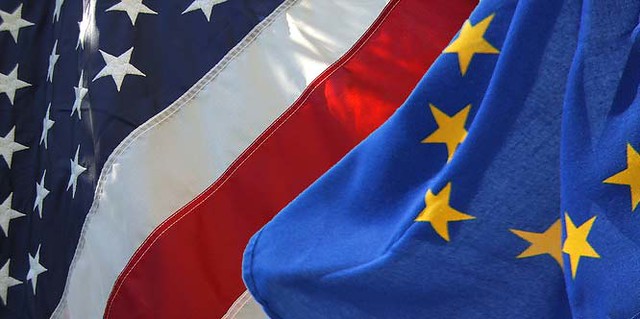
Since the Trump administration imposed sweeping 15% tariffs on most European Union imports in July 2025, US and European imperialism have been locked in an open economic and political struggle. The cited justification was an intolerable $200bn US trade in goods deficit with the EU. The European imperialist bloc is a major economic competitor to US imperialism, which, under Trump, is enforcing tough measures to buoy its domestic industry at the expense of its rivals. As the crisis deepens, these forms of economic warfare – tariffs, sanctions and trade threats – become increasingly aggressive. They are a prelude to further political and ultimately military escalation.
On 22 September the US announced EU member Denmark will allow the construction of two US military bases in its autonomous territory Greenland, described by Trump as giving the US ‘permanent control over [Greenland’s] security’. While EU leaders presented this de-escalation as a victory, they have been strong-armed into conceding Euro-pean political control over Greenland to the US. In January 2026 the Trump administration threatened to annex Greenland. This is not just bluster: US imperialism has very real interests there. It contains some 30 billion barrels of oil equivalent in fossil fuels, equal to around 20-30% of total US reserves, which the US wants to wrest from EU hands. The US plans to use Greenland as a military buffer zone against China and Russia – it lies on the shortest missile flight path between the US and both countries. Both the US and EU are indifferent to the wishes of the indigenous people of Greenland.
Another area in US imperialism’s sights is Canada. Like Greenland, Canada is near the US and possesses vast oil reserves, the fourth largest in the world. The Trump administration has sought to militarily assert control over other oil-rich nations, most notably Venezuela and Iran. Since his second term began in January 2025, Trump has publicly threatened Canada by referring to it as the 51st US state. On 27 August he signed an executive order for renaming Lake Ontario ‘Lake America’. On 23 September Canadian Prime Minister Mark Carney told the New York Times that Canada is preparing for the ‘extreme tail risk’ of US military action.
The European imperialist bloc has moved to exploit the tension, with EU Commission President Ursula von der Leyen calling for Canada to become an ‘associate member’ of the EU on 16 September. The EU proposal is symbolic. Canada’s economy is deeply integrated with the US’s. 70% of Canada’s exports go to the US, and its industrial and logistical supply chains are tied to the US. EU ‘associate membership’ would do nothing to dent Canada’s dependency on the US. It is instead a political manoeuvre aimed by the EU to cut preferential deals with Canada in important sectors such as critical minerals, energy and AI at the expense of the US. Trump described it as a ‘hostile act’, threatening ‘very serious tariffs or [to] stop trading with Europe on many things’.
The Trump administration is pursuing a variety of levers to apply political pressure to European imperialism, aiming to weaken the bloc so it can be subordinated to US interests. In its November 2025 National Security Strategy, the Trump administration accused the EU of ‘undermin[ing] political liberty and sovereignty’ and pledged to ‘cultivat[e] resistance to Europe’s current trajectory within European nations’. In practice, this means directly supporting far-right, Eurosceptic political parties, whose ascendancy increases pressure on the EU. The EU’s fragmentation would prevent European imperialist states, who are individually too weak, from seeing off US competition. This aim is expressed in the National Security Strategy: ‘opening European markets to US goods and services and ensuring fair treatment of US workers and businesses’.
The far-right and openly Eurosceptic Alternative for Germany (AfD) won state elections in Saxony-Anhalt and Mecklenburg-Western Pomerania on 6 September and 20 September, with 44% and 38% of the popular vote, respectively.
The Trump administration openly supports AfD. In February 2025 US Vice President JD Vance met AfD co-leader Alice Weidel at the Munich Security Conference, where he called for European nations to drop electoral ‘firewalls’ in which parties refuse to enter coalitions with the far-right – a major block to an AfD government. When Germany’s intelligence agency classified AfD as ‘extremist’ in May 2025, US foreign secretary Marco Rubio condemned this classification as ‘tyranny in disguise’ and called for its reversal. On 9 September, Trump took to his Truth Social account to celebrate AfD’s election victory, declaring ‘MGGA!’ (Make Germany Great Again).
British imperialism has historically tried to play both sides in the conflict between the US and Europe, and the Labour government today is no exception. On 22 September, immediately before he met with EU Commission President Ursula von der Leyen at the UN General Assembly, British Prime Minister Andy Burnham publicly refused to rule out a reversal of Brexit in Labour’s next election manifesto. This is part of Labour’s efforts, begun under Keir Starmer, to ‘reset’ relations with the European imperialist bloc.
Britain is a major parasitic imperialist power, with a vast overseas network of interests from which it extracts surplus value. As of March 2026, Britain’s external assets totalled £15trn, around five times annual GDP. The imperialist Labour government is prepared to defend Britain’s global position militarily. However, Britain is too weak to do so alone, so it is exploring deeper ties with European imperialism in the face of increasingly aggressive and unpredictable manoeuvres by US imperialism.