

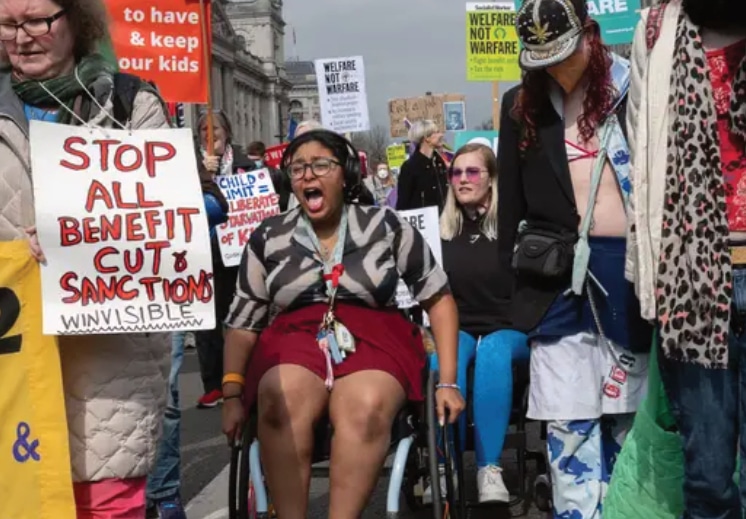
A series of changes to Universal Credit (UC) for new claimants came into effect in April, as part of the Labour government’s plans to overhaul the state welfare system. These ‘reforms’ will disproportionately push sick and disabled people further into poverty.
The government introduced its Universal Credit and Personal Independence Payment Bill in June 2025. This included tightening the already stringent criteria for receipt of the Personal Independence Payment (PIP), as well as cuts to the ‘health element’ of UC. Prime Minister Keir Starmer claimed that the welfare system needed to be reformed and that ‘those who can work should work.’ The government also claimed the reforms would remove what it described as ‘perverse incentives’ that discourage people from finding employment and ‘trap’ people on long-term benefits; in reality, most of the changes target those who are unable to work or have limited capacity to work due to disability or ill health.
170 of Starmer’s own Labour MPs rebelled against the bill, forcing the government to change tack: changes to PIP were scrapped and the government conceded an amendment protecting existing claimants from changes to UC. The bill was, however, passed and in April the changes to the health element of UC came into effect. UC payments are split into the standard allowance – the minimum amount all UC claimants receive, based on age and whether or not they are living with a partner – and the ‘health element’, an additional payment for those unable to work because of disability or illness.
While the standard UC allowance will increase by £250 per year, those dependent on the health element uplift will not benefit from this. The Department of Work and Pensions (DWP) will now divide potential claimants for the health element into two categories – Limited Capability for Work (LCW) and Limited Capability for Work and Work-Related Activity (LCWRA). Those in the LCW category are deemed not fit for work at present but expected to be fit for work in future; in the LCWRA category are those judged to be unfit for work and not expected to be fit for work in the long term. Claimants in the LCW category will no longer receive any additional payment and will need to rely on the standard allowance alone.
Meanwhile those in the LCWRA category will be subject to a two-tier system – higher tier claimants will receive an extra £429.80 per month and lower tier claimants an extra £217.26. The criteria for who belongs in the higher tier and lower tier is arbitrary – claimants receiving the higher tier payment will be those who were on UC before April 2026, whereas those receiving the lower tier will be new claimants. In effect, benefits have been cut nearly 50% for new UC claimants who are long-term disabled.
These changes are a blatant attack on the disabled. They also erode the rights of any worker in full-time employment who suddenly finds themselves out of work because of an injury or illness. Those deemed to be only temporarily unfit to work will be deprived of vital support to help them look after themselves and their families, running the risk of spiralling into poverty and denying them the chance to get their lives back on track. Those who develop longer-term disabilities leaving them unable to work will also face further degradation of their living standards.
These reforms will decimate the limited work opportunities available to disabled workers. A UNISON survey of 3,000 union members in receipt of benefits indicated that 60% used their benefits to pay for transport to and from work. Several workers also indicated that they used their benefits to make adjustments to their homes to make it easier to work from home.
28% of people with disabilities are already living in poverty; these reforms will cut the health element of UC by £3,000 per year for 750,000 disabled people, devastating living conditions for some of the most vulnerable sections of the working class.