
Privatisation, the continuing transfer of public property to the private sector after 1981 is the greatest transfer of wealth in British history since Henry VIII’s Dissolution of the Monasteries. Then it was to promote a new bourgeois class, now it is to consolidate a decaying state monopoly capitalism. JAMES MARTIN sums up.
Despite the tight controls placed on the nationalised industries between 1946 and 1981, designed to subsidise private companies, overall the nationalised industry sector still provided trading surpluses for the government. While the railways were an exception – as in all countries – these industries’ assets and surpluses were too mouthwatering a temptation for the bourgeoisie to ignore, and without serious opposition to their appropriation, were seized at knock down rates from the early 1980s.
Over £60bn of state assets were sold from 1980 to 1990, and the share of employment accounted for by nationalised industries fell from 9% to under 2%. The privatisation wave initiated by the 1979-1990 Margaret Thatcher regime has resulted in the pay-out of profits of £193bn in dividends since 1991, all of which otherwise would have been retained in those industries or in the Treasury. The fraudulent promise of competition and lower prices ended with higher prices and worse services. The middles class and better paid workers were prompted to buy small numbers of shares, for example, by the patronising ‘tell Sid’ campaign of the 1986 Gas industry sale, and in the privatisation of BT in 1984 where up to 10% of shares were reserved for employees. They sold them as soon as they were allowed, and Thatcher’s fiction of a ‘share owning democracy’ soon disappeared as financial conglomerates bought out the small owners. Large international corporations now own large proportions of shares in these companies. The result was, for example, that between 2020-24 the energy network companies (distributors of gas and electricity) had operating profits of 55%. Almost a quarter of the average energy bill goes to corporate profit. The purchase of public assets simply to bleed them is exampled in the water industry.
Half the rail industry’s income in 2023-24 was made up of direct or indirect state subsidies, the real basis of the dividends paid out. These are eagerly and quietly accepted by the financiers involved, who before privatisation screamed blue murder at state subsidies. Subsidies have become inevitable since the 1950s if the rail system is to be maintained in the face of the huge competing interests at work supplying the profitable motor vehicle industry, actively supported by the state. Consequently, 20% of Britain’s commercial bus services have disappeared since 2019 alone. Meanwhile the companies that lease rolling stock to the rail franchises paid dividends equivalent to 102% post tax profits between 2016-24 (according to ‘CommonWealth’ think tank).
This scandalous manipulation of the previously state-owned means of production, and the subsequent private thieving of the added value of the working class in these sectors, to enrich a minority, is led by ‘new’ directors who themselves shamelessly scoop massive salaries and dividends, whatever their failures and whatever the scandals they create. Across the privatised sector, directors snatched more than £662.8m for themselves between 2020-24. It is now calculated that the shareholders of this sector overall received £7.2bn a year from 2010 to 2024 (accumulating some £114.6bn in total).
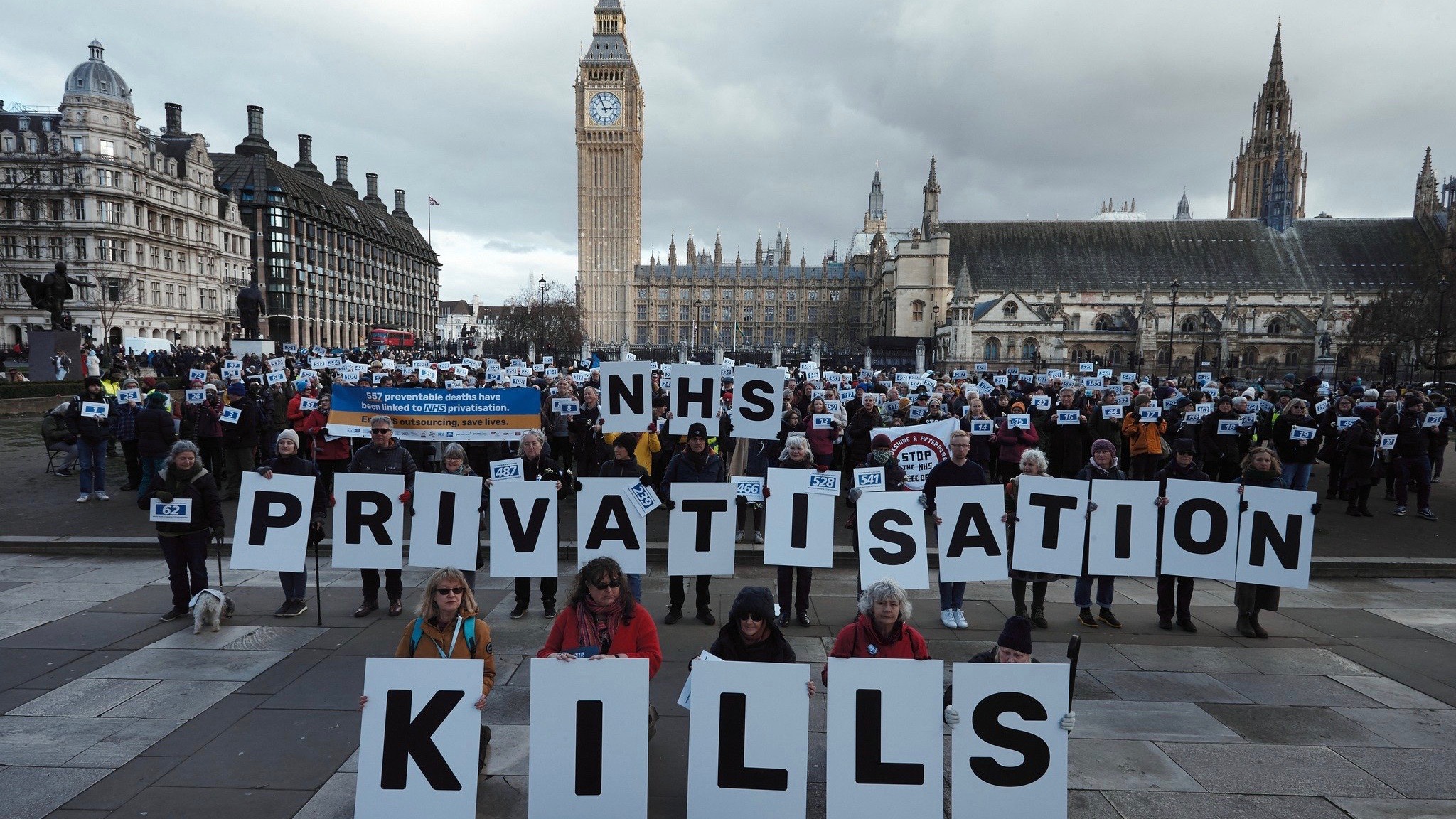
Tory leader Edward Heath complained in an election speech in 1970 that public spending as a proportion of GDP was as high in Britain as in socialist East Germany. His successor Thatcher responded by handing over of public property faster than any states other than Russia, Hungary and the Czech Republic in their disastrous period of post socialist ‘shock therapy’. The results in Britain include disastrous rail crashes, polluted waterways, overpriced power supply, and a shrinking postal service. Huge sums have been gained by the sell-off of ‘surplus’ land and property at absurdly cheap rates by the railway authorities and water companies, the Royal Mail and the Post Office, a process also forced on the NHS, including psychiatric hospitals closed under the cynical rubric of ‘care in the community’.
The strategy of privatisation was the key to sustaining British imperialism for the past 40 years, but the pump is now dry, and the London stock markets are losing clients. The path to further private accumulation must fall back on further state initiatives, a direct political attack on workers’ rights of all sorts (so the infamous slashing of ‘red tape’), health, housing, and further and higher education.
The sell-off local authority property, and the conversion of all public accounting processes to commercial methods (‘Accrual’ accounting) in parallel since the 1980s is the less immediately dramatic twin of the larger privatisation programme. As a result of budget cuts state schools were forced to sell off 223 playing fields between 2010 and 2020. Over 780,000 council homes have been sold under Right to Buy, transferring £194 billion in housing equity to tenants. Councils were compelled to sell these homes at huge discounts to their market value, averaging around 44%, to boost the labour aristocracy and its political conservatism and feed the banks’ mortgage portfolios.
English councils sold approximately £15 billion worth of public assets (about 75,000 assets) between 2010 and 2023 to help balance their budgets. An average of 6,000 council assets – such as playing fields, community centres, libraries, youth clubs and swimming pools – worth £1.2bn have been sold each year in the past 13 years (IPPR Research). After 2016 sales income was used to make up current spending ‘overshoots’, rather than replace stocks of assets.
The post second world war concessions to the working class have, to a large degree, been dramatically withdrawn. This disastrous situation continues and must be challenged with a socialist programme determined to remove the political class that protects the decayed system of state monopoly capital.