

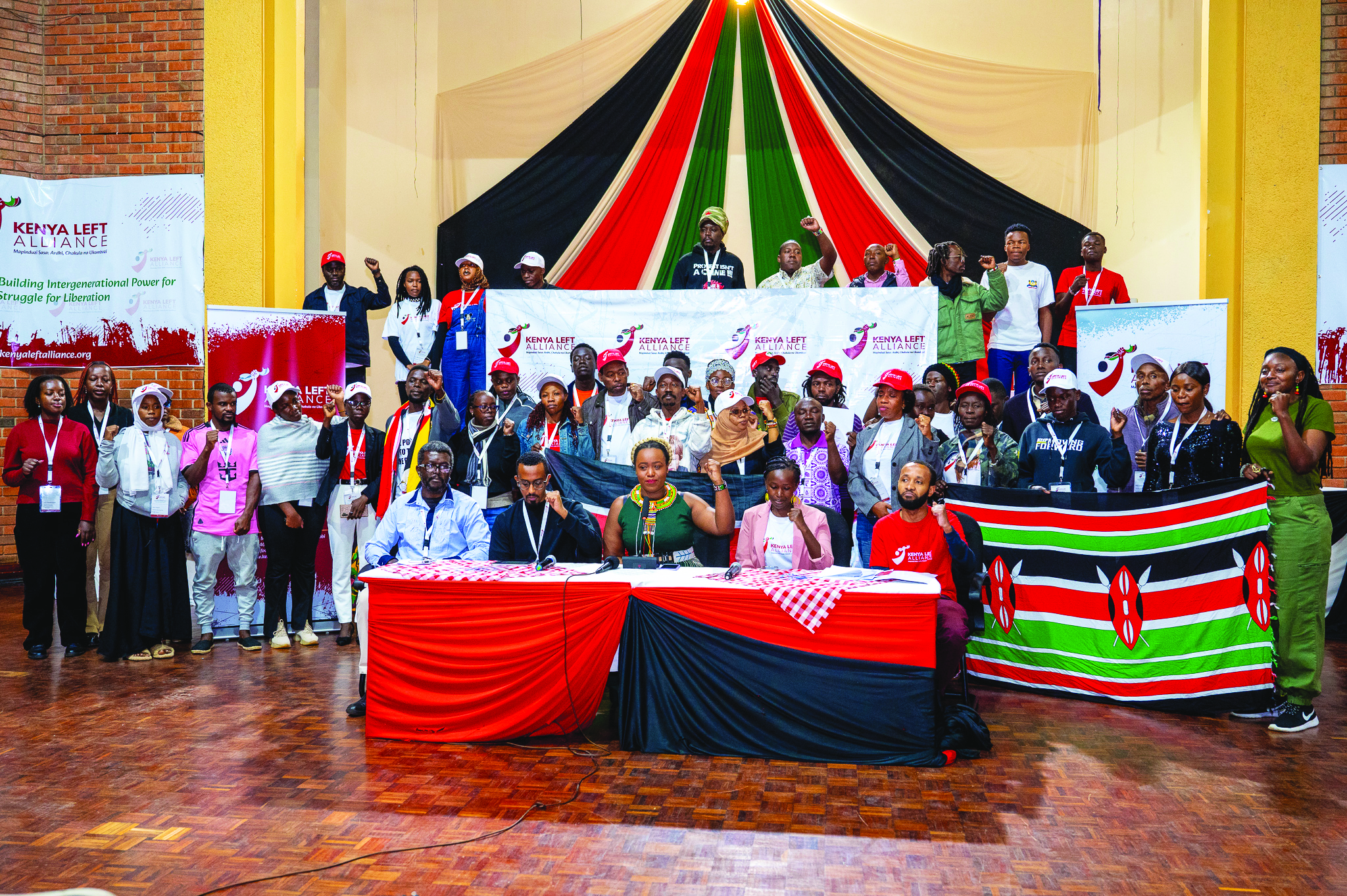
Consecutive waves of anti-austerity protests in 2024 and 2025 have shaken Kenya. Initially spontaneous demonstrations, the various elements involved in these protests are beginning to coalesce into a real political alternative to the pro-imperialist, corrupt politics represented by Kenyan President William Ruto. The Kenya Left Alliance (KLA), officially launched in 2025, is a coalition of social movements and progressive organisations that have been at the forefront of recent protests in Kenya. It recognises the need for political organising that can sustain the momentum of the protests and fight for a future for Kenya’s youth.
Building an alternative
The organisations which make up the KLA have been deeply involved in the social unrest of the past two summers in Kenya. While initially sparked by the now-scrapped finance bill introduced by Ruto’s administration in 2024 under pressure from the IMF, these protests have exposed something far more fundamental than the corruption of a single administration: the stranglehold in which oppressed countries are held by a global economy designed by imperialist powers. Debt, austerity, and structural adjustment are tools used by capital to plunder Kenya and wage war on the working class.
In 2024, Kenya used over 50% of its export revenues to service external debt, instead of investing that wealth in healthcare, education, or infrastructure. Western leaders routinely frame Africa as the recipient of vast amounts of aid and investment. In reality, most African countries are net creditors to the rest of the world, with huge volumes of capital flowing out of the continent through debt servicing, capital flight, and profit repatriation. In 2021, the United Nations Conference on Trade and Development estimated losses to illicit financial flows to be equivalent to nearly half of Kenya’s domestic revenue.
An alternative to Ruto’s government’s sell-off of state assets to foreign capital is urgent for Kenya’s working class. The last wave of protests in summer 2025 saw hundreds of people murdered, forcibly disappeared, and injured by state forces. As Kenya’s economic and political crisis deepens, another wave of protest and repression looms. While recognising the limits of bourgeois electoralism, the KLA seeks to build a mass, popular party capable of contesting the 2027 presidential elections, in line with the alliance’s assessment that ‘the time for mere activism is over.’
The protests have opened a rare political window, exposing the comprador political class and mobilising broad layers of the working class, particularly youth, against a common enemy. The KLA’s first objective is what it calls a ‘National Democratic Revolution’, aimed at breaking the shackles of neo-colonialism and placing power in the hands of the Kenyan people. The three prongs of this programme are:
• Economic sovereignty: public control over essential resources and strategic industries.
• Social justice: free, universal education and healthcare, and radical land reform.
• Empowerment: industrialisation (One County, One Factory) to employ youth, alongside progressive taxation.
This programme draws inspiration from the demands made by protestors in 2024 and 2025, which centred around Ruto’s resignation, the redirecting of state funds to education and health, cracking down on corruption, improving the conditions of public service workers, recalling Kenyan forces deployed in Haiti, and conducting an audit of the national debt. The KLA takes these further, attempting to build the foundation of a worker and peasant-led economy which breaks the chains of underdevelopment. The first challenge for the KLA will be to politically educate and organise the Kenyan masses which came out on the streets, if it wants to ever have a chance at implementing its programme.
The legacy of the Mau Mau
The KLA positions itself as an inheritor of the Kenya Land and Freedom Army (KLFA) struggle: politically, and in many cases literally, as descendants of KLFA fighters are among those leading resistance to Ruto’s regime today. The alliance’s four pillars, pan-Africanism, socialism, feminism and anti-imperialism, seek to bring to life the vision of a truly liberated Kenya in which society is organised for the needs of the people, not foreign capital.
Britain colonised East Africa from the 19th century and Kenya was a formal colony of Britain from 1920 to 1963. The KLFA, or the ‘Mau Mau’ as the British branded them to obscure the crux of their demands, took up arms against the British Empire between 1948 and 1963. British colonial repression was barbaric: concentration camps were established to detain pro-independence Kenyans, where thousands were tortured and killed, and many more died of starvation and disease. In total, over 1.5 million Kenyans were detained in British concentration camps.
Britain has never accepted responsibility for crushing the uprising of the Kenyan people, offering only expressions of ‘regret’ and prosecuting not a single British officer, despite extensive evidence of systematic atrocities.
For the KLFA, the land question was central. As a settler colony, Kenya’s most fertile land was confiscated from indigenous communities and handed to European settlers. The KLFA were drawn largely from those dispossessed peasants whose homes and livelihoods were destroyed by colonialism; those with the most to gain from its overthrow.
Independence did not resolve this question. Kenya’s early post-independence leadership, with ‘father-of-the-nation’ Jomo Kenyatta at its head, completed the political marginalisation of the KLFA and signalled that the new state would remain ‘open for business’. A conservative nationalist, Kenyatta was Kenya’s first president, ruling the country until 1978. In that time, he erected Kenya as a bulwark against communist influence and a haven for foreign investment. To this day, Kenya maintains close alignment with imperialist states, particularly Britain. Comprehensive land reform capable of addressing colonial dispossession has never been seriously pursued, and the cycle of land injustice continues to this day. Independence in 1964, Kenya was forced to ‘buy back’ land from departing settlers, accruing a debt that was only fully repaid in 1980, over 15 years later.
Radical land reform is one of the KLA’s cornerstone policies. Its programme promises that ‘all public land and privatised strategic national assets that have been illegally acquired will be repossessed and returned to public or communal ownership’, and that maximum and minimum acreage of landholdings will be established to protect access to land and resist commodification. They promise that alongside land reform, environmental justice and food sovereignty will be pursued, moving away from Kenya’s colonial cash-crop economy and its dependency on food imports.
The KLA demands more than the simple slogan of ‘Ruto must go.’ Recent years have shown what people can accomplish when they take collective action, but also the lengths to which the ruling class will go to crush resistance. The KLA will undoubtedly face this same repression the minute it is perceived as posing a serious threat to the current political establishment. The only solution for the Kenyan people is to build a political alternative which unseats the comprador class and puts them in charge–a victory which can only be won through struggle.
Ukombozi Sasa!
Mapambano Yaendelee!
Revolution Now!
Land, Food and Liberation!