

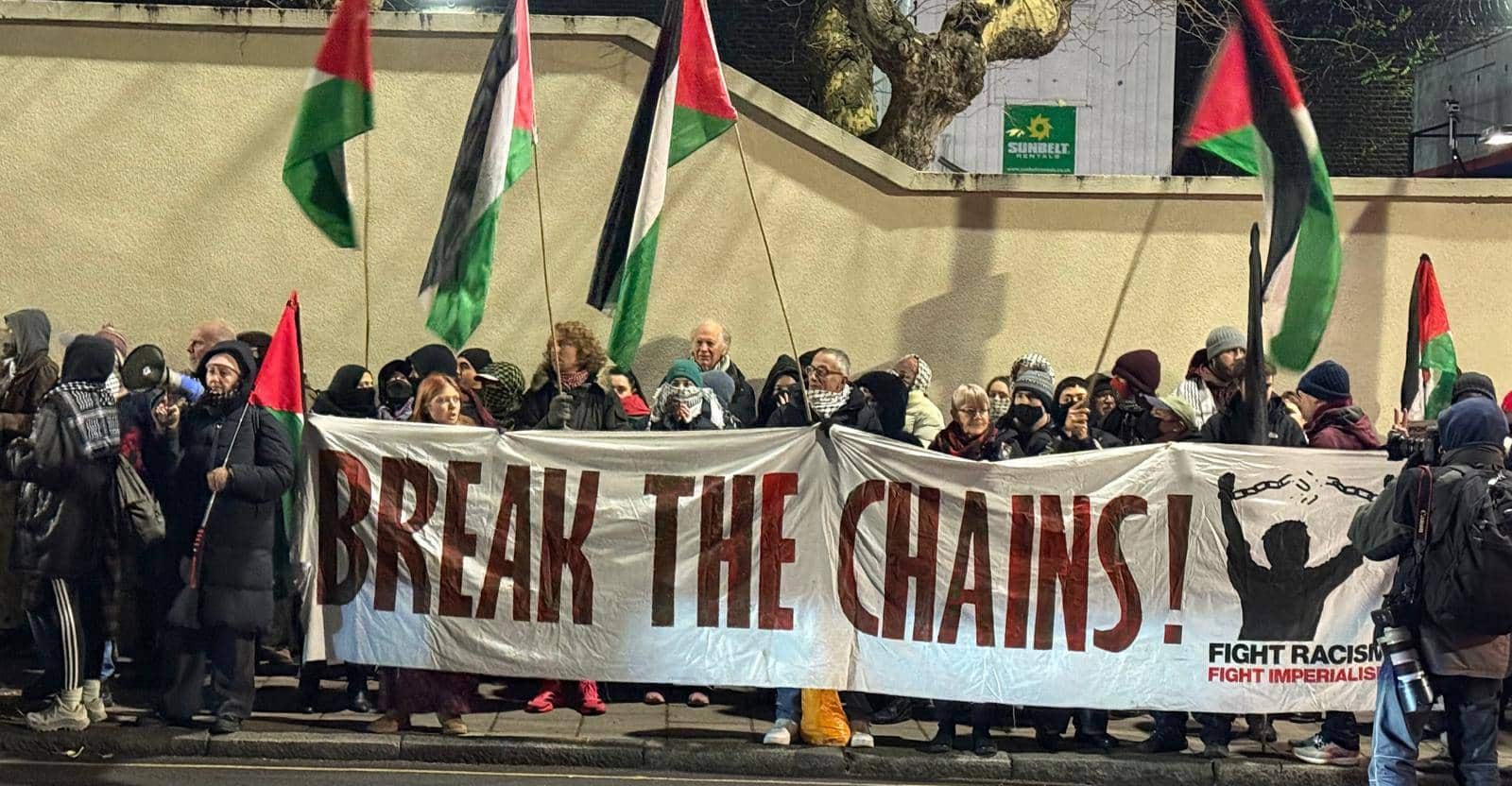
On 27 January Prisoners for Palestine announced that Umer Khalid – the last of a group of pro-Palestinian activists staging a protest within the British prisons holding them on remand – had ended his hunger and thirst strike. Two weeks earlier, after 73 and 65 days’ refusing food, Heba Muraisi and Kamran Ahmed had also ended their hunger strike. On 24 January a protest at Wormwood Scrubs prison in west London in solidarity with Umer was violently repressed, with 86 protesters arrested. This is a pivotal moment for the solidarity movement in Britain. NICKI JAMESON reports.
Prisoners remanded in connection with actions by the now proscribed organisation Palestine Action had begun a hunger strike on 2 November 2025, the anniversary of the Balfour Declaration. Eight prisoners across five prisons participated for varying periods of time, with many coming close to death, as the government refused to engage with their demands.
Five of the eight are charged with actions against the Israeli weapons firm Elbit Systems’ factory in Filton in Gloucestershire. The other three, including Umer, are charged in con-nection with an alleged break-in at the Brize Norton RAF airbase on 20 June 2025 intended to highlight the role of British war planes in aiding the Zionist onslaught on Gaza.
The decision by Heba and Kamran to end their protest came as it became known that the Ministry of Defence had not awarded a promised £2bn contract to Elbit Systems. Prisoners for Palestine welcomed this massive loss of revenue to the Zionist warmongers as a victory for the solidarity movement.
Although other demands, including that of immediate bail, have not been won, many of the prisoners have reported a marked lessening of prison censorship as a result of the spotlight shone on it by the hungerstrikers’ demand ‘End censorship’ – a shift that we also perceived, as prisoners previously refused copies of FRFI were suddenly issued with them. As a result of his protest, Umer was able to negotiate with the prison governor the release of his stopped mail and the lifting of restrictions on visits.
Galvanising the movement
More important than success in relation to specific demands, the action has reinvigorated those sections of the Palestine solidarity movement organised outside the ‘official’ Palestine Solidarity Campaign (PSC), which has shown only the most minimal and grudging support for the hungerstrikers.
The hunger strike has focused attention on British imperialism’s deep entanglement with and responsibility for the genocide against the people of Gaza. It has broken through the initial news blackout and brought Palestine solidarity back into the spotlight at the exact moment when the pro-Zionist British government would have hoped that the phoney ceasefire would take the heat off it. Inspired by the prisoners’ demands, activists have stepped up the direct action campaign against Elbit systems, Barclays Bank and other companies which supply or fund the Zionist war machine.
Demonstrations in support of the hungerstrikers have taken place across Britain and Ireland, as well as further afield outside British consulates and embassies around the world. Prisoners in the US, Netherlands and Italy have undertaken solidarity actions. In Britain, prisons and the whole criminal justice incarceration machinery have become a focus for protest with frequent demonstrations, attended by large numbers of supporters, outside Peterborough prison, New Hall in Wakefield, Bronzefield in Surrey and Pentonville in north London. This escalated to near daily demonstrations at New Hall and Pentonville as Heba and Kamran’s situation became critical, and then at Wormwood Scrubs as Umer moved from hunger to thirst strike.
Prison protests under attack
The British state has been unnerved by this militant solidarity directly targeting its punishment institutions, unmediated by the controlling hand of the PSC. As a result, these protests have faced increasing police repression, while inside the prisons staff have retaliated by meting out punishment both individually to the pro-Palestine prisoners and collectively to all prisoners in the form of lockdowns, denial of visits and other punitive measures.
Weeks of police attack on demonstrators at Pentonville, Bronze-field and New Hall reached a crescendo at Wormwood Scrubs on 24 January, when police surrounded the protest and refused to let anyone leave. Having been contained in the street for several hours in the rain, 86 people including three FRFI sup-porters were arrested on suspicion of Aggravated Trespass on prison grounds. They were held in custody for most of the weekend, with almost all having their mobile phones seized. They have been told to attend various police stations in March and April and been given bail conditions forbidding them from going within 500m of Wormwood Scrubs, Bronzefield or Pentonville. This disproportionate response to a peaceful protest is a calculated attack, specifically de-signed to intimidate activists from continuing to stand in solidarity with the movement’s prisoners.
We won’t be intimidated!
Solidarity with pro-Palestine prisoners!
For updates go to prisonersforpalestine.org