

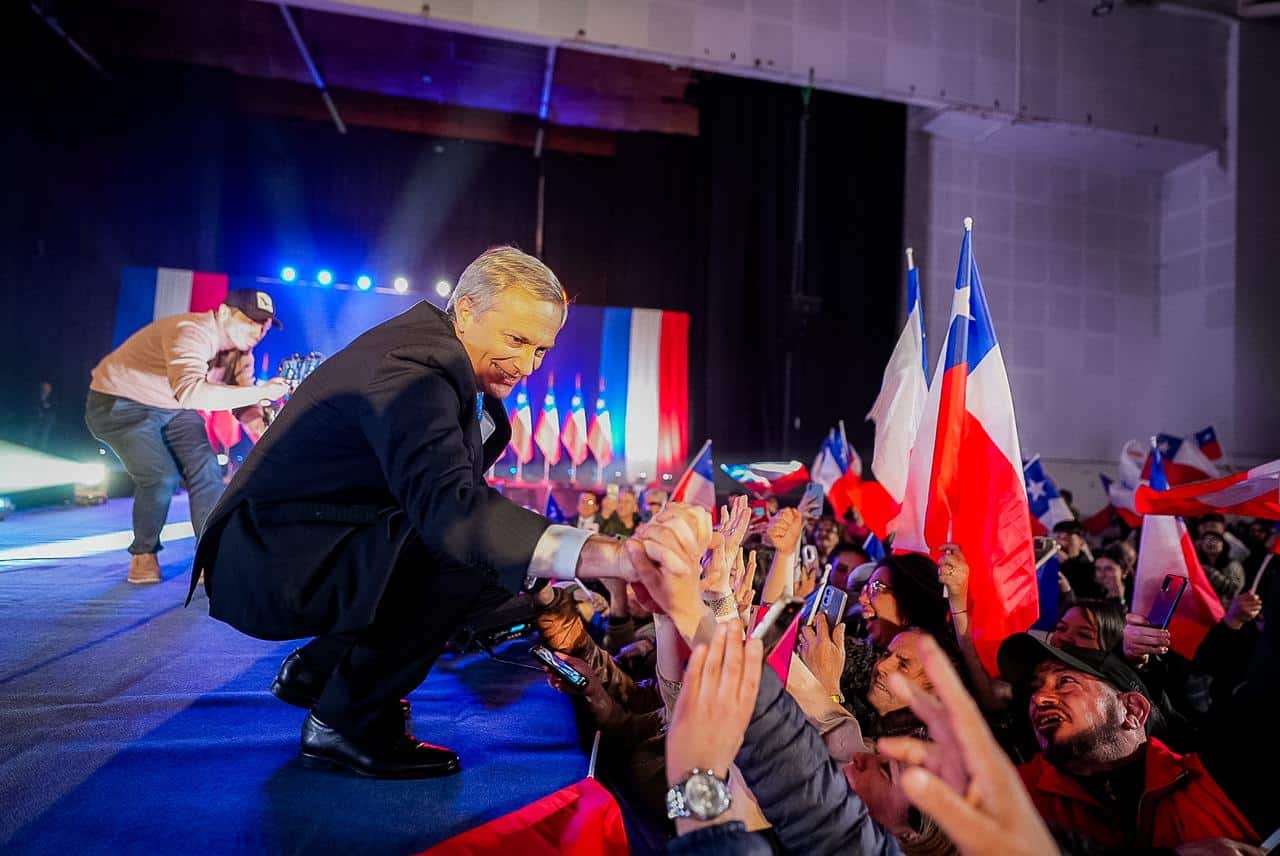
On 14 December 2025, far-right reactionary José Antonio Kast defeated centre-left Communist Party member Jeanette Jara in the run-off of Chile’s presidential elections. Chile is the latest country to be swept up by the right-wing wave in Latin America, with victories in Ecuador, Bolivia, Argentina, Panama, El Salvador, Paraguay and, most recently, Honduras.
Chile tends to swing between (centre-) left and right on each election, but Kast is the most far-right leader the country has had since the end of the military dictatorship in 1990, and the first to openly declare himself an admirer of the former dictator General Augusto Pinochet. The son of a former German Nazi Party member, Kast has been a supporter of Pinochet since his student years, when he campaigned to extend the dictator’s rule in 1988. This was the third time he had stood for election, having lost to outgoing President Gabriel Boric in 2021 with 44% of the votes. This time around, despite coming second after Jara in the first round, he gained endorsement from right-wing candidates in the run-off, securing over two million votes more than his rival and winning in every region of the country.
Kast was congratulated by right-wing leaders and politicians including Donald Trump, Giorgia Meloni, Javier Milei, Marco Rubio and Viktor Orbán, while left-leaning Latin American presidents such as Claudia Sheinbaum of Mexico and Gustavo Petro of Colombia have called for a moment of reflection and regret that ‘people are choosing their own Pinochet’.
Kast’s politics are virtually identical to those of the international right-wing who celebrated his victory. The key focus of his campaign was public safety, promising to take an iron-fisted approach to crime which he claims migration is to blame for. ‘We need more Bukele’, said Kast, referring to El Salvador’s president who has imprisoned over 2% of the country’s adult population. Kast has promised to expel about 330,000 undocumented migrants, construct detention centres and walls, trenches, electric fences, and increase the military presence along the border. He has proposed building a police force inspired by the US Immigration and Customs Enforcement (ICE) and has threatened to impose a state of siege in the Araucanía region in order to expel armed Indigenous groups. His economic plans mirror those of right-wing Argentinian President Javier Milei – whom he visited to discuss security, migration and his economic model – involving looser labour laws, corporate tax cuts, less regulation and a $6bn reduction in public spending. Kast has warned the people of Chile that they will have to face ‘difficult decisions’. In other words: an intensification of the war on the working class which will inevitably result in greater poverty and worsening working conditions.
Chile’s president-elect is due to be inaugurated on 11 March, and his victory has already seen people in the streets protesting against his agenda: deep cuts to public services, tax breaks for the capitalists, heavily militarised borders, mass expulsion of migrants, legal immunity for police and military forces and broad expansion of executive powers to crush resistance. The harshest consequences will fall on the indigenous Mapuche people, who have long resisted the theft of their ancestral lands by the parasitic private sector. Labelled as ‘terrorists’ they already face violent state repression. Under Kast, this colonial violence is set to escalate.
Migrants, most of them Venezuelan, have been fleeing the country for weeks trying to get to Peru out of fear of detention and expulsion. Peruvian president José Jerí has responded with an announcement of plans to declare a state of emergency in the region.
Kast’s electoral win is not an isolated development but is clearly part of a wider far-right resurgence across Latin America, as the global capitalist crisis deepens. Chile now joins a growing bloc of reactionary governments in the aligned closely with US imperialist interests. Kast has openly stated his unwavering support for US dominance, vocally condemning Cuba and Venezuela while welcoming Trump’s belligerent imperialist agenda and NATO’s policy plans for the region with open arms. The far-right leader described the Venezuelan government of Nicolas Maduro as a ‘narcodictatorship’ and stated that while Chile would not intervene directly, his administration would provide ‘moral and political support’ to any international action against the Venezuelan government. Following the US attacks on Venezuela on 3 January, Kast celebrated the kidnapping of Maduro. Chile also has close financial and trade ties with Britain, and it is a major destination for British investment.
Although Chile’s outgoing president had also condemned Maduro’s government and the countries had no diplomatic or economic ties, Boric denounced US intervention as undemocratic. The new Chilean government will leave Venezuela and Cuba even more isolated and vulnerable to imperialist aggression.
Progressive working class forces across Latin America, from Bolivia to Argentina, are already organising against the new right-wing governments, while the people of Cuba and Venezuela have risen to defend their governments against US aggression. Authoritarianism and reaction are the answer of the ruling class to a capitalism in crisis, but only the collective, revolutionary strength of the masses can save humanity from imperialist destruction and barbarism. Long live revolutionary Latin America!