

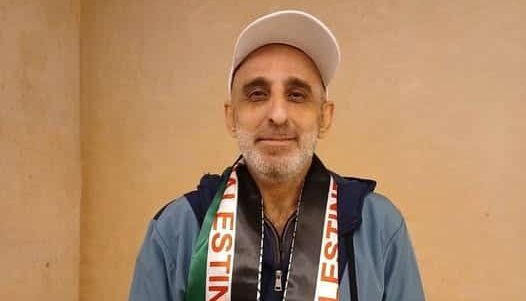
Kamil Abu Hanish, a leading member of the Popular Front for the Liberation of Palestine (PFLP), was released from Zionist imprisonment on 13 October 2025, following over 22 years in prison. Exiled to Egypt in an exchange deal which freed nearly 2,000 Palestinian political prisoners, comrade Abu Hanish was deeply involved in revolutionary education behind bars.
Having combined political leadership with intellectual work in prison, his freedom presents opportunities to regenerate Palestinian revolutionary consciousness and leadership. Speaking to FRFI from Cairo after his release from the torture camps of the regime, comrade Abu Hanish brings political perspectives for the ongoing struggle for liberation.
For the benefit of our readers, could you introduce yourself, your political journey and your role in the PFLP?
My consciousness as a Palestinian was awakened by the occupation. I was raised in a nationalist family in Beit Dajan village, in the Nablus district. My awareness developed through seeing the occupation confiscate land and arrest people when I was young. My uncle, father and many relatives were arrested in the 1970s and 1980s. But the most important turning point in my experience of struggle was the outbreak of the first intifada in 1987. I joined the uprising when I was a child of no more than twelve years old, participating in the intifada and its activities, resisting alongside my people against the occupation through popular means, such as throwing stones, distributing leaflets, hanging flags, participating in strikes and sit-ins, and so on.
This period lasted six or seven years, during which my generation grew up and developed its consciousness. It was during this period that I joined the Popular Front for the Liberation of Palestine. I consider my activism during these years to be the first stage in my journey of struggle. The second stage came in 1993-2000, which was the era of political settlement, namely the Oslo Accords and the establishment of the Palestinian Authority. At that time, I was in university and involved in student activity and I became one of the student leaders [of the PFLP] in the West Bank.
The second intifada erupted in 2000 and I became involved in the armed resistance against the Zionist occupation and settlers. I established the Martyr Abu Ali Mustafa Brigades in the northern West Bank and was pursued by the occupation for two and a half years. In this intifada, I survived several assassination attempts until the occupation forces arrested me on 15 April 2003. The third phase of my struggle was therefore the second intifada.
The longest and most significant phase of my struggle was my time in prison, where I was detained from 2003 until my release in 2025. Over the 23 years I spent in prison, I remained active as one of the leaders of the prisoners’ movement, and a later became a leader of the PFLP prison branch. My focus during this period was on organisational and cultural activities among the prisoners. I was very active in this regard, giving lectures and holding sessions on reading and writing.
During this time, I read thousands of books and wrote and published more than 20, including novels, short stories and political writings, along with hundreds of articles, studies, research papers, poems and literary criticism. My journey with culture and my writing experience culminated in Writing and Imprisonment, a book summarising this experience. I also completed my university studies [behind bars], earning a master’s degree in political science.
I consider my deportation to Egypt a new stage in my struggle: the stage of exile. I will continue my struggle against the occupation through other means, alongside my people.
As an activist who had languished within the Zionist prisons long before 7 October, can you describe the differences in the experiences of the prisoners before and after the launching of the Gaza genocide?
We now see prison in terms of two periods: before and after 7 October. The period before 7 October has been written about and is well-known; everyone knows that we were fighting the jailers, but things were acceptable to us in terms of our survival. Through our struggle, we had dozens of rights that we were able to obtain during our detention. Examples included the recreation area, family and lawyer visits, the canteen, exercise, television, chairs and tables – everything related to prison life. We were able to obtain these rights through our resistance, and especially hunger strikes.
After 7 October, we were stripped of all our rights to the point that we were deprived of clothes, toothbrushes and all basic necessities. Even the simplest of rights were taken away. I want to speak frankly because we intend to expose these practices that were carried out against us. You know very well that the Zionist security minister, the one responsible for the prisons, is the fascist [Itamar] Ben Gvir. I refer to the institutionalisation of his policy as animalism. Israelis would refer to him prior to 7 October as ‘the animal’ or ‘beast.’ But the bestiality that characterised this minister has now spread throughout Israeli society. This is particularly true of the prisons, where Ben Gvir raised the salaries of the prison police, guards, officers, and repressive units, and openly encouraged them to severely attack us.
More than 300 martyrs have fallen in Zionist prisons since 7 October. Yesterday, a new martyr fell [Sakher Zaoul]; more than one Palestinian prisoner is killed every week. Some are killed as a result of severe beatings, others due to the policy of starvation, and some have died due to medical negligence and preventable diseases spreading inside the prisons. We had patients, like Walid Daqqa and Khaled Al-Shuwaish, who had medical conditions and were killed due to deliberate negligence and denial of medical care.
Our starvation was blatant. They gave us food that was so poor and in such small quantities that we had to pass a spoon around to share it. The prison administration was also responsible for the spread of diseases among the prisoners, including skin diseases caused by a lack of sanitary supplies and overcrowding. The cells, meant for six or nine prisoners, were crammed with up to 15, with no access to fresh air, sunlight or showers. These diseases spread, and despite pressure on the Israeli government, they neglected to treat them. They provided meagre treatments that were completely ineffective.
We were deprived of the most basic rights. For example, nail clippers were forbidden, and they invented a type of toothbrush for us that was only the size of a finger, barely big enough to fit in the mouth. We were forbidden from shaving; they shaved our heads every three months. They would confiscate blankets, especially in winter. We were only allowed to wear prison uniforms.
Besides the constant humiliation and tension, cells would be raided randomly, and prisoners would be taken out and forced to lie on their stomachs with their hands tied behind their backs for hours, exposed to extreme cold or heat. Dozens of torture practices were carried out against us. I have read about the experience of detainees under the Nazis in Auschwitz and Majdanek concentration camps during the Second World War. The way prisoners were humiliated then is very similar to what is happening today in Palestine, so much that I think both experiences should be studied side by side. It could be said that the Zionist occupiers have adopted the Nazi approach to dealing with Palestinian prisoners inside the occupation prisons.
We are talking about new methods of oppression, aimed at beating us to break our spirits. Any prisoner who is about to be released today is assaulted, having their arms, legs or ribs broken before release. We were all assaulted the day before our release in October. The occupiers are not satisfied with their own brutality. Even after the ceasefire deal and the prisoner exchange deal, these practices have continued and intensified.
Some activists understand that Palestinian prisoners are a compass for the movement—not just for Palestine, but as a vanguard for every revolutionary or progressive. How do you see the role of Palestinian prisoners in the current situation?
The Palestinian prisoner is in the vanguard of the people’s struggle and has always been their model in resisting the occupation. When a prisoner spends many years in prison, he becomes a symbol, an inspiring role model for his people, and an inspiration to the free peoples of the world. We only need mention comrade Ahmed Saadat, Marwan Barghouti, Hassan Salameh and Walid Daqqa, who became international symbols. Hundreds of Palestinian prisoners have gained international recognition, whether through their long years of imprisonment or their political, national, humanitarian and moral standing.
We derive this symbolism from the justness of our national cause. We are proud when the world celebrates us as liberated prisoners, rejecting US and Israeli characterisations of us as terrorists… Palestinian prisoners are an integral part of the national struggle. We have transformed prison courtyards into universities, academies and arenas for confronting and resisting the occupation in different ways. Throughout these long years, we have preserved our identity and resisted attempts to instil defeat within us and break our will.
There have been wolfish attempts by the jailers to strip us of our humanity, morality, struggle and patriotism, but we have resisted and emerged with our heads held high. The resistance has managed to defeat them and force the occupation to release us.
It is true that our joy is incomplete due to the massacres committed by the occupation in Gaza, as well as the continued imprisonment of hundreds of our brothers and comrades, who are subjected to severe torture and repression in the prisons. However, these prisoners remain steadfast. We continue the path of defiance, the path of revolution, the path of struggle, and we are part of this struggle. The Palestinian prisoner has become a national and international symbol.
In the book The Splint’s Spark and the Scrapheap, you wrote about the difference between the culture of resistance and the culture of defeatism. Could you summarise these ideas and their importance in the current conjuncture?
This book came from lectures I did in prison and was smuggled out for publication; after my release, I was surprised and elated to find that [PFLP activists] had compiled them and published it as a book. The book analyses cultural life, even though, as you know, I was in prison and had limited access to culture within Palestine. However, from the writings that were smuggled to us in prison, I was able to assess the Palestinian cultural scene and offer a critical contribution. I distinguished between two cultures: one I called the culture of the ‘splint’s spark,’ meaning the culture of resistance. This refers to the committed, serious culture that is in harmony with the national struggle as it wages the battle for liberation, where the battle for national liberation requires a culture of resistance.
The other culture I termed the ‘culture of the scrapheap,’ meaning a culture with no value – a degraded, consumerist culture, inharmonious to the Palestinian national struggle. We are therefore talking about two cultural projects. The first project, characterising our initial experience, belongs to the era of the Palestinian revolution and was a defining characteristic of the revolution in its heyday. However, a modern culture, linked to the settlement phase after 1993 and the signing of the Oslo Accords, has become a decadent, liberal cultural project on the Palestinian scene, inconsistent with the national liberation struggle. This project calls for normalisation and cultural laxity.
Therefore, there are two cultures on the Palestinian scene: a culture of resistance, serious and committed to the revolutionary Palestinian national discourse, committed to the foundations of the Palestinian national cultural project; and another culture that is unserious and uncommitted, decadent, compromising and self-serving. It seeks money, media attention, fame and self-interest, without considering or seeking the higher national interests of the Palestinian people. Thus, the idea behind this book is to critique the current state of Palestinian culture, while simultaneously offering a set of proposals that could contribute to the advancement of national cultural work as it confronts the occupation.
Was this critical approach influenced by Ghassan Kanafani?
I mean, personally, if I have anything to say on culture and literature, the credit goes first and foremost to the martyr Ghassan Kanafani and I consider myself a son of the Kanafani school. When I became aware of the world, the first thing I read was Kanafani’s novels. When we say that Kanafani is a ‘school,’ we refer to his genius as a teacher, as the dean of literature in Palestine. No Palestinian writer has been able to reach this stature until now. Kanafani’s journey was baptised in blood: he was assassinated by the Zionist occupation because he understood the importance of culture. He understood the grave danger to the occupation posed by the revolutionary intellectual and the struggling writer devoting all their time to the Palestinian national cause.
When we were young children in the first intifada, we used to go out and write Kanafani’s slogans on the walls, taken directly from his books. We would ‘bang on the walls of the tank’ that appeared in the novel Men in the Sun, as if it were an act of rebellion or revolution. We would write his slogans on the walls, as when he said, ‘Beware of natural death. Do not die except under a shower of bullets.’ We still read and follow his writings. We are all on Ghassan’s path.
In prison, we would hold meetings to read and study Kanafani’s books. We would give these books to all new prisoners, young and old, who were entering prison, and they would read them enthusiastically. In the cells, we would commemorate the anniversary of Kanafani’s martyrdom every year. So, Ghassan Kanafani is always present through his culture, thought, awareness and literature.
You devoted significant periods of time to studying other prison struggles during your own years of incarceration. Did you find connections between the Palestinian and Irish national liberation struggles?
Of course. First, we respect all peoples fighting to liberate themselves from the yoke of colonialism and respect the Irish people in particular. We are brothers, comrades. The Irish people resisted colonialism and endured centuries under British occupation. They resisted and struggled, so we are not surprised by the solidarity with the Palestinian people shown in Ireland… We have also been inspired over the years by the Irish experience in national consciousness. The Irish hunger strike showed us that this option was always on the table.
Like the Irish, the Palestinian people have suffered greatly at the hands of British governments, since the Balfour Declaration, the British colonisation of Palestine and the handover of our land to the Zionists. The current British government, which has not atoned for Britain’s sins, continues to align itself with and remain biased towards Israel, whether in international forums, political stances or through arms support. The British state has, unfortunately, has not sided with or yielded to the pressure of its own people and the millions who took to the streets in solidarity with Palestine in British cities.
This also applies to the US. Look at the transformations taking place in the US in favour of the Palestinian people. But these exploitative, imperialist countries which gave birth to Israel still maintain their close alliance – their interests are shared, and the Zionist occupation remains part of the global imperialist project. We are not surprised by the US and British position and therefore salute all peoples who stand with us, especially the Irish people and all the freedom fighters who stand with us and support us.
Secondly, we call upon these governments to cease supporting the Zionist project. This project is destined to fall. For this reason, these countries must adhere to their declared positions on democracy, human rights and the right of peoples to self-determination. When these countries endorse and sign international agreements and then renege on them, it means they suffer from flaws of conscience, politics and morality. What do we call this other than political hypocrisy? Why do the US, Britain and other biased countries speak with forked tongues?
Could you summarise the current moment faced by the project for the liberation of Palestine in general and the PFLP in particular?
The Palestinian people have been waging a national liberation struggle for more than 120 years, since the launch of the Zionist project on our land under the auspices of global imperialism. By waging this struggle, our people proven capable of igniting revolution after revolution, uprising after uprising. The Palestinian cause has passed through numerous phases, encompassing very dangerous turning points and stages.
The Palestinian arena is now witnessing the phase after 7 October 2023, where our people were subjected to genocide, especially in the Gaza Strip. The barbaric aggression against our people in Gaza lasted for two years, during which more than 70,000 Palestinians were martyred, hundreds of thousands wounded, hundreds of thousands displaced, completely destroying the Strip.
What distinguishes this barbaric war is that it occurred in full view of a silent world. Most genocidal experiences in previous centuries of settler colonialism were carried out without media coverage; no one questioned them. We read about them decades later. But the experience [of Gaza genocide], this barbaric and criminal war, was witnessed by the world in sound and image, around the clock.
Despite widespread international solidarity, in which the world’s conscience stirred in support of the Palestinian cause, the cause is now at a dangerous turning point. Had it not been for the steadfastness of the Palestinian people in the Gaza Strip, the West Bank, Jerusalem and everywhere else, the occupier would have been able to displace or even exterminate them. The fact that they failed in this attempt is a victory for the Palestinian people.
The Palestinian people will not be broken or defeated because the balance of power does not allow for such an outcome. The honour of struggle is enough for us [to prevent a Zionist victory]; the honour of fighting is enough for us; the honour of steadfastness is enough for us. In terms of gains and losses, the Palestinian people, having thwarted the enemy’s attempts and plans to exterminate them. We are a living people, deserving of existence, liberation and self-determination. We remain on the path of struggle, overcoming our weaknesses. These path of the resistance, for example, freed us prisoners from the occupation prisons, despite long years of confinement. We now continue our struggle in different ways.
We Palestinians are a people with a just cause and we will continue this journey, along with all the sons of our Arab nation, the Arab resistance, and the free peoples of the world.
The PFLP has not wavered from its radical political and national stance since [its formation in] 1967, and has offered leaders, martyrs and heroic operations throughout it history. It is true that there are moments of weakness and relative decline that national movements and parties go through but exist so long as they stand on their feet in spite of these difficulties. It is so because national liberation movements are always persecuted—look at what is happening to us—we are persecuted everywhere.
Geographically, our place in the world may be limited, but we remain steadfast. We continue the path of comrade George Habash, the martyr Abu Ali Mustafa, Ahmad Sa’adat, the martyrs Wadi Haddad and the Guevara of Gaza [Muhammad al-Asmar], the path of Leila Khaled and Ghassan Kanafani. We continue and the PFLP will not back down. At its anniversary rally on 11 December, deputy general secretary Jamil Mezher emphasised the continuation of the resistance, the unwavering commitment to Palestinian national principles, and the PFLP’s adherence to the revolutionary and national path.