

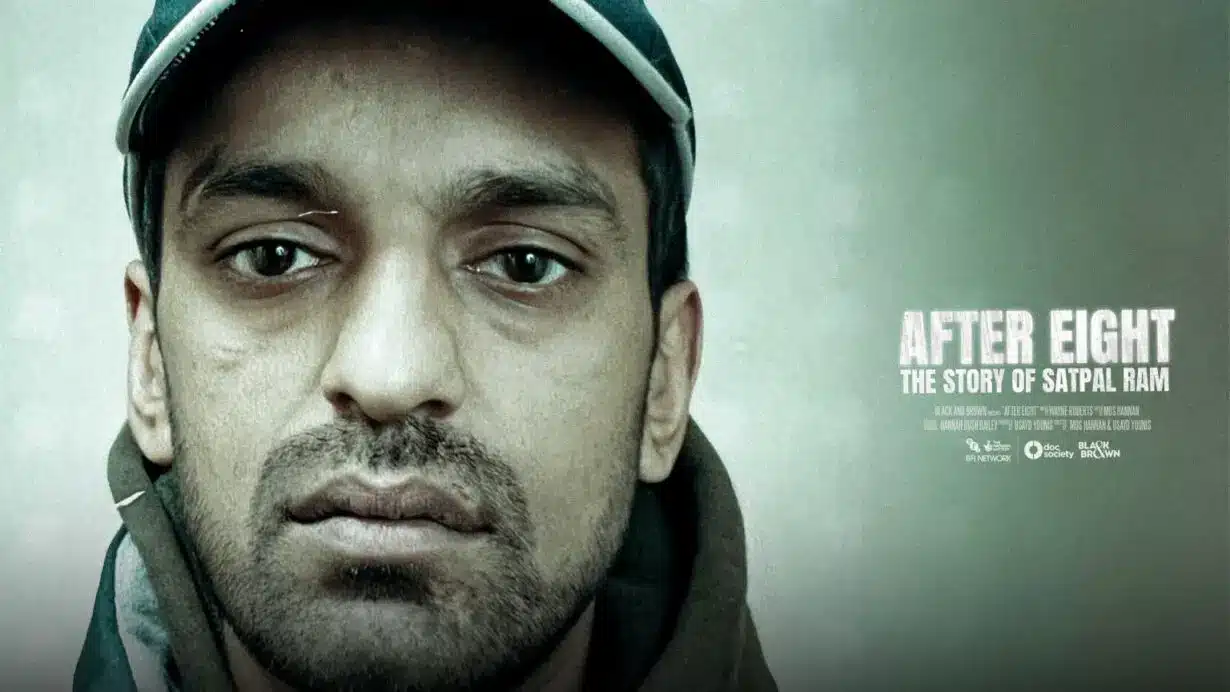
After Eight: The Story of Satpal Ram, directed and produced by Mos Hannan and Usayd Younis, Black & Brown Films, 2025
The London premiere of After Eight on 3 November 2025 brought together comrades, activists, friends, and family to celebrate a remarkable documentary that has already garnered two awards. The film chronicles the extraordinary life of Satpal Ram, who spent 24 years in prison following a criminal conviction rooted in self-defence, and the decades-long campaign that fought for his freedom – a campaign which FRFI comrades supported at solidarity protests in London, Birmingham and outside prisons across the country. The screening was a powerful mix of remembrance, education, and reflection, with photos and memorabilia from Satpal’s campaign displayed in the venue. The film was followed by a Q&A featuring directors Mos Hannan and Usayd Younis, alongside John Bowden, a long-term contributor to this paper and himself a former prisoner who served over 40 years. He spoke movingly about organising within prisons and the vital role resistance plays in survival.
Satpal, who was released in 2012 and has since been diagnosed with Parkinson’s disease, watched the film with quiet dignity. The documentary paints a vivid picture of the miscarriage of justice he endured, beginning with the night of 16 November 1986, when 20-year-old Satpal and two friends went out for a meal at the Sky-Blue Indian restaurant in Birmingham. A table of six white men began hurling racist abuse at the staff and complaining about the Asian music being played. Satpal responded by asking for the music to be turned up. One of the men, Clarke Pearce, attacked Satpal with a broken glass. Satpal defended himself with a short-bladed penknife during the struggle, resulting in Pearce sustaining wounds, which, when he refused medical treatment, proved fatal.
What followed was a trial marred by systemic failures and prejudice. Satpal’s barrister advised him against pleading self-defence or giving evidence, having misinterpreted a pathology report, while the judge declared he would ‘interpret’ on behalf of witnesses, despite not speaking Bengali. Against this stacked process, Satpal was convicted of murder, setting the stage for his unjust 24-year imprisonment.
The documentary, underscored by the hauntingly fitting music of Asian Dub Foundation’s Free Satpal Ram, does not shy away from the trauma Satpal endured. It reveals that his Parkinson’s diagnosis stems directly from repeated head injuries inflicted by prison officers, confirmed by his medical consultant. Yet the film also celebrates his enduring spirit. Satpal’s kindness, humour, and resilience shine through and at the event he greeted attendees with smiles and jokes, thanking all those who had fought for his freedom, even while recounting the terror of his incarceration.
After Eight situates Satpal’s personal story within the broader context of racial injustice in Britain. Despite curry houses becoming symbols of multicultural Britain, they have also been sites of racism and violence. As the directors noted in the Q&A, there are many others like Satpal out there whose stories are unseen and unheard. The film reflects on how an ordinary night out turned into a life-altering struggle for survival and justice, exposing systemic biases that led to the denial of a fair trial. Through interviews, archival footage, and firsthand accounts, the documentary traces the global campaign that sought to secure Satpal’s release.
The documentary opens with a line from George Jackson’s Soledad Brother: ‘Without the cold of winter, there could not be the warmth of spring.’ This sets the tone for a film that chronicles not only suffering and injustice but also resilience and hope. While justice was long delayed, the premiere offered a sense of closure. In the week before this screening, his life licence was finally revoked, meaning he no longer needs to report to probation or submit to licence conditions. Satpal Ram, finally, is free.
The evening was a celebration of endurance and a testament to the power of collective action. After Eight – The Story of Satpal Ram is more than a documentary; it is a call to remember the ongoing fight against injustice and the courage of those who refuse to surrender in the face of oppression.
Rose Mackenzie Lewis